Connect with us

International News

“We Will Fight As Long As It Takes”: Iran Defies Trump, Names Mojtaba Khamenei, New Supreme Leader, World Watches Hormuz

Published

on

America’s Costliest Gamble: The Iran War’s Human, Economic, and Strategic Price Tag

The Fire That Won’t Be Named ‘Over’

“We are well prepared to continue attacking them with our missiles as long as needed and as long as it takes.” — Abbas Araghchi, Iranian Foreign Minister, March 2026

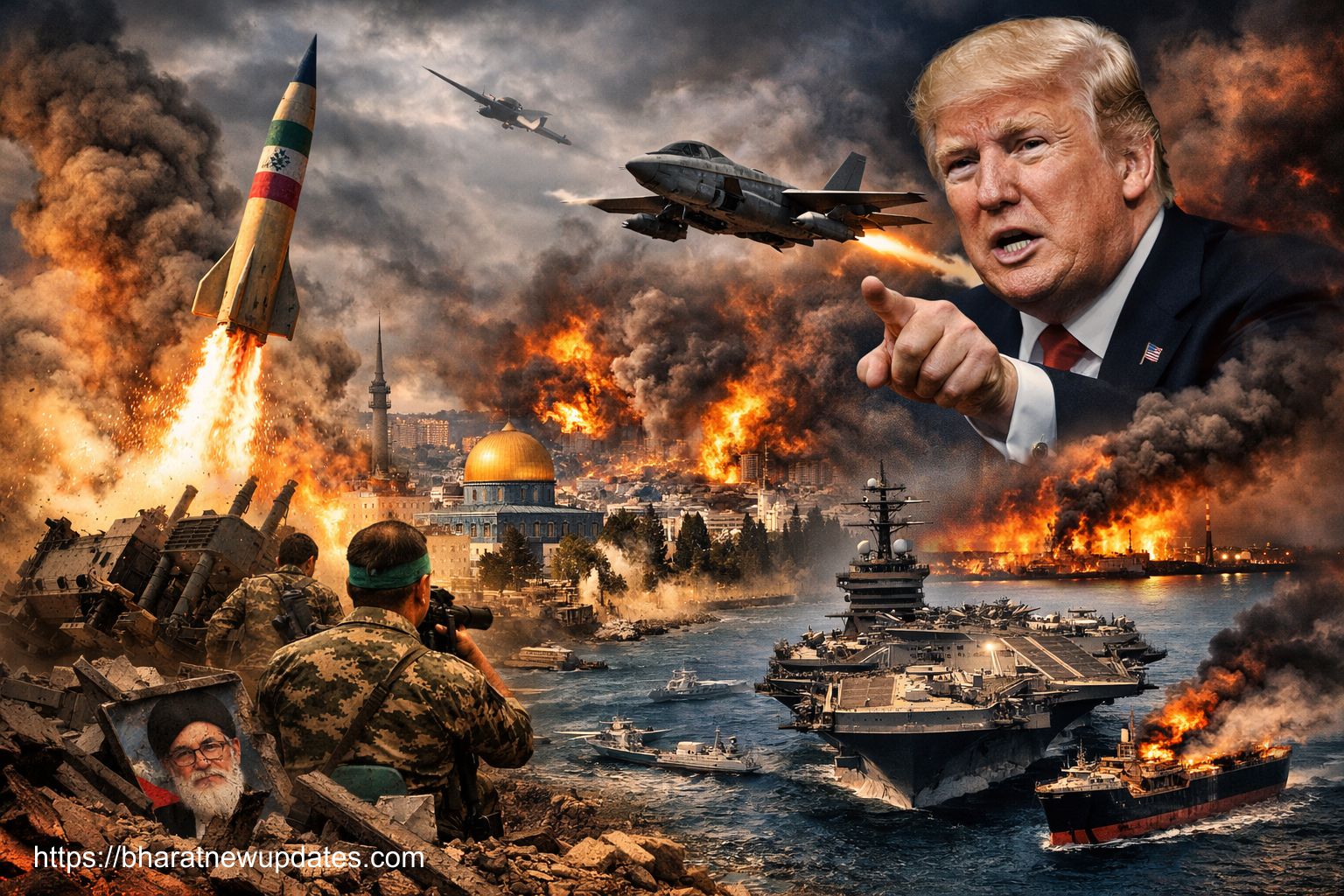
There is a particular cruelty to a war that its instigator keeps telling the world is almost finished. Eleven days into Operation Epic Fury — the joint American and Israeli aerial campaign launched against Iran on February 28, 2026— President Donald Trump has described the conflict at various moments as ‘very complete, pretty much,’ a ‘short-term excursion,’ and something that would end ‘very soon.’ And yet explosions still rock Tehran overnight. Oil still clogs at the mouth of the Strait of Hormuz. And Iran has just named a new Supreme Leader — the son of the man Washington killed on Day One — who has already been called a target by Israel.

This is not a war wrapping up. This is a war finding its shape.

The Iranian Site of Destruction Where Supreme Leader Khamenei Got Killed

What Iran’s Foreign Minister Actually Said — And Why It Matters

When Iranian Foreign Minister, Abbas Araghchi told PBS that Iran was prepared to keep firing missiles ‘as long as needed and as long as it takes,’ he was not engaging in bluster. He was doing something more calculated: he was publicly severing any remaining diplomatic thread. At the same moment, he confirmed that talks with the United States were ‘no longer on the agenda.’ That phrase, quiet and final, is the most consequential sentence uttered in this conflict.

Iran has historically used the possibility of negotiation as a strategic lever — a way to buy time, ease sanctions pressure, or reposition internationally. Araghchi’s statement signals that Tehran has decided the lever is no longer useful. The killing of Supreme Leader Ali Khamenei on the war’s opening day, the destruction of much of Iran’s military command structure, the strikes on oil refineries, energy infrastructure, and even schools and historic monuments like the Golestan Palace— all of it has placed Iran in a position where negotiating now would look like surrender. And Iran’s new leadership will not allow that framing.

So what does continued Iranian resistance actually look like? According to Iran’s Revolutionary Guards, it means a commitment to deny the world ‘one litre of oil’ from the Middle East if US-Israeli attacks continue. That threat is not merely rhetorical. As of this writing, tanker traffic through the Strait of Hormuz has ground to near zero. Major shipping firms including Maersk, CMA CGM and Hapag-Lloyd have suspended transits entirely. Maritime insurers have cancelled war-risk coverage for the region. Qatar— which supplies roughly 22 percent of the world’s liquefied natural gas — halted production after Iranian strikes damaged two of its gas facilities.

The Strait of Hormuz: The World’s Chokepoint, Now Mostly Closed

It helps to understand what is actually at stake with the Strait of Hormuz, because no amount of political commentary conveys it as well as raw numbers. Roughly 20 million barrels of oil pass through this 21-mile-wide channel every single day. That is approximately one-fifth of the world’s entire daily oil supply. Beyond crude, 22 percent of the world’s liquefied natural gas also flows through it. The oil originates from Iran, Iraq, Kuwait, Qatar, Saudi Arabia, and the UAE. Around 84 percent of that crude heads to Asian markets — meaning China, India, Japan, and South Korea are perhaps the most immediately affected economies in the world.

Brent crude oil prices climbed 27 percent in the war’s first week alone — the largest weekly gain since the COVID-19 pandemic in 2020. By Day 10, prices briefly touched $120 a barrel. The G7 has declined to jointly tap emergency oil reserves. Qatar declared force majeure on its gas contracts on March 4. Bahrain‘s state oil company declared force majeure on its shipments after Iranian strikes set its sole refinery ablaze.

Iran’s IRGC has deployed anti-ship missile systems on three disputed Gulf islands. At least three tankers have been struck near the strait since hostilities began. The IRGC announced on March 2 that the strait was officially closed to shipping — though in practice it has been functionally closed far longer, simply because no ship owner with an ounce of commercial sense would send a vessel through a waterway where protection and indemnity insurance has been cancelled entirely.

Trump responded to Iran’s blockade threat by warning that the US would strike Iran ‘20 times harder‘ if it interfered with traffic through the strait. Whether that threat deters or merely inflames is an open question — but the markets answered it: oil prices dropped momentarily after Trump’s assurances about a quick end to the war, then climbed again when Iran named its new Supreme Leader and launched fresh strikes.

Destruction at Iran’s Fordow Nuclear facility after U.S. strikes. Image Courtesy: Maxar


Damage at Iran’s Intelligence Ministry in Tehran. Image Courtesy: Vantor

Will the US and Israel Bomb More? The Short Answer Is Yes.

A senior official in the Israeli military’s operations directorate told us, on condition of anonymity, that Israel needs approximately three more weeks to accomplish its goal of ‘wiping out Iran’s military forces.’ That timeline — assuming it holds — suggests this conflict has weeks, not days, left in it. Defense Secretary Pete Hegseth told media bluntly that ‘there will be more casualties,’ and that each American death in the conflict ‘stiffens our spine and our resolve.’

Israel’s stated objectives in this war go beyond the destruction of missile infrastructure. Prime Minister Benjamin Netanyahu has spoken openly about seeking to ‘destabilize the regime and enable change.’ Israel announced it would target those involved in choosing Iran’s next supreme leader — and then, when Mojtaba Khamenei was named to the role anyway, Israel described him as a potential target. The US, for its part, announced on March 4 that strikes on Iran would increase in intensity.

US Israel bombing of a Girls’ School in Minab, Southern Iran Killing More Than 160 People.

The strikes have been devastating in their scope. On Day One, the opening salvos reportedly killed not just Supreme Leader Khamenei but as many as 40 senior military and intelligence commanders. Iran’s nuclear sites have been targeted. Its domestic energy infrastructure — oil refineries, gas facilities — has been attacked. An elementary school was struck in a raid later attributed to a hit on an adjacent naval base. The Grand Bazaar in Tehran was damaged. Satellite images show fires across the city. Over 1,330 Iranian civilians have been killed, and more than 100,000 displaced, according to Iran’s UN Ambassador.

Iran has responded with extraordinary reach. By March 5, the IRGC had launched over 2,034 missiles and drones at US military bases and other targets across Bahrain, Kuwait, Qatar, Saudi Arabia, the UAE, Jordan, Turkey, Azerbaijan, and Cyprus. The US Embassy in Kuwait shut down indefinitely after being struck. Bahrain’s desalination plant was hit. Aramco’s Ras Tanura oil refining facility was targeted. Houthi-controlled Yemen has also resumed threats in the Red Sea, potentially adding a second front to an already fractured global shipping network.

Trump’s Claim That the War Is Nearly Over: What He Means, What He Doesn’t Say

Donald Trump is a president who has a long and well-documented pattern of declaring victory before it arrives, then quietly revising the goalposts. His statements about this war fit that pattern precisely. On one day he says the conflict is ‘very complete, pretty much.’ On the next, his press conference message is ‘we’ve already won in many ways, but we haven’t won enough.’ When asked directly if he was declaring mission accomplished, he declined.

Oil Depot in Tehran destruction by US Israel strikes

There are several things Trump’s optimistic framing is designed to do simultaneously. First, it is market management. Oil prices dipped measurably when Trump suggested the war would end soon. A president deeply invested in economic optics cannot afford crude oil prices sitting above $120 a barrel for months. Second, it is domestic political inoculation. Trump entered this conflict with stated goals — destroy Iran’s nuclear program, degrade its missile capability, potentially achieve regime change. Claiming forward progress, even when the trajectory is murky, keeps the war politically viable at home. Third, and perhaps most importantly, Trump’s framing of a ‘short-term excursion’ was a signal to nervous Gulf allies — the UAE, Qatar, Saudi Arabia— that their infrastructure would not be in the crosshairs forever.

But the harder reality is visible in Trump’s own contradiction: he also told media, of the war’s duration, ‘I never project that— whatever it takes.’ That phrase is the honest one. ‘Whatever it takes’ is not a short-term excursion. It is an open-ended conflict whose endpoint remains undefined because the definition of success— regime change? nuclear elimination? unconditional surrender? — remains deliberately vague.

Mojtaba Khamenei: The Son Who Inherited a War

Perhaps the single most significant development of this conflict’s first eleven days is the one that happened quietly, in a meeting of 88 clerics: Iran named Mojtaba Khamenei, 56-year-old son of the assassinated Supreme Leader, as the Islamic Republic’s third leader. Trump called the choice ‘unacceptable.’ Israel described the new supreme leader as a potential target. The IRGC pledged ‘full obedience’ and vowed to continue fighting until Iran achieved victory.

Mojtaba Khamenei is in many ways the worst possible outcome for Washington’s strategic vision. He is a hardliner with deep ties to the Revolutionary Guard. His father’s death did not weaken his family’s grip on Iran — it martyred it. His mother, wife, and family members were also killed in the opening strikes. He now leads a nation that, whatever its internal divisions, has been united by a sense of external assault. Within Iran, reactions to the elder Khamenei’s death were genuinely mixed — some celebrated in the streets, others mourned — but the appointment of his son, who survived when so many around him perished, carries a mythological weight in a culture that understands sacrifice and succession in deeply religious terms.

Mojtaba Khamenei has spent decades in the shadows, cultivating influence within the IRGC without seeking public exposure. US diplomatic cables from the late 2000s, published by WikiLeaks, described him as ‘the power behind the robes.’ He has been under US sanctions since 2019. He lacks his father’s clerical credentials — he is a hojatoleslam, a mid-level cleric, not an ayatollah — but the same legal accommodation made for his father in 1989 can be made for him. The IRGC has already pledged its allegiance. Hezbollah posted his portrait online within hours of the announcement.

Trump’s response— ‘I have no message for him. None, whatsoever’— was characteristic bluster, but it masked a genuine strategic failure. Washington wanted a leadership transition in Tehran it could influence or control. Instead, it got a dynasty.

The Human Cost Nobody Is Counting Loudly Enough

Numbers have a way of going abstract in wartime. So let us be concrete. At least 1,330 Iranian civilians have been killed in eleven days. More than 100,000 have been displaced. In Lebanon, 394 people have died — including 83 children — and more than half a million have been displaced. Fifteen people have been killed in Israel. Eleven in Kuwait. Four in the UAE. Three in Oman. Two in Saudi Arabia. Seven American service members have come home in caskets. A 20-year-old from Iowa. A 26-year-old from Kentucky.

The Iranian elementary school struck on February 28 — later attributed to a nearby naval base— produced casualties that the New York Times reported were caused by a direct US airstrike. The Golestan Palace, a UNESCO World Heritage Site that has stood for four centuries, was damaged. The Grand Bazaar of Tehran — the commercial and cultural heart of a city of nine million people — was struck.

None of this appears in Trump’s framing of a tidy, nearly complete military excursion.

America’s Spending, Iran’s Destruction: The Cost Accounting Nobody Wants to Do

There are no publicly confirmed figures yet for the full cost of US military operations in this conflict, but context is useful. The US military buildup preceding the strikes was described as the largest in the Middle East since the 2003 Iraq invasion. The deployment includes carrier strike groups, B-2 bombers operating from Diego Garcia, and the full weight of the US Fifth Fleet operating from Bahrain. Independent military analysts estimate daily operational costs for large-scale US air campaigns in the tens to hundreds of millions of dollars. Across eleven days of intensifying strikes, the figure almost certainly runs into the billions.

US Nuclear-powered aircraft carrier USS Abraham Lincoln Some Where Stationed At Middle East

Against that expenditure, Iran’s losses are severe but uneven. Its nuclear sites have been significantly degraded. Its missile infrastructure has been damaged, though clearly not neutralized — Iran is still launching hundreds of missiles and drones daily. Its Supreme Leader is dead. Many of its top military commanders are dead. Its domestic energy sector is burning. Its population is displaced, grieving, and increasingly destitute.

And yet Iran is still fighting. The IRGC is still launching. The Strait is still effectively closed. Qatar has declared force majeure. Oil is above $120 a barrel. Bahrain’s oil infrastructure is on fire. And the new Supreme Leader has just taken office, backed by the full weight of the Revolutionary Guard and the symbolic power of martyrdom.

This is what ‘winning in many ways, but not enough’ looks like from the ground.

The US military spends more than $5 billion worth of ammunition in the first two days of the war with Iran

What Comes Next: An Honest Assessment

The most sobering fact of this conflict is that neither side has a clear exit. Israel needs three more weeks, by its own military’s estimate, to complete its objectives. Trump’s stated endpoint — ‘unconditional surrender’ — is a demand no Iranian government, least of all one led by the son of the man America just killed, will formally accept. Iran cannot close the strait indefinitely without triggering a global economic crisis that costs it the diplomatic goodwill of China and India, its two most important oil customers. But Iran also cannot simply stand down without the regime losing its foundational claim to legitimacy.

The most likely trajectory is a war that escalates further before it de-escalates, with the Strait of Hormuz becoming the central pressure point of international diplomacy. China — Iran’s primary oil customer — is already in talks with Iran about transit through the Hormuz. Russia, which Trump called before agreeing to waive oil sanctions for certain countries, is positioning itself as an energy beneficiary. The E3 — Britain, France, Germany — have signaled willingness to back ‘proportionate military defensive measures’ against Iranian drones. The war has already gone global in its economic consequences.

A ceasefire, if it comes, will likely be brokered through Oman— Iran’s traditional back-channel— and will require a face-saving formula that lets Iran claim resistance and lets Washington claim victory. What that formula looks like when the adversary is Mojtaba Khamenei, a man who watched his family die in Washington’s first strike, is genuinely unclear.

  • In the end, the most dangerous thing about this war is not the missiles. It is the gap between what the two sides say they want and what would actually constitute peace. Trump wants ‘unconditional surrender.’ Iran wants to keep existing on its own terms. Those two things are not compatible — and every day that gap remains open, more people on both sides of it lose their lives.

International News

When The Middle East Broke Open: The Iran–Israel–US War, the Fall of Khamenei, the Strait of Hormuz, and the World Geopolitics That Comes After

Published

on

Bharatnewsupdates - Netanyahu, Khamenei and Trump

Iran-28th Feb 2026: The Day Everything Changed!

There are moments in history that break the world into a clear before and after. The assassination of Archduke Franz Ferdinand in 1914. The fall of the Berlin Wall in 1989. September 11, 2001. Add to that list the events of 2026 — when Israeli and American forces launched a combined operation that killed Iran’s Supreme Leader Ayatollah Ali Hosseini Khamenei along with dozens of senior military commanders, intelligence chiefs, and Revolutionary Guard generals in a series of strikes across Tehran and Qom.

The world had been holding its breath for months. The tension had been building since Iran’s nuclear program crossed what Israel called its ‘red line’ — weapons-grade enrichment at multiple

sites. Diplomatic efforts had collapsed. Back-channel negotiations had failed. And then came the strikes.

What followed was not just war. It was a complete rupture of the existing Middle Eastern order — one that had been fragile, stitched together with oil money, diplomatic pretense, and American military presence since the 1979 Iranian Revolution. That order is now gone. What replaces it will define the next 50 years.

The Military Picture: What Actually Happened

The US–Israel operation was surgical at its core but devastating in scope. Multiple Israeli F-35 sorties, backed by US B-2 stealth bombers operating from Diego Garcia, targeted Iran’s command-and-control infrastructure, air defense networks, and leadership compounds simultaneously. The operation reportedly involved months of intelligence preparation, including penetration of Iran’s internal security apparatus.

Who was killed: Beyond Ali Khamenei himself, the strikes eliminated the head of the Islamic Revolutionary Guard Corps (IRGC), the commander of the Quds Force, Iran’s Intelligence Minister, and senior commanders of the Basij paramilitary. In one night, Iran lost its entire top security layer— a decapitation strike of historic scale.

Iran’s response was swift but asymmetric. Unable to match US–Israeli air power directly, Iran activated its regional proxy and retaliatory network. Ballistic and cruise missile volleys struck US military installations in the UAE (Al Dhafra Air Base near Abu Dhabi), Al Udeid Air Base in Qatar’s vicinity, logistics hubs in Oman and Saudi Arabia, and — most dramatically — a volley of drones and missiles targeted Tel Aviv, causing significant damage to civilian and infrastructure areas.

The Iranian strikes on Gulf Arab soil — especially on UAE and Saudi facilities — were a deliberate message: ‘We will drag your neighbors into this fire with you.’ It was Iran’s way of internationalizing the conflict and fracturing the Arab consensus against them.

Strait of Hormuz: The $1 Trillion Chokepoint

If the death of Khamenei was the political earthquake, the closure of the Strait of Hormuz was the economic one. Iran mined the strait and deployed fast-attack naval units to enforce a de facto blockade— one of the most consequential strategic moves of the 21st century.

Consider the numbers: approximately 21 million barrels of oil pass through the Strait of Hormuz every single day. That’s roughly 21% of global oil consumption and about 30% of all seaborne crude oil trade. Qatar’s LNG exports — which power homes and industries across Europe, Japan, and South Korea— also pass through this narrow stretch of water between Iran and Oman. When the Strait closes, the world doesn’t just get more expensive. It gets unstable.

Crude oil price impact: Brent crude jumped from approximately $85/barrel pre-conflict to over $140/barrel within days of the closure announcement — a spike of over 65%. Goldman Sachs and JPMorgan analysts warned of $180–$200/barrel scenarios if the closure persisted beyond 60 days. For context, the 1973 Arab oil embargo — which caused far less physical disruption— still triggered a global recession.

Saudi Arabia, the UAE, and other Gulf producers faced a paradox: their own export routes were compromised. While they could theoretically benefit from higher oil prices, their ability to pump and ship oil was constrained by the very conflict they had tried to stay out of. Saudi Aramco’s logistics teams went into crisis mode. The Saudi–Iraq pipeline was activated as an alternative route, but its capacity (roughly 1.65 million barrels per day) is a fraction of what Hormuz handles.

The Gulf Arabs Caught in the Crossfire

The most underappreciated dimension of this conflict is the position of Saudi Arabia, the UAE, and Oman— countries that had spent years trying to normalize relations with Iran while also depending on US security guarantees. That careful balancing act just exploded, literally.

Saudi Arabia: Riyadh had been in quiet diplomatic contact with Tehran since the 2023 China-brokered normalization deal. Now Iranian missiles had struck Saudi facilities. Crown Prince Mohammed bin Salman faces a brutal choice: activate the US defense umbrella and formally join the anti-Iran coalition, or try to remain neutral and risk looking weak domestically. Neither option is clean.

UAE and Dubai: The UAE is a particularly exposed node. Dubai has long hosted a large Iranian business diaspora and serves as a financial hub for Iranian trade— much of it informal and sanctions-busting. Iranian strikes on Al Dhafra have rattled the Emirates‘ carefully constructed image of stability and safety. Foreign investment and tourism — the twin pillars of the UAE economy— face severe headwinds. The Dubai real estate market, which saw record transactions in 2024–25, is showing early signs of stress as capital flight concerns rise.

Oman: Oman has historically played a unique back-channel role between Iran and the West — it was Omani soil where secret US–Iran talks happened before the 2015 nuclear deal. That role is now untenable. With Iranian strikes on Omani territory, Muscat’s carefully preserved neutrality has been violated, forcing it to either seek closer shelter under the US or Arab League umbrella, or risk being seen as weak and complicit.

What the US and Israel Actually Gained

Strip away the humanitarian framing and the realpolitik math of this conflict becomes clearer — though far from simple.

For Israel, the strategic dividend is significant. Iran‘s nuclear program — the existential threat that has dominated Israeli strategic thinking for 15 years — has been set back by a decade or more. The command structure that coordinated Hamas, Hezbollah, and Houthi operations simultaneously is dismantled. Iran‘s ability to project power through proxies — the so-called ‘Axis of Resistance‘ — is severely degraded, at least in the short to medium term.

For the US, the calculus is more complex. Washington eliminated a hostile state’s nuclear ambitions and its most anti-American leadership structure. But American bases were struck on friendly soil, regional allies are shaken, and the economic costs of the Hormuz closure— including inflationary pressure on a domestic economy already dealing with fiscal stress — are real.

The liberation dividend: One dimension that deserves honest acknowledgment is the internal Iranian picture. The regime that fell was one of the world’s most repressive — particularly toward women. Since the killing of Mahsa Amini in 2022 sparked the ‘Woman, Life, Freedom’ movement, millions of Iranians have risked everything to push back against mandatory hijab laws, gender apartheid in education and employment, and state violence against dissidents. The collapse of Khamenei‘s rule creates a genuine — if uncertain — opening for a different Iran to emerge. Whether that happens depends entirely on what the post-war transition looks like.

India: Walking the Tightrope of Strategic Autonomy

No major power outside the immediate conflict zone has more at stake — or more to lose — from this war than India. And no major power has crafted a more carefully calibrated position of studied neutrality.

India‘s relationship with Iran is old, deep, and practical. The two countries share the Chabahar Port agreementIndia‘s most significant strategic investment in the region — which gives New Delhi access to Afghanistan and Central Asia bypassing Pakistan. India buys Iranian oil (often through informal channels during sanctions periods). The Iranian plateau has historically been part of India‘s civilizational and trade sphere.

At the same time, India has a thriving strategic partnership with IsraelIsraeli defense systems including the Barak-8 missile, Heron drones, and Tavor rifles are deeply embedded in India‘s military. The US-India relationship, cemented through QUAD and defense technology transfer agreements, makes open opposition to Washington’s Iran policy politically costly.

The Gulf diaspora factor: Over 8.9 million Indian workers live and work in Gulf countriesSaudi Arabia (2.5 million), UAE (3.5 million), Kuwait, Qatar, Oman, and Bahrain. They collectively sent home $55+ billion in remittances in 2023–24. If the Gulf security environment deteriorates sharply, the risk of mass evacuation operations— India has done this before (Operation Kaveri in Sudan, Vande Bharat during COVID)— and the loss of remittance flows could severely stress India‘s external account.

India‘s diplomatic stance has been to call for de-escalation, express concern for civilian lives, and avoid taking sides. This is the same posture India maintained during the Russia–Ukraine war— and it drew both criticism and grudging respect. The challenge this time is that the Gulf conflict is both closer geographically and more directly linked to India‘s energy security.

Energy impact on India: India imports approximately 85% of its crude oil needs. The Middle East— especially Iraq, Saudi Arabia, and the UAE— accounts for over 60% of those imports. A sustained Hormuz closure would send India‘s import bill spiraling. At $140/barrel, India‘s annual crude import bill could jump by $60–80 billion compared to normal years. This would widen the current account deficit, depreciate the rupee, and stoke domestic inflation— particularly in fuel, transport, and food prices.

Financial Markets and the Global Economy

Wars are expensive. This one is particularly so, because it has struck the world’s most important energy artery at a moment of existing economic fragility.

Beyond crude oil, the Hormuz closure affects LNG prices (already elevated post-Ukraine war), fertilizer supply chains (Gulf producers are major urea exporters), and shipping insurance rates, which have spiked 400–600% on routes through the Arabian Sea. Container shipping costs — a leading indicator of consumer price inflation — are rising rapidly.

Global equity markets have reacted with predictable volatility. Defense and energy stocks have surged. Airlines, consumer goods companies, and emerging market indices have fallen. Gold crossed $3,200/oz as a safe haven. The dollar strengthened against most currencies — a double pain for emerging economies that borrow in dollars and pay for oil in dollars.

Central banks in Europe, India, and Japan face an unpleasant dilemma: rate cuts to support slowing growth, or rate hikes to contain imported inflation. There is no clean answer. This is stagflationary shock territory — the kind that defined the 1970s and produced a decade of economic pain.

The Bigger Question: Will Islamic States Get Stronger or Weaker?

This is the most consequential long-term question, and the answer is not simple or singular.

In the short term, expect emotional rallying and anti-Western solidarity across Muslim-majority countries. The optics of American and Israeli forces killing Iran‘s Supreme Leader — regardless of how repressive he was — will be weaponized by every authoritarian and extremist movement in the region. Protests, flag-burnings, and political pressure on governments to distance themselves from the US-Israel axis are already happening in India, Pakistan, Turkey, Bangladesh, Indonesia, and Malaysia.

Shia Protest at Lal Chowk, Srinagar, J&K, India After the death of Shia Supreme Leader of Iran Ali Khamenei.

But zoom out and a different picture emerges. Iran‘s model of political IslamVelayat-e-Faqih, or rule by the supreme jurist — was already deeply unpopular inside Iran itself. The 2022 protests showed that a generation of young Iranians utterly rejected theocratic rule. If the post-war transition produces a more open Iranian government, it will represent a massive blow to the ideological legitimacy of political Islam as a governance model.

Saudi Arabia and the UAE, meanwhile, have been moving in a more secular direction under their respective young leaders — MBS and MBZ — for a decade. The Vision 2030 project in Saudi Arabia explicitly ties national success to diversification away from oil and away from religious conservatism as a political organizing principle. This war may accelerate that trajectory, not slow it.

The extremism wildcard: The real danger is the fringe. Al-Qaeda, ISIS, and their affiliates have always thrived in power vacuums and conflict zones. Post-Khamenei Iran— particularly if it descends into factional conflict between hardliners and reformists — could become exactly the kind of ungoverned space that extremist groups exploit. The lesson of post-Saddam Iraq and post-Gaddafi Libya is that decapitating a government without a credible plan for what follows creates more problems than it solves.

The World That Comes After

We are living through one of those rare historical inflection points where the tectonic plates of world order genuinely shift. The Iran–Israel–US conflict of 2026 is not just a Middle Eastern war. It is a stress test for globalization, for energy markets, for the doctrine of multilateral neutrality that powers like India have built their foreign policy around, and for the question of whether authoritarian theocracy can survive as a governing model in the 21st century.

Iran’s Royal Family-Might Be The New Power Center In Iran

The answers to those questions are not yet written. What is clear is that the world on the other side of this conflict will be structurally different from the one before it. The Strait of Hormuz, once assumed to be a permanent feature of global energy infrastructure, has revealed itself as a leverage point of extraordinary fragility. The ‘axis of resistance’ that Iran spent decades and tens of billions of dollars building has been beheaded — though headless movements can still cause tremendous damage. And the women and men who risked their lives in the streets of Tehran chanting ‘Woman, Life, Freedom’ are watching — with a mix of hope and terror — to see what comes next.

The Middle East has always been a region where history happens fast. It’s happening very fast right now.

Continue Reading

International News

Airstrikes Over Kabul, Drones Over Peshawar: Pakistan vs. Afghanistan Open War on the Durand Line

Published

on

When the Terror Nursery Burns: Pakistan, Afghanistan, and the War Nobody Should Be Surprised By!

A war decades in the making finally has a name.

There is a bitter, almost tragic irony in what is unfolding on the Pakistan-Afghanistan border. The country that spent decades cultivating Islamic militancy groups as instruments of foreign policy sheltering them, nurturing them, training them, funding them, hiding them and then dubiously, shamelessly looking away when the world asked questions — is now fighting one of its own creations. The Taliban, once Pakistan’s most reliable strategic asset, has become its most dangerous adversary. And the border that was always a Illusory— a colonial line drawn through Pashtun homelands that neither side ever truly accepted — is now a battlefield.

This is not a sudden war. It is a slow collapse arriving all at once.

How It Started — Or Rather, How It Finally Boiled Over

The immediate trigger is straightforward enough. Pakistani airstrikes hit Afghan territory earlier in the week, targeting positions Islamabad claims are used by Tehreek-e-Taliban Pakistan (TTP)— the Pakistani Taliban— to plan and launch attacks inside Pakistan. The TTP has killed hundreds of Pakistani security personnel over recent years and claimed responsibility for a suicide bombing at an Islamabad courthouse last November that killed a dozen people.

Afghanistan’s Taliban government retaliated by storming more than 50 Pakistani border posts in a coordinated ground assault — exactly the kind of operation the Taliban perfected during two decades of insurgency against American forces.

Pakistan answered with airstrikes on more than 20 locations across Afghanistan, including the capital Kabul, the southern city of Kandahar— home to Taliban supreme leader Sheikh Haibatullah Akhundzada— and four border provinces. Pakistan’s Defense Minister Khawaja Asif put it bluntly on social media: “Our cup of patience has overflowed. Now it is open war between us and you.”

The Taliban spokesman Zabiullah Mujahid insisted Kabul did not start a war— only answered one. “Our operation was retaliatory,” he said at a press conference in Kandahar. ” A response to Pakistan’s operation, not an attack to start a war.”

Both sides claim the other started it. Both sides are, in their own way, correct.

The Killing and the Chaos

Casualty figures from active war zones are always contested, and this one is no different. Pakistan’s military spokesman Lt. Gen. Ahmed Sharif Chaudhry claimed at least 274 people had been killed in border fighting— a number that makes no distinction between Afghan civilians, TTP fighters, and Afghan security forces. The Taliban government’s spokesman said 55 Pakistani soldiers were killed. Satellite imagery reviewed by intelligence and press confirmed strikes on at least one ammunition depot in Kabul. Pakistan’s state broadcaster reported another depot hit in Kandahar.

Afghan forces have also launched drone strikes inside Pakistani territory— a development that signals the Taliban now possesses capabilities, reportedly including weapons supplied to TTP fighters, that go beyond the AK-47 and rocket-propelled grenade imagery most people still associate with them. The United Nations Security Council has noted that Afghanistan’s Taliban administration provided TTP with rifles and drones. Pakistan has lost at least one aircraft to Afghan fire during the exchange— a humiliation that carries symbolic weight far beyond the hardware.

In the border regions of Pakistan’s Khyber Pakhtunkhwa province, ordinary families are sheltering in basements. “When firing begins from both sides, we rush our children into the basements and wait for hours, uncertain of what will happen next,” said Zar Wali, a poor farmer from near the Torkham crossing. In the district of Kurram, a schoolteacher described villagers climbing into trenches alongside security forces. Communities that once shared ethnic roots — Pashtun families with relatives on both sides of the Durand Line— are now taking sides in a armed conflict.

This is what the abstraction of “geopolitical tension” looks like on the ground: children in basements during Ramadan, farmers clutching their children, teachers choosing trenches instead of classrooms.

The Mediation That Hasn’t Worked

Qatar, Saudi Arabia, and Turkey have all tried. None have succeeded. A ceasefire signed in October 2025 was broken almost immediately by skirmishes that became so routine that border communities stopped expecting peace. The United Nations had hoped Ramadan would provide a natural pause— a shared religious obligation to step back. Instead, the holy month became the backdrop for the fiercest fighting in years.

The international community is watching with alarm but limited leverage. China, which has cultivated ties with the Taliban and has significant investments in the region through the China-Pakistan Economic Corridor (CPEC), has urged restraint. Russia, which became the first country to formally recognize the Taliban government, finds itself in the uncomfortable position of having legitimized a regime now openly at war with a nuclear-armed neighbour. The once-discussed possibility of Afghanistan joining CPEC— a corridor that would have tied the region’s economies together— is now, as one Pakistani official put it, “out of the question.”

The Terror Nursery That Burned Itself Down

To understand why this war feels less like a surprise and more like an inevitability, you have to go back further than the TTP attacks, further than 2021, further than 9/11.

Pakistan’s military and intelligence establishment — particularly the Inter-Services Intelligence (ISI) directorate— built its strategic doctrine around the cultivation of militant proxies. This was not an accident or a failure of oversight. It was policy: deliberate, sustained, and enormously profitable in the short term. The logic was straightforward — use non-state actors to bleed adversaries (primarily India and, through Afghanistan, the broader American and Western allies presence in the region) without triggering conventional war.

The Afghan Taliban was sheltered in Quetta and Peshawar for the entire duration of the American war. The Haqqani Network— the Taliban’s most lethal operational arm — operated with near impunity from Pakistani soil. When American Navy SEALs found Osama bin Laden in Abbottabad in 2011, he was not hiding in a cave. He was living in a large compound, barely a kilometer from Pakistan’s premier military academy. Pakistan denied knowledge. The denial was, to put it diplomatically, not persuasive to anyone who examined it seriously.

The 2001 America’s World Trade Center attacks were planned by al-Qaeda. Al-Qaeda found sanctuary, sympathy, and operational space in the Afghanistan-Pakistan region. The Pakistani state’s relationship with groups that shared ideological DNA with al-Qaeda— through the madrassas, through the ISI’s funding networks, through the revolving door of militant commanders — has been documented extensively by American officials, UN reports, and investigative journalists over two decades.

And while Pakistan pointed outward, it destroyed inward. The Baloch people— an ethnically distinct group in Pakistan’s largest but least-developed province— have faced what human rights organizations describe as systematic enforced disappearances, extrajudicial killings, mass rape and collective punishment stretching back decades. Baloch activists speak of a pattern: a family member is picked up, no paperwork is filed, no charge is brought, and the body, if it surfaces at all, shows signs of torture. Pakistan calls its Balochistan operations counterterrorism. The United Nations Human Rights Committee calls them deeply disturbing. The Baloch call it what it feels like: a slow extermination of their identity.

The nursery of extremism, built to export instability to neighbours, has been leaking back into the house for years. Now it is on fire.

What Pakistan Stands to Lose— and Has Already Lost

Pakistan enters this war from a position of profound weakness. Its economy has been in intensive care for the better part of three years, surviving on IMF bailouts and the goodwill of Gulf states increasingly impatient with Islamabad’s circular crises. Inflation has gutted the middle class. Unemployment among young people is structural, not cyclical. The Pakistani rupee has been in freefall. Foreign exchange reserves have repeatedly dipped to levels that would fund only weeks of imports.

The military— which has, in practice, run Pakistani foreign and security policy for most of the country’s existence— now faces simultaneous insurgencies. The TTP attacks in the northwest. The Baloch Liberation Army in the southwest of Pakistan. And now, a conventional conflict with Afghanistan.

A prolonged war with Afghanistan will further drain reserves, disrupt trade through the Torkham and Chaman border crossings (already almost closed), and provide the TTP with exactly the kind of chaos it needs to expand operations inside Pakistan. The Pakistani military’s considerable air power advantage is real, but air power has never resolved the kind of territorial, ethnic, and political conflicts that define the
Pakistan-Afghanistan relationship. The Taliban know this better than anyone— they beat the Americans, who had infinitely more air power superiority, over twenty years of grinding attrition.

What does Pakistan gain? In the optimistic scenario, there is enough military pressure to force the Taliban to genuinely act against TTP sanctuaries. In the realistic scenario, a prolonged, unwinnable conflict accelerates the country’s financial collapse and political turmoil and may lead to Balochistan’s separation.

What Afghanistan Stands to Lose — and What It Never Had

Afghanistan’s Taliban government came to power in 2021 inheriting a destroyed economy, zero international recognition (beyond a handful of states), and a country with no functioning banking system, no tax base, and a population increasingly desperate after four decades of war. They have governed with an iron rigid Islamic ideology but limited administrative capacity, banned girls from education, expelled women from public life, and made themselves a pariah in the international community whose aid money had kept Afghanistan’s basic functions running.

A war with Pakistan— a nuclear-armed state with a modern air force— is not a fight the Taliban can win conventionally. What they can do is what they have always done: absorb punishment, retreat, disperse, and wait. Afghanistan’s mountains and the Taliban’s institutional knowledge of guerrilla warfare make Pakistan’s air strikes failure in political terms even when they succeed militarily claim through ISPR propaganda.

But Afghan civilians, who have endured more war per capita than almost any people on earth except Hindus and the Jews, will pay the price. The strikes on Kabul and Kandahar are not landing in unpopulated deserts. They are landing in cities. The humanitarian consequences are serious, and the international community— already struggling to fund Afghan aid given the Taliban’s human rights record— has almost no mechanisms left to respond effectively.

How India Is Watching

India watches this war with the cool, careful attention of a country that has spent decades being burned by precisely what Pakistan has now built. The instinct might be to feel a certain grim satisfaction— Pakistan reaping what it sowed, the jihadist infrastructure turned against its architects. But India’s strategic establishment is far too sober to indulge that feeling for long.

A Pakistan in full-blown chaos is not, from India’s perspective, an unambiguous gift. A nuclear state in anarchy, with command-and-control structures under strain, a military stretched thin across multiple fronts, and an economy in free fall, is a significantly more dangerous neighbor than a stable, if adversarial, one. The question Indian policymakers are asking is not whether Pakistan deserves its current predicament — they know the answer — but what the consequences of Pakistani state failure would mean for the region.

At the same time, India sees the war as vindication of what it has argued for years: that Pakistan’s use of militant proxies as instruments of foreign policy was always going to produce blowback, and that the international community’s closed eye tolerance of that policy— in exchange for Pakistani cooperation on Afghanistan front during the American war— was a catastrophic mistake. The TTP is not a creation India had any hand in. The Haqqani Network‘s shelter in Pakistan was not India’s doing. The Abbottabad compound was not India’s failure to notice.

India also watches the Chinese dimension carefully. Beijing’s investments in Pakistan through CPEC are enormous— estimated at over $60 billion— and a destabilized Pakistan threatens Chinese infrastructure projects and supply chains running through a country that is now at war. China’s influence over both Pakistan and, increasingly, the Taliban gives it leverage that India does not have. How China plays that
leverage— whether it mediates, pressures, or simply protects its assets— will shape the regional outcome as much as anything happening on the Durand Line.

India is not neutral. But it is wise enough to know that gloating is a luxury it cannot afford.

The Honest Reckoning

What is happening at the Pakistan-Afghanistan border is not simply a bilateral military conflict. It is the visible symptom of a deeper disease: the idea that states can use violent non-state actors as foreign policy tools without eventually being consumed by them.

Pakistan tried it with the Afghan Taliban. It worked, for a while— until the Taliban came home. Pakistan tried it with the TTP — or rather, tolerated the TTP’s growth in the ungovernable tribal areas— until the TTP started bombing courthouses in Islamabad. Pakistan tried it against India through Lashkar-e-Taiba and Jaish-e-Mohammed, and the result is a permanent state of near-war with a neighbour that has grown stronger while Pakistan has grown weaker.

The people paying for these strategic Islamic terrorism gambles are not the generals who made them. They are the farmers sheltering in basements in Khyber Pakhtunkhwa. The Baloch families waiting for sons who never came home. The Afghan girls who were allowed one brief decade of education before the men with guns came back. The families who lost someone in Mumbai in 2008, or New York in 2001, or Kabul every year since.

History does not always deliver justice. But occasionally it delivers consequences. Pakistan is living inside one now.

Continue Reading

International News

Donald Trump vs. the Supreme Court of America: The Tariff Battle Reshaping Global Trade and Economies.

Published

on

The clash between trade power and judicial limits has returned to the center of American politics after a landmark ruling by the Supreme Court of the United States that blocked President Donald Trump from using sweeping tariff authority the way he intended.

What followed was a swift counter-move from President Donald Trump: a 10% global tariff under Section 122 of the Trade Act of 1974 — a rarely discussed provision that suddenly matters for the world economy.

Below is a clear, analytical look at what happened inside the court, what the ruling means, and why the ripple effects extend from Washington to Mumbai, Beijing, Berlin, and beyond.

What went behind the US Supreme Court ruling

At the heart of the dispute was executive authority over tariffs. Trump argued that existing statutes allowed the president to impose broad tariffs without congressional approval, framing trade deficits and unfair practices as economic emergencies.

Opponents — including industry groups, importers, and some lawmakers — challenged this approach, saying the administration stretched statutes beyond their intended limits. The key constitutional question was simple yet profound:

How far can Donald Trump as a President go in imposing tariffs unilaterally?

Inside the court, the majority signaled concern that the administration’s interpretation effectively granted the president open-ended tariff power, bypassing Congress’s constitutional role in regulating commerce.

The ruling therefore emphasized three themes:

  1. Statutory boundaries matter – emergency or trade laws cannot be expanded indefinitely.

  2. Separation of powers – tariffs cannot become a tool of unchecked executive policymaking.

  3. Economic impact – broad tariffs have consequences beyond trade disputes, affecting consumers, inflation, and supply chains.

The decision was not unanimous. Justices Brett Kavanaugh, Clarence Thomas, and Samuel Alito dissented, arguing the president historically holds wide discretion in trade enforcement. Meanwhile, even Trump-appointed justices Amy Coney Barrett and Neil Gorsuch joined the majority — a striking political signal.

Economic meaning of the ruling

For the US economy

The decision brings policy stability, which markets usually welcome. Companies gain predictability in supply chains and pricing decisions. Analysts expect:

  • Reduced tariff uncertainty

  • Potential easing of import costs

  • Slight relief for inflation pressures

  • Stronger investor confidence

However, it also limits the White House’s ability to use tariffs as a rapid negotiating weapon in trade disputes.

For the global economy

Globally, the ruling signals that US trade policy may face stronger institutional checks, which reduces fears of sudden tariff shocks. That stabilizes commodity markets, shipping rates, and manufacturing planning worldwide.

Trump’s response: invoking Section 122

Within hours, Trump pivoted — announcing a 10% tariff on all countries using Section 122 of the Trade Act of 1974.

What is Section 122?

Section 122 allows a president to impose a temporary import surcharge to address:

  • Large balance-of-payments deficits

  • Fundamental international payments problems

But it has strict limits:

  • Tariff cannot exceed 15%

  • Duration capped at 150 days

  • Intended as a short-term corrective measure

Notably, this provision has rarely been tested in court, making Trump’s move both legally creative and politically controversial.

Trump argued the tariff was necessary to defend American industry and trade balance, saying the court ruling was influenced by politics and foreign interests, while calling some justices “a disgrace to the nation.”

How major economies view the tariff shift

India

India sees both risk and opportunity. Export sectors like textiles, pharmaceuticals, and IT hardware may face price pressure, but companies could benefit if tariffs reshape supply chains away from China.

Brazil

Commodity exports — especially agriculture and metals — could face temporary headwinds. Yet Brazil may gain market share if trade tensions push diversification.

China

China remains most exposed. Even uniform tariffs can intensify geopolitical trade rivalry and accelerate decoupling trends already underway.

Australia

Australia’s mining and agricultural exports face modest risk, but its diversified Asia-Pacific trade partnerships cushion impact.

Japan

Japan worries about auto and electronics exports but values predictability from the court ruling more than it fears temporary tariffs.

Germany

Germany’s manufacturing sector remains highly sensitive to tariffs, particularly autos and machinery. European policymakers are watching closely.

Canada and United Kingdom

Canada’s exemption reduces immediate risk, while the UK views the tariff as a reminder that post-Brexit trade relations with the US remain vulnerable to political swings.

The broader impact: a new era of tariff politics

The episode highlights a deeper shift in global trade:

  • Courts increasingly shape economic policy

  • Trade is now a domestic political battleground

  • Temporary tariffs can still disrupt global markets

  • Supply chain diversification is accelerating

In short, even when courts limit presidential power, trade tensions don’t disappear — they simply evolve.

Cover Image Courtesy :  Niall O’Loughlin Artist @nialloloughlin on X

Continue Reading

Trending