

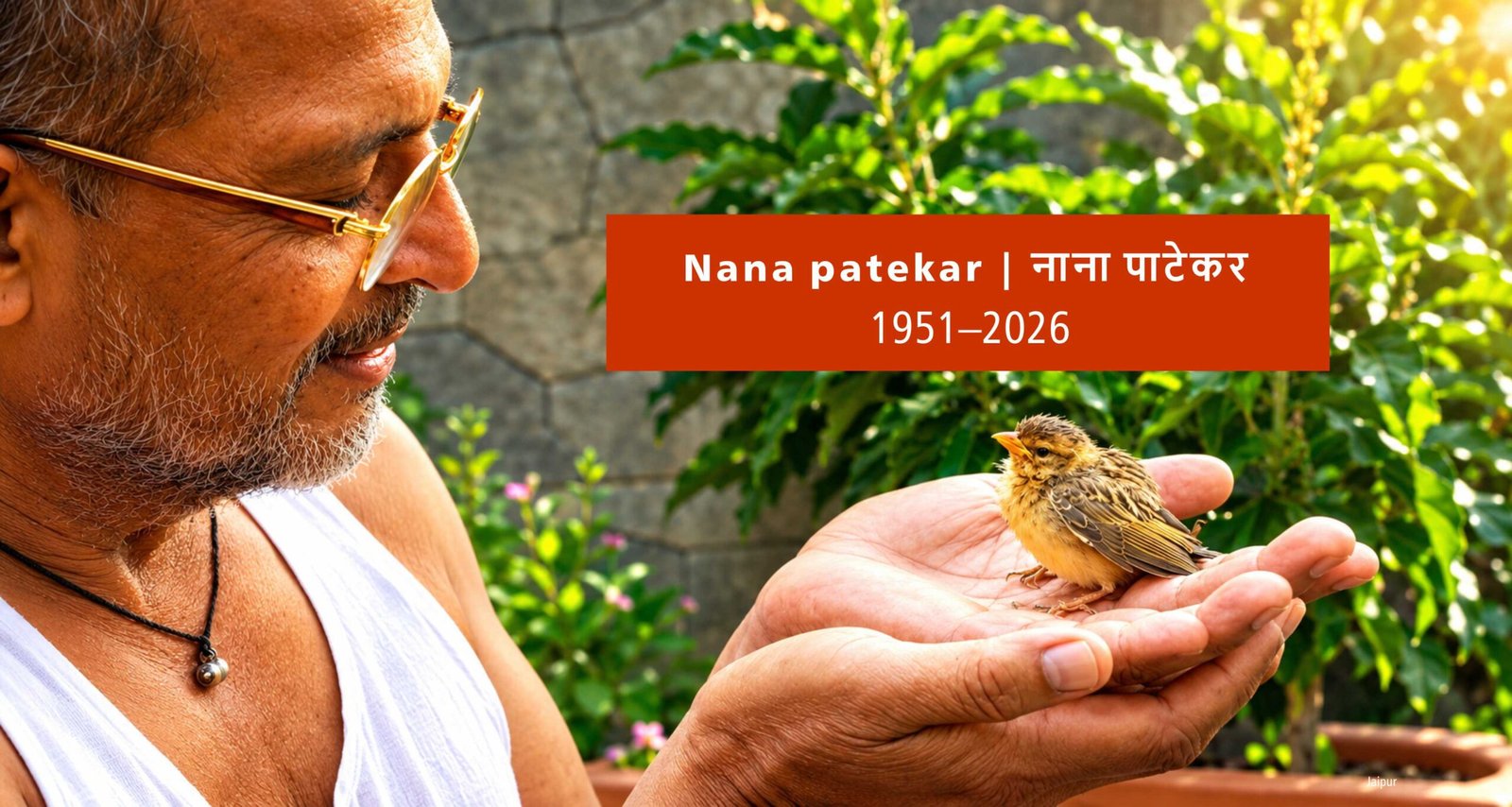
Hindi cinema has had louder stars and richer ones. It has rarely had anyone as unsparing as Nana Patekar, who died today at 75.
What we know about the final hours
Patekar died at around 4.00 am on Thursday after a cardiac arrest at his Dona Paula, Goa residence. Manipal Hospital‘s Dr Shekhar Salkar, Chief of the Oncology Department, Manipal Hospital, says, “Nana Patekar was brought dead to the hospital by his caretaker at around 4:20 or 4:30 am. He was formally declared dead by 5:30 am. Cardiac massage was given for almost 45 minutes to an hour; we had tried our best to save him, but he just could not be saved.”
Early reports differ on how the night unfolded. One account says he complained of severe chest pain around 2:30 am and messaged a close friend that he was unwell. Another says he had a headache since the previous night, with his nephew Prasad at home. Until the family speaks, treat the timeline as provisional. The Maharashtra government has announced a full state funeral. The last rites are at his Donje farmhouse near Pune at 4 PM.
Before the stardom: no shortcut, no godfather
Born Vishwanath Patekar in Murud-Janjira in 1951, he trained at Mumbai’s Sir J.J. Institute of Applied Arts. That is a painter’s education, not an actor’s. It explains something about his work: he composed a scene the way a painter composes a canvas, using stillness, negative space and a stare that held a frame together.
His film debut was Muzaffar Ali’s Gaman (1978), a small, serious film. Then came years of minor roles in Marathi cinema. His father died of a heart attack when Nana was 28. Around the same time he married Neelkanti, and the couple lost their first son, Durvasa, at two and a half. Nana later spoke about that loss with a candour few stars attempt. He admitted that when his sick child was alive he worried about what people would think of him, and that the memory shamed him. Those who knew only the shouting Nana of the screen rarely saw that side of him.
Theatre: the real school
Vijaya Mehta directed his first play, and the stage gave him what the studios never did: breath control, silence and timing. It’s the likeliest source of his best trick. He rarely raised his voice to scare you. He lowered it, and you leaned in.
The roles that made him legend
Ankush (1986) is where the country noticed him. It’s a raw film about unemployed young men turned vigilantes, made with little polish. His performance was dangerous because it was believable. Parinda (1989) followed, and it won him a National Award.
By the early ’90s he was the actor producers called when a villain or a hero needed a spine. Tiranga (1993) is the one many remember, a patriotic blockbuster where he played the army man opposite Raaj Kumar. Then Krantiveer (1994) earned him the National Award for Best Actor. He added a third National Award for Agni Sakshi, and ended with three of them, four Filmfare awards and a Padma Shri in 2013.
The contradictions that make him interesting
He played the angriest men in Hindi cinema, yet he was one of the few top actors to live in a 1BHK flat in Andheri, sharing it with his mother until she died at 99 in 2019. He made Prahaar, a film about discipline, and then served with the Territorial Army and lent his services during Kargil. He could do comedy that audiences adored, as in Welcome, and then switch to the cold political menace of Raajneeti.
The sharp-tongued actor also ran the Naam Foundation, which supports farmer families in distress. He didn’t preach about it, and that fits the Nana pattern. He did the work and let others talk.
The last few years: fewer films, more soil
After the mid-2010s he chose his projects sparingly. Aapla Manus (2018) showed he could still anchor a film at his own pace. Recent years found him away from the Mumbai circuit and closer to his Donje farmhouse, which he preferred to the city. Fittingly, it’s where he will be cremated. He wasn’t fading. He was done performing for the room, and those in his orbit say he preferred the farm’s quiet to premieres.
Who he leaves behind
He is survived by his son Malhar, who stood beside him at his grandmother’s funeral. His brothers Ashok and Dilip, and his nephew Prasad, are also part of the family circle.
Where to start if you’ve only seen the memes
The viral dialogue clips are the least of him. Watch Ankush for rage with a reason, Parinda for restraint, Krantiveer for a one-man argument with the country, and Aapla Manus to see how little he needed late in life to hold a room.
His death at 75 ends a rare career: an actor who never confused volume with power.