

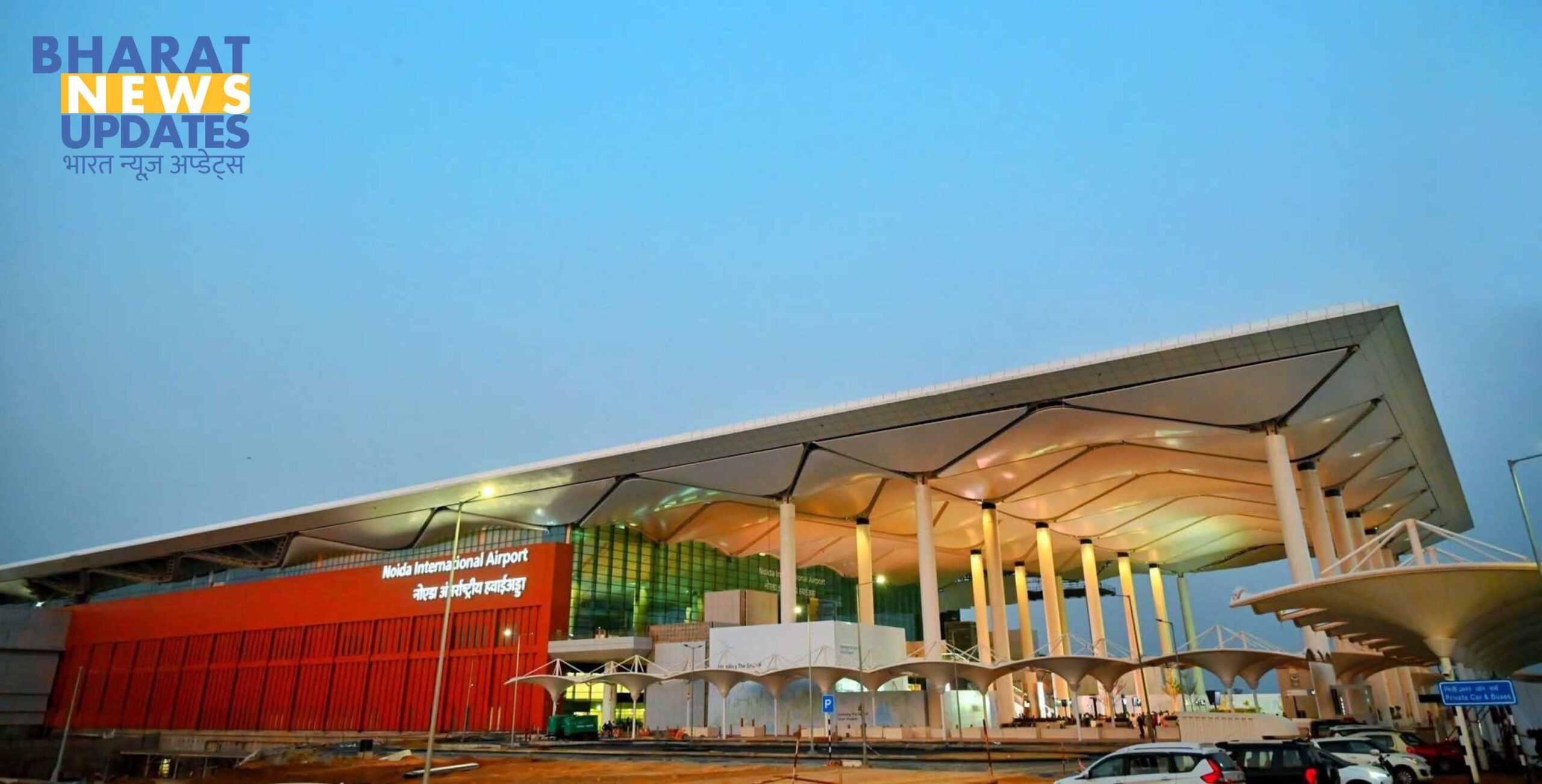
PM Modi Inaugurates Noida International Airport Accompanied by CM Yogi: What It Means for Flyers, Trade, and UP
A dream decades in the making, the Jewar airport opens its doors — and with it, a new chapter begins for Uttar Pradesh and the entire NCR region.
There are moments that mark a before and after in the life of a region. Today, March 28, 2026, is one such moment for Uttar Pradesh. Prime Minister Narendra Modi, accompanied by Chief Minister Yogi Adityanath and Union Civil Aviation Minister Ram Mohan Naidu, formally inaugurated Phase I of the Noida International Airport at Jewar— a project that, despite its long and winding road to completion, now stands as a powerful symbol of what focused governance and determined execution can deliver.
PM Modi first walked through the terminal building at around 11:30 AM before formally inaugurating Phase I at noon and addressing a public gathering. The crowd that gathered reflected the scale of the occasion— this isn’t just an airport opening. It is the birth of a second international gateway for the entire National Capital Region.

A Long Wait, Finally Over
The story of Jewar airport is, in many ways, a story of patience. Originally proposed as far back as 2001 as a greenfield Taj International Aviation Hub, the project spent years caught between political transitions and procedural delays. It was revived and anchored to Jewar only in 2014, and PM Modi laid the foundation stone of Phase I on November 25, 2021.
The road to inauguration was not without more bumps. The airport missed its December 2024 launch window, was pushed to April 2025, then September 2025, and finally arrived at this March 2026 date. But as anyone who has watched Uttar Pradesh’s transformation under CM Yogi Adityanath‘s leadership would tell you— the state has learned to build right, not just build fast. Law, order, and infrastructure have moved together.

What Makes Jewar Airport Special?
Phase I has been developed at a total investment of around ₹11,200 crore under a Public-Private Partnership model, with Zurich Airport International AG— operator of one of Europe‘s finest airports— as the private partner. That global pedigree shows in every corner of the facility.
The terminal building draws architectural inspiration from Indian heritage— its design echoes the visual language of traditional ghats and havelis, weaving cultural identity into a thoroughly modern structure. It’s an airport that feels unmistakably Indian while operating to global standards.


The runway stretches 3,900 metres and is built to handle wide-body aircraft. Modern navigation systems including an Instrument Landing System (ILS) and advanced airfield lighting make it capable of all-weather, round-the-clock operations.
The terminal itself spans 1,00,000 square metres, equipped with :
-
DigiYatra Integration: DigiYatra Biometric-based boarding systems that allow for paperless, facial recognition entry, minimizing queues.
-
Automated Efficiency: From self-check-in kiosks to automated baggage drop counters, the airport aims to reduce wait times significantly.
-
Passenger Comfort: The terminal features spacious premium lounges, premium business class sections, extensive duty-free shopping, and diverse food courts options.
-
Sustainability: In line with global standards, the airport incorporates solar power, rainwater harvesting, and energy-efficient designs to minimize its carbon footprint.
all designed to make travel smoother and less stressful.
The Numbers Tell the Story
In Phase I, the airport will handle 12 million passengers annually. As subsequent phases are completed, capacity will scale up to 70 million passengers per year— placing Noida International Airport among Asia‘s largest aviation hubs.
The cargo infrastructure is equally impressive. The Multi-Modal Cargo Hub is designed to handle over 2.5 lakh metric tonnes of cargo annually, expandable to 18 lakh metric tonnes, with a dedicated 40-acre MRO facility for aircraft maintenance, repair, and overhaul. For western Uttar Pradesh’s growing industrial belt, this is transformational— it means faster exports, better logistics, and direct connections to global supply chains.

Who Does It Serve?
Beyond reducing pressure on Delhi’s IGI Airport, Noida International Airport is positioned as a major logistics and economic hub, expected to stimulate industrial development, tourism, and employment across western Uttar Pradesh and adjoining regions.
Cities like Noida, Greater Noida, Ghaziabad, Meerut, Mathura, and Agra— which together represent tens of millions of people— now have an airport far more accessible than the perpetually congested IGI. Pilgrims heading to the Mathura-Vrindavan belt and tourists bound for the Taj Mahal will find Jewar a natural starting point.
Getting There— and Getting Connected
The airport sits along the Yamuna Expressway, making road access straightforward from Noida, Greater Noida, and Agra. But the vision goes further. Rapid rail links, metro connectivity, and dedicated railway lines connecting the airport to both Delhi and the broader NCR rail network are in various stages of planning and construction. Multi-level parking, app-based cab integration, and bus services will round out the last-mile experience.
The planned Ghaziabad-Jewar RRTS, a 71-kilometre rapid rail line with 11 stations, is targeted for completion by 2031, while a new 61-kilometre railway line will link the airport to Palwal and Khurja, integrating it into the broader national rail grid.
Flight Operations: What to Expect
The airport has already secured its aerodrome license from the DGCA and clearance from the Bureau of Civil Aviation Security. Commercial flight operations are expected to begin in April–May 2026, starting with domestic routes before international services are introduced later in the year. Typically, airports take 45 days to two months after licensing to finalize coordination with airlines, ground handlers, and other stakeholders before launching passenger flights.

Green by Design
The airport is designed to operate as a net-zero emissions facility, integrating energy-efficient systems and environmentally responsible practices throughout. Solar power, rainwater harvesting, and sustainable building design make it one of India’s greenest infrastructure projects— a template for what the next generation of Indian airports should look like.
UP’s Growth Story, Written in Concrete and Steel
There is something worth pausing on here. This is a state that, not long ago, was better known for missed deadlines and infrastructure announcements that never materialized. Under the combined political will of the Modi government at the Centre and CM Yogi Adityanath in Lucknow, Uttar Pradesh has quietly become one of India’s most watched development stories — in investment, in law and order, in expressways, and now in world-class aviation.
The Jewar airport is not a standalone achievement. It is part of a broader pattern: the Purvanchal Expressway, the Bundelkhand Expressway, the Ganga Expressway, defense corridors, data parks, and now an airport built to Swiss standards. For a state that holds nearly a sixth of India’s population, this matters enormously.
Today, as flights prepare to take to the skies from Jewar, they carry more than passengers. They carry the aspirations of an Uttar Pradesh that is finally, firmly, on the rise.