

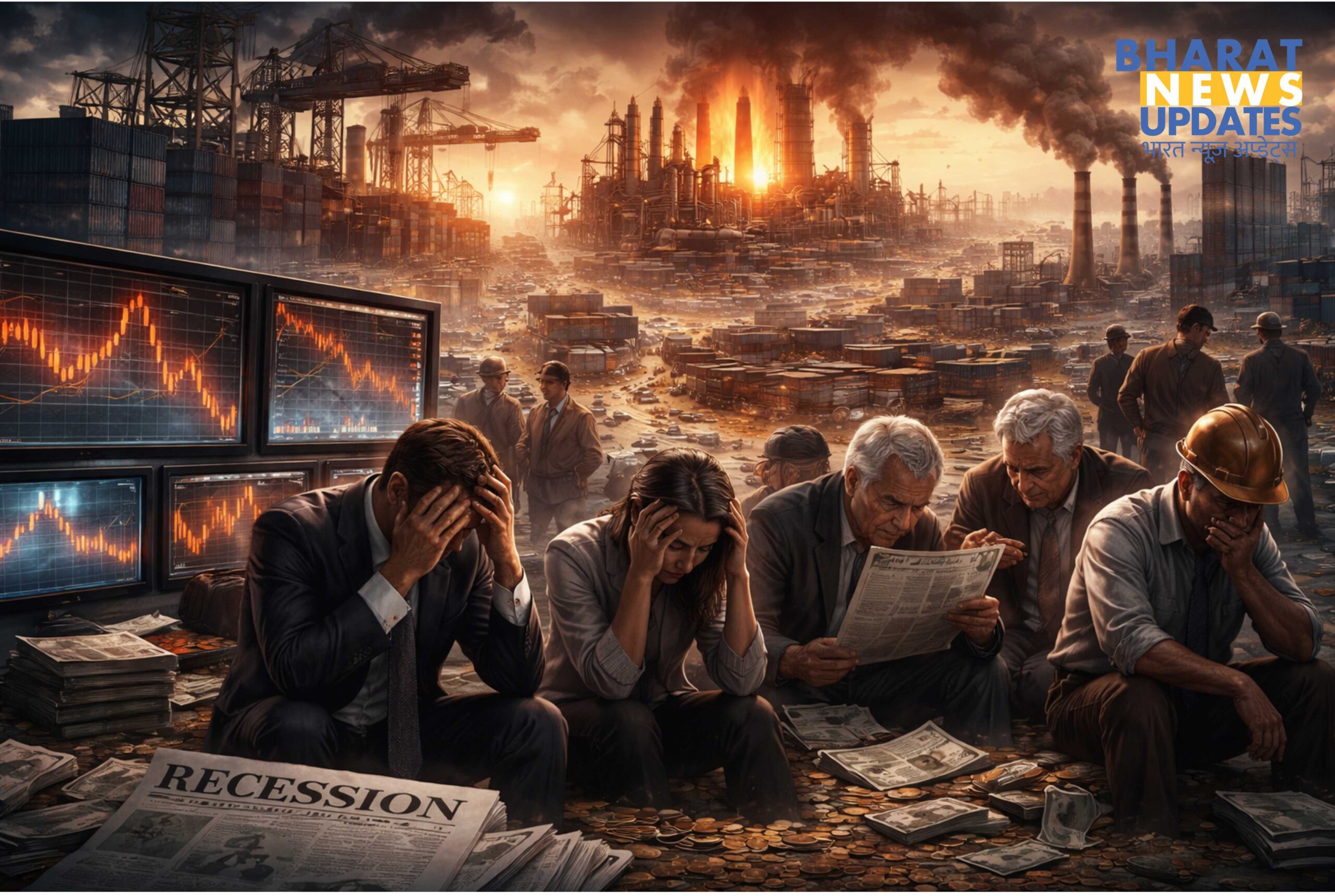
One Month In— The Iran War Is Burning Down the World’s Economy
Thirty days of bombs, missiles, and closed sea lanes have done something no single conflict has since the 1970s: put the global economy on the edge of a genuine crisis. Here is what we know— and what it means.
On February 28, 2026, at dawn, the United States and Israel launched one of the most dramatic opening strikes in modern military history. Hundreds of missiles and fighter jets— including B-2 stealth bombers, B-1 Lancers, and B-52 Stratofortresses— rained down on military, government and civilian infrastructure across Iran. In the very first hours, Supreme Leader Ali Khamenei was killed at his residential compound, along with family members and dozens of senior officials. By morning, a thirty-year chapter of Middle East geopolitics had been forcibly closed. What replaced it is something the world is still trying to understand.
Thirty days later, the war is no longer just about Iran, Israel, or the United States. It has become a structural shock to the global economy— one that is spreading faster than most governments can contain.

The Human Cost: Thousands Dead, Millions Displaced
Start with the numbers, because they are staggering. In Iran alone, HRANA — a US-based human rights group — has documented 3,461 deaths, including 1,551 civilians and 236 children. The International Federation of Red Cross and Red Crescent Societies reported at least 1,900 deaths and 20,000 injuries from US-Israeli strikes.
Lebanon has recorded 1,189 fatalities from Israeli strikes, with 124 of those being children. In Iraq, at least 100 people have died since the crisis began. In Israel, 19 people have died from missile attacks. In the US, 13 service members have been killed, six of them when a military refuelling aircraft crashed in western Iraq.

Three million people remain internally displaced inside Iran alone. In Lebanon, more than one million people have been displaced — approximately 25 percent of the entire population.
At least 18 hospitals and health facilities inside Iran have been confirmed hit, according to the WHO. The deadliest single incident was a strike on an elementary girls’ school in Minab, in southeastern Iran, which killed more than 170 people, most of them schoolgirls.
Kuwait’s Desalination Plant and the New Front Against Gulf Civilians
Iran‘s retaliation has not been limited to military targets. Bahrain has intercepted and destroyed 143 missiles and 242 drones since Iranian attacks began on February 28. Saudi Arabia shot down at least 47 drones in a single barrage covering just three hours.
The strike on Kuwait was particularly alarming in what it signals. An Iranian attack hit a power and desalination plant in Kuwait, killing one worker and injuring ten soldiers. Desalination plants are the lifeblood of water supply across the Gulf Arab states— they are not military assets. Hitting them is a deliberate message: the Gulf’s entire civilian infrastructure is a target.
Cities across the UAE, Kuwait, Saudi Arabia, and Bahrain have borne the brunt of most Iranian missiles and drones, sowing deep distrust that analysts say will last for years. Most Gulf nations now view the Iranian regime as a direct and long-term threat to their safety.

Kharg Island: Trump’s Next Move
The war is now entering a potentially catastrophic new phase. President Trump told the Media that his “preference would be to take the oil” in Iran. He floated the idea of seizing Kharg Island— Iran’s most critical oil export hub— and compared it to US ambitions around Venezuela‘s oil.
Taking Kharg Island is a tactical fantasy that risks a strategic nightmare. The island, 15 miles off the Iranian coast, is the choke point for 90% of Iran’s crude exports. The US already struck military installations there on March 13, hitting 90 targets including naval mine storage facilities and missile bunkers. A U.S. ground invasion would require the Navy to transit the Strait of Hormuz—through which a fifth of the world’s oil flows in peacetime—and place 2,500 Marines (with another 2,500 en route) directly under the guns of Iran’s coastal artillery.
“It’s not the taking of the island that’s the problem,” a retired CENTCOM intelligence officer, speaking on condition of anonymity to discuss operational realities, told this reporter. “It’s the month after. Every oil tanker in the Gulf becomes a hostage. Every desalination plant in the Gulf Cooperation Council (GCC) becomes a target.”

Iran has been laying traps and moving military personnel and air defenses to Kharg in preparation for a possible US operation. The island is just 25 kilometers off Iran‘s coast— well within artillery range from the Iranian mainland. Experts warn that holding it, even if it can be taken, would require a sustained, extended US military presence— and could trigger Iranian strikes on oil processing infrastructure across other Gulf states.
Trump extended a pause on strikes against Iranian energy plants to April 6, 2026, saying “talks are ongoing.” But no confirmed direct negotiations between Washington and Tehran have been acknowledged by both sides. Iranian officials said they were in “complete doubt” over Washington’s willingness to engage in ceasefire discussions.
The Energy Shock: Worst in History
This is where the war stops being just a regional conflict and becomes everyone’s problem.
The International Energy Agency has called the 2026 Iran war the “largest supply disruption in the history of the global oil market.”
Before the war, roughly twenty million barrels of oil and petroleum products moved each day through the Strait of Hormuz. Those flows have now slowed to a trickle. Brent crude surged above $100 per barrel, up from roughly $65 when tensions began heating up in early February. By late March, Brent had reached nearly $120 per barrel, close to its highest level since 2008.
LNG prices have risen even more sharply — by almost 60% since the start of the war. On March 2, QatarEnergy suspended its LNG production after an Iranian drone attack, straining the global LNG market. Qatar supplies 20% of the world’s LNG.
By March 9, J.P. Morgan projected that regional production shut-ins could reach 12 million barrels per day if the Strait of Hormuz remains closed, potentially rising to 16 million barrels per day if Kharg Island’s infrastructure is destroyed.
Petrol prices in the US hit $3.63 per gallon by mid-March, up 55 cents from the same time last year. The IEA released 400 million barrels from strategic reserves globally, including 172 million barrels from the US Strategic Petroleum Reserve alone.
The Economic Holocaust: $20 Trillion Vanished
If this war continues, historians will note that its most devastating weapon was not the bunker buster bomb, but the barrel of oil.
According to an analysis of global market capitalization data from the World Federation of Exchanges, the combined value of equities wiped out since February 28th now exceeds $20 trillion.
The European Central Bank postponed its planned interest rate reductions in March, raising its 2026 inflation forecast and cutting GDP growth projections. Economists warned that energy-intensive economies face high risks of technical recession if the maritime blockade persists through the summer.
Capital Economics projected that eurozone GDP growth could slow to just 0.5% in the second half of 2026, while China’s economic growth could fall below 3% annually. Inflation was forecast to peak above 4% year-on-year in the eurozone.

To put that number in perspective: that is more than the combined Gross Domestic Product (GDP) of the United Kingdom, Japan, and Italy. In one month, the world has lost wealth equivalent to the entire economic output of the three largest developed economies outside the United States.
This is not a correction. It is a destruction of capital that has eviscerated retirement funds, pension plans, and sovereign wealth funds. The Shanghai Composite is down 18%. The FTSE 100 has shed 14%. In the US, the S&P 500 briefly entered bear market territory on Monday before a volatile rally—driven entirely by speculation over a potential (and unlikely) ceasefire.
“We are looking at the potential destruction of two-thirds of the world’s economy if this drags on,” a senior economist at a global investment bank told us, asking not to be named due to company policy. “We’ve already lost the GDP of three G7 nations. If the Strait closes completely, we’re talking about a recession that makes 2008 look like a minor hiccup.”
The Hunger Domino
The most terrifying aspect of this war is not the luxury goods becoming unaffordable in Manhattan or Mayfair; it is the food that will stop arriving in Cairo, Colombo, and Nairobi.
The ripple effect of $120 oil is immediate. Industrial manufacturing in Europe, already reeling from the energy crisis of the last decade, is grinding to a halt. German factory output fell 8% in the last week alone. But for the Global South, it’s a matter of survival.

The UN World Food Programme has issued an internal warning (leaked to our newsroom) that 23 nations are now at risk of acute food insecurity due to the combined factors of shipping insurance premiums skyrocketing in the Persian Gulf and the rising cost of fertilizer, which is a natural gas derivative.
When natural gas prices spike due to war, fertilizer becomes too expensive to ship. When fertilizer becomes too expensive, the next harvest fails. When the harvest fails, the people who live on $2 a day starve.
The attack on Kuwait’s desalination plant is a microcosm of this. If that plant had been completely destroyed, Kuwait—one of the wealthiest nations on earth—would have run out of drinking water in three days. If the war expands to target Saudi Arabia’s Eastern Province (which intercepted five missiles on Monday) or the UAE’s industrial hubs, the logistical collapse will cascade from luxury hotels to refugee camps within weeks.
Where Does This Go?
Thirty days in, the shape of an exit is still unclear. Bankrupt Pakistan is acting as mediator. Trump‘s special envoy Steve Witkoff confirmed the US had presented a “15-point action list” as a framework for a peace deal. Iran rejected it. Iran has insisted Lebanon must be part of any ceasefire deal, making a settlement conditional on ending the Lebanon front as well.
Iran is not winning militarily. Its supreme leader is dead. Its military has taken catastrophic losses. But it is not yet broken either — and its strategy of hitting Gulf infrastructure, choking the Strait of Hormuz, and drawing the war into a prolonged economic crisis may be its most powerful remaining weapon.
The longer this runs, the more lasting the damage becomes. This is not a Gulf crisis. It is a global one— and right now, nobody has a clear plan to end it.