

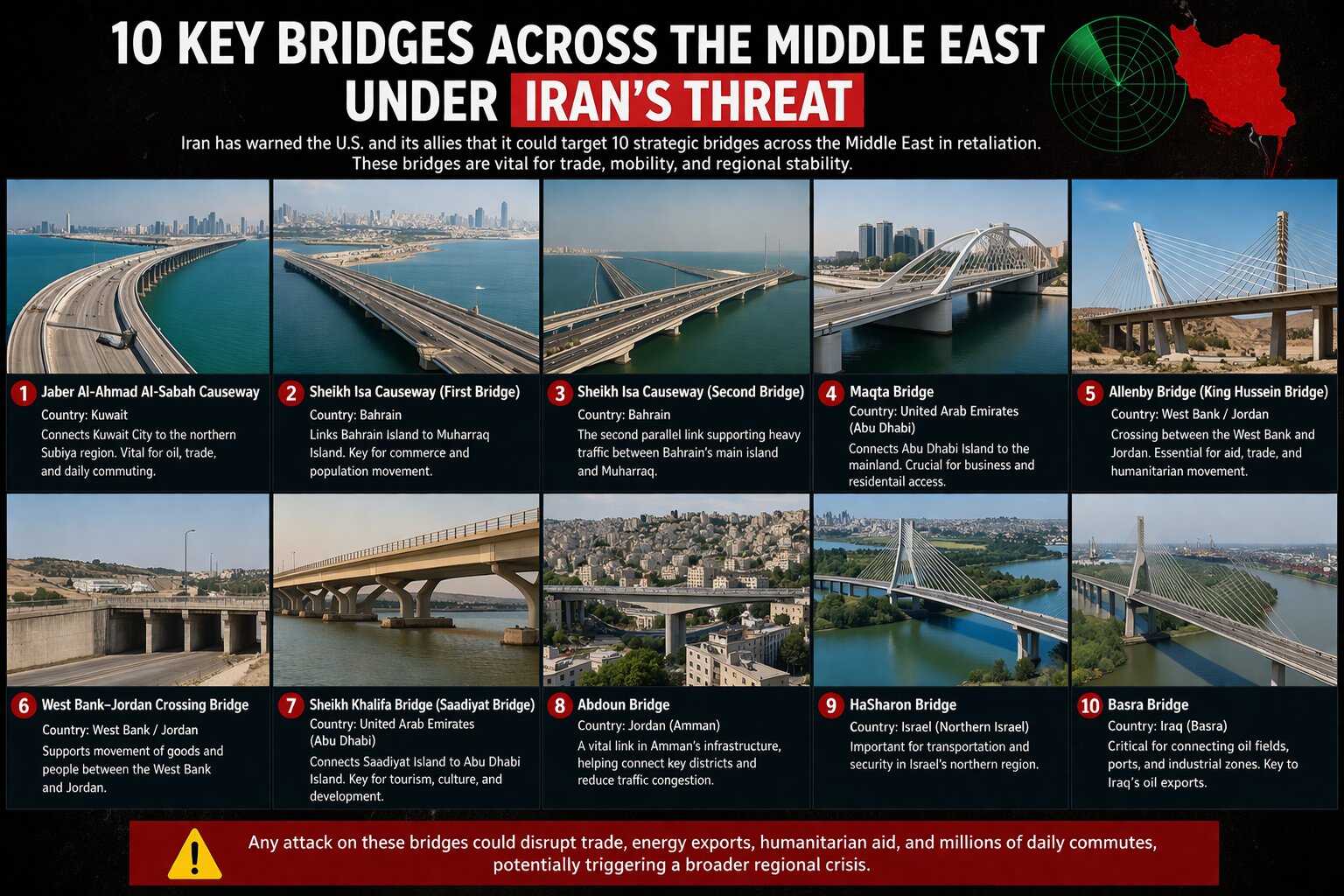
After the U.S. destroyed Iran’s tallest bridge in Karaj, Tehran published a chilling list of regional bridges it could target next — from Kuwait to Basra. Here’s what each bridge means, and what losing it would really cost.
On the morning of April 2, 2026 — while Iranian families were out celebrating the national holiday of Day of Nature — a U.S. airstrike tore through the B1 bridge in Karaj, a city just west of Tehran. The bridge was hit twice, roughly an hour apart, with the second strike arriving just as emergency responders reached the site to help the victims of the first. Eight people were killed and 95 wounded, according to Iran’s health authorities.
The B1 was considered one of the tallest bridges in the Middle East — inaugurated this year and described by Iranian officials as an engineering masterpiece. U.S. officials justified the strike by saying the bridge served as a planned military supply route for moving ballistic missile components and drone parts toward Iranian firing units. Iran’s foreign minister flatly rejected that framing, saying that striking civilian structures “will not compel Iranians to surrender.”

President Trump posted a video of the collapse on social media, writing that the bridge had come “tumbling down, never to be used again,” and warned that “much more” would follow.
Iran’s response came swiftly— not with missiles, but with a list.
Tehran’s Warning: Ten Bridges, Ten Pressure Points
Iran’s semi-official Fars News Agency published a list of prominent regional bridges as possible retaliation targets, including the Sheikh Jaber Al-Ahmad Al-Sabah Sea Bridge in Kuwait, the King Fahd Causeway linking Saudi Arabia to Bahrain, the Sheikh Zayed Bridge and Sheikh Khalifa Bridge in the UAE, as well as the King Hussein Bridge, Damia Bridge, and Abdoun Bridge in Jordan. Israeli and Iraqi crossings were also referenced. Here is what each of these bridges actually means — and what losing them would look like on the ground.
1. Sheikh Jaber Al-Ahmad Sea Bridge — Kuwait Stretching 36 kilometers, it is a critical northern lifeline for Kuwait. Destroying it would sever the country’s fastest land connection to its northern territories and complicate the movement of goods, emergency services, and military logistics for U.S. forces stationed there.
2 & 3. King Fahd Causeway — Bahrain (Saudi Arabia link) The King Fahd Causeway is the only fixed road link between Saudi Arabia and Bahrain, vital for regional trade and U.S. Fifth Fleet logistics. The Fifth Fleet, which coordinates much of America’s naval activity in the Gulf, depends on this corridor. Its destruction would be more than symbolic — it would be a direct hit on American military supply lines.
4 & 5. Sheikh Zayed Bridge and Al Maqta Bridge — Abu Dhabi The Sheikh Zayed Bridge is a major architectural landmark connecting Abu Dhabi island to the mainland. Al Maqta Bridge, meanwhile, was the first permanent crossing ever built in Abu Dhabi. Together these two bridges form the backbone of Abu Dhabi’s daily traffic. Losing either one would paralyze commuter movement and freight into the UAE’s capital, disrupting oil-sector operations and the wider economy of the emirate.
6. Sheikh Khalifa Bridge — Abu Dhabi to Saadiyat Island A key 10-lane highway bridge connecting Abu Dhabi’s main island to Saadiyat Island, this crossing serves a rapidly developing cultural and residential district. Its destruction would strand tens of thousands of residents and cut off one of Abu Dhabi’s fastest-growing economic zones.
7 & 8. King Hussein Bridge and Damia Bridge — West Bank / Jordan The King Hussein Bridge (also called the Allenby Bridge) is the principal crossing between Jordan and the Palestinian West Bank. It is the lifeline for Palestinian civilians — carrying people, food, medicines, and humanitarian aid. Closing or destroying it would be catastrophic for an already stressed civilian population. The Damia Bridge, further north on the Jordan River, controls agricultural and goods movement between the two banks.
9. Abdoun Bridge — Amman, Jordan Located in the heart of Amman, the Abdoun Bridge is not just an engineering structure — it is a city icon. Destroying it would send shockwaves through Jordan’s capital, disrupt emergency services, and signal that no U.S.-allied capital is off limits.
10. Bridges in Basra — Southern Iraq Basra’s crossings over the Shatt al-Arab and connecting waterways are the arteries of Iraq’s oil economy. Iran has already struck Gulf refineries and industrial facilities as part of this escalating campaign. Hitting Basra’s bridges would choke Iraq’s southern oil exports and deliver an economic blow to a country already caught between its ties to both Tehran and Washington.
What Would It Actually Mean If These Bridges Fall?
Strip away the geopolitics and this is what a bridge destruction means for ordinary people: no commute to work, no ambulances getting through, no food trucks arriving, ports backing up, oil not moving, and families on one side not reaching relatives on the other. In dense urban areas like Amman or Abu Dhabi, a single bridge going down is weeks of gridlock and economic disruption. In conflict zones like the West Bank, it is a humanitarian emergency overnight.
Oil prices have already surged, with Brent crude reaching $109 a barrel, as the wider conflict rattles energy markets. Bridge strikes across the Gulf would only accelerate that spiral.
The IRGC has framed these threats explicitly: “These attacks are a warning, and if the attack on Iranian industries is repeated, the next response will be much more painful.”

Where Does This Leave Us?
This is no longer just a military conflict playing out in the skies over Tehran. It has moved to infrastructure— to the roads, bridges, and arteries that economies and civilian lives depend on. About 40 countries are now in discussions to reopen the Strait of Hormuz, as Iran’s blockade continues to squeeze global oil supply. Every bridge on Iran’s list sits in a country hosting American allies, American bases, or American economic interests.
The B1 bridge in Karaj took years to build. The damage it caused — in lives, in connectivity, in trust — will take far longer to repair. If even two or three of the bridges on Iran’s list were to be hit, the Middle East’s already-strained infrastructure would face a crisis that no ceasefire agreement could fix quickly.
The real question now is not whether these bridges are militarily significant. It is whether the escalation logic that started with one bridge in Karaj can be stopped before it reaches ten more.