

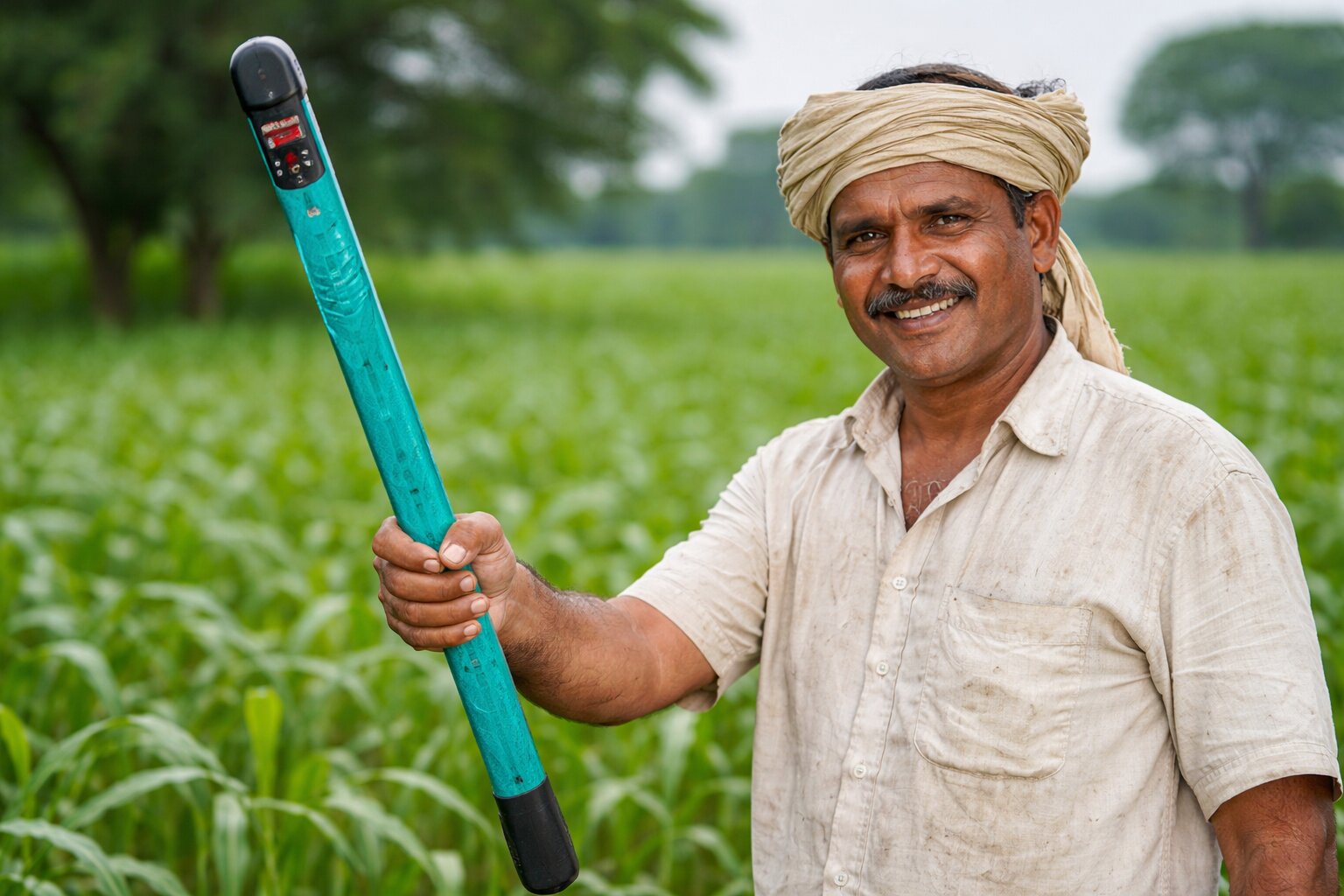
One stick that could save a farmer’s life— India’s Kisan Mitra Chhadi
India loses nearly 58,000 people to snake bites every year. The majority of them are farmers. A simple, vibrating stick— now officially introduced at a National Agricultural Fair, Raisen, Madhya Pradesh— may be the most important tool a farmer carries into the field.
- 58,000 snake bite deaths in India every year (Million Death Study, 2001–2019)
- 1.2 million total snake bite deaths in India recorded over 20 years
- 61% of all snake bite victims are farmers and agricultural workers
Picture a farmer in the middle of Uttar Pradesh, walking through his paddy field at 10 pm to check on his irrigation pump. No torch. Just the sound of water and the monsoon dark. He does this every night. And every year, thousands like him don’t come back home alive.
Snake bite is not a rare, exotic tragedy in India. It is an occupational hazard— a quiet, persistent killer that disproportionately targets the people who grow the country’s food. India alone accounts for nearly half of all snake bite deaths in the world, and study after study shows the same grim pattern: most victims are rural, most are poor, most are farmers, and most die before they can reach any medical help.
That is the reality that Indian scientists and agriculture officials are trying to address with a new device— the Kisan Mitra Chhadi, or “Farmer’s Friend Stick”— introduced by Union Agriculture Minister Shivraj Singh Chouhan at the national-level Advanced Agriculture Festival held in Raisen, Madhya Pradesh, this April.
Why the fields are so dangerous
India is home to over 350 species of snakes. About 50 of them are venomous. Among these, the “Big Four”— the Indian cobra, the common krait, Russell’s viper, and the saw-scaled viper— are responsible for the vast majority of deaths. Each has its own hunting pattern and timing.
- Common Krait: Bites sleeping farmers at night on floor mats
- Indian Cobra: Defensive bites during planting and harvesting
- Russell’s Viper: Attacks during paddy field work and night walks
- Saw-Scaled Viper: Stepped on while hand-cutting grass with sickles
The monsoon makes everything worse. Research shows that between 5,000 and 7,000 people die from snake bites every month during the monsoon months of June through September— months when farmers are most active. Rain flushes snakes out of their burrows and into fields, and farmers work longer hours in low visibility, in bare feet or sandals, reaching into straw, piles of soil, and unlit corners.
“When you use your pump to irrigate your fields at night, you are likely to get bitten by a snake.”
That is what Union Minister Shivraj Singh Chouhan said when explaining why this device was created. It is not a hypothetical danger. It is something that happens — routinely, seasonally, in almost every farming district of this country. The tragedy is that most of it is preventable.

The problem no one counted for years
For a long time, the scale of the problem was itself hidden. Official hospital records reported around 11,000 snake bite deaths a year. The real number, revealed by the landmark Million Death Study that tracked 6 lakh deaths across India over 15 years, was closer to 58,000 annually. The official number was off by more than five times — because most victims in rural India never reached a hospital. They went to local healers, or they simply died at home or in the field.
The World Health Organization added snake bite to its list of neglected tropical diseases in 2017. India followed with a National Action Plan for Prevention and Control of Snakebite Envenoming (NAPSE) in March 2024. And now, on the ground level, the Kisan Mitra Chhadi represents perhaps the simplest and most direct intervention yet— stopping the bite before it happens.
What the stick actually does
The Kisan Mitra Chhadi is a handheld device designed to look and function like an ordinary walking or farming stick, so that carrying it into a field requires no habit change and no special training. When the farmer presses its activation button, it begins scanning the surrounding area for the presence of snakes and other venomous creatures within a radius of approximately 100 meters.
Key features of the Kisan Mitra Chhadi:
- Detects the presence of snakes and venomous creatures within approximately 100 metres
-
Alerts the farmer through intense tactile vibration— no audio needed, works silently in the dark
-
Lightweight and portable — designed for easy carrying during regular farm work
-
Useful for night irrigation rounds, when most dangerous encounters happen
-
Simple, single-button operation requiring no technical knowledge
When a snake is detected nearby, the stick vibrates intensely in the farmer’s hand. There is no sound, no complicated display— just a physical alert that tells the person holding it: something dangerous is close, be careful, move away. That simplicity is the point. A farmer working alone in a dark field at midnight does not need a smartphone app. He needs something in his hand that tells him when to stop walking.
“The moment the stick begins to vibrate, the farmer realises that a snake may be present in the area and understands the need to take evasive action.” Union Agriculture Minister Shivraj Singh Chouhan, Advanced Agriculture Festival, Raisen, April 2026.
The golden time problem
Even when a snake bite happens, it is not always immediately fatal. Most venomous bites become fatal because the victim cannot access anti-snake venom in time. Doctors call this the “golden time” window — the narrow period after a bite during which anti-venom can still work. In rural India, where primary health centers may be 20–30 kilometers away and roads flood in the monsoon, that window closes fast.
This is why prevention matters more than cure. Anti-snake venom in India is also severely limited— the country has only one facility producing the venom needed to make it, and it covers only the Big Four species. For bites from any of the other 46 venomous species, treatment options are dangerously thin.
A stick that warns a farmer before any bite happens does not depend on hospitals, roads, anti-venom supply chains, or the willingness of a frightened rural family to seek formal medical care. It works in the field, in the dark, in the hands of the person most at risk.
Why this matters beyond the numbers
There is a tendency, when talking about farmer welfare in India, to speak in the language of policy and scheme-names. What the Kisan Mitra Chhadi represents is something more grounded: a recognition that a farmer’s life is at risk not just from drought and debt, but from the physical act of walking through a field after dark.
The people dying from snake bites are, as multiple studies confirm, mostly men aged 21 to 30, from lower socioeconomic backgrounds, working in outdoor agricultural settings. They are the backbone of the rural economy and also the most exposed to its daily hazards. Many of these deaths never make it into any official count.
A simple stick that vibrates when a snake is nearby will not solve every problem. It needs to be affordable enough that a marginal farmer in Uttar Pradesh, MP, or Bihar— where the state records among the highest snake bite deaths in the country— can actually own one. It needs to be durable enough to survive monsoon fields. But as a starting point, as an idea— meeting a farmer where he works with a tool he can actually use— it is the right kind of thinking