

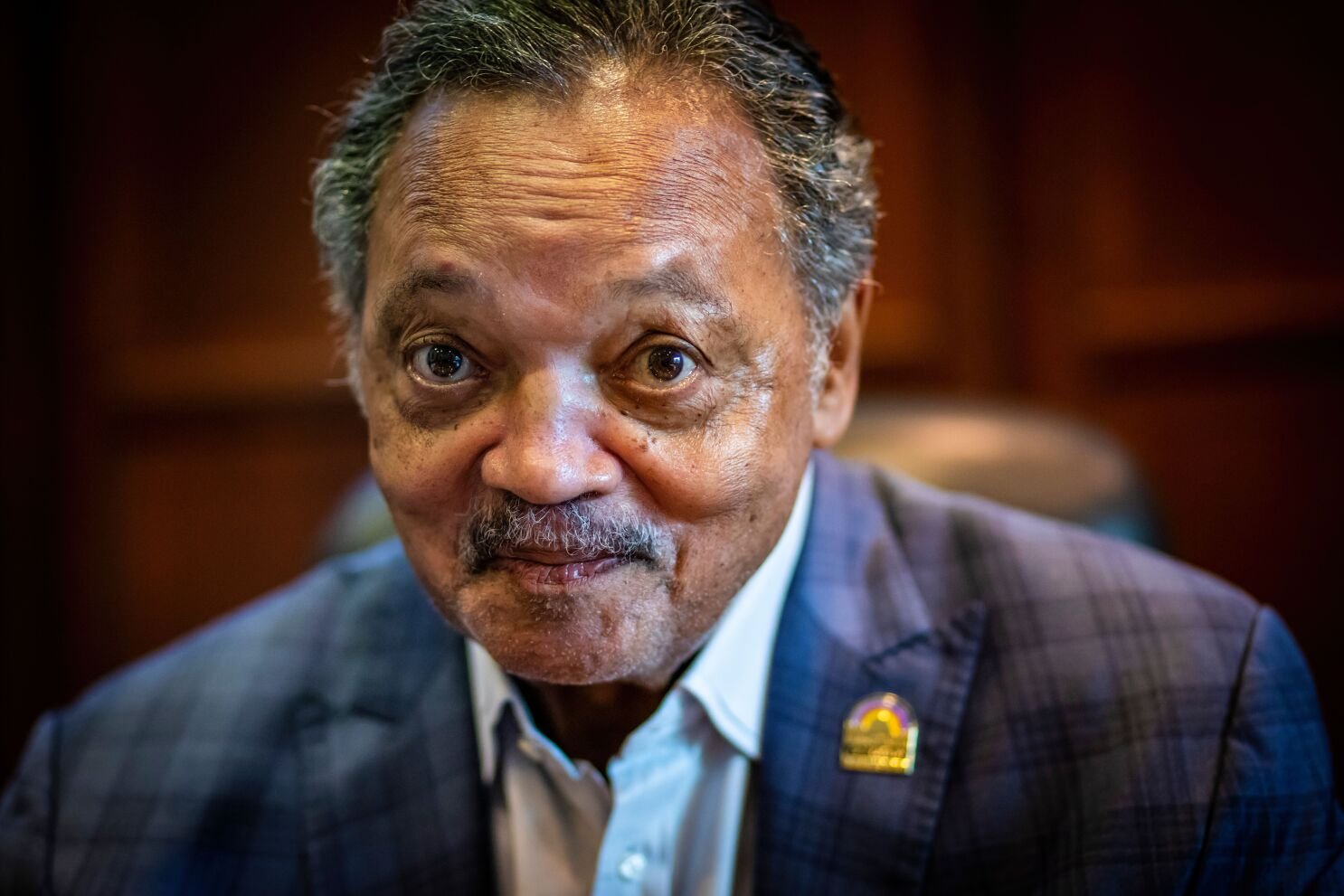
Before Obama, There Was Jackson: The Man Who Rewired the Democratic Party
The Rev. Jesse Jackson never walked quietly into a room. He entered like a sermon in motion — tall, rhythmic in speech, eyes flashing with conviction. For more than six decades, he stood at the intersection of faith and politics, insisting that America live up to its own promise.
On Tuesday morning, surrounded by family, Jackson died at 84. With him passes one of the last towering figures who bridged the age of segregation, the assassination of Martin Luther King Jr., and the rise of a multicultural political coalition that now defines modern Democratic politics.

But before the podiums and presidential campaigns, before the chant that would echo across convention halls — “Keep hope alive!” — there was a boy in Greenville.
A Child Named Jesse Louis Burns
He was born Jesse Louis Burns on October 8, 1941, in segregated Greenville, South Carolina. His mother, Helen Burns, was just 16. His biological father, Noah Robinson, lived next door and had another family. A year later, when Helen married Charles Henry Jackson, the boy took his stepfather’s surname and became Jesse Louis Jackson.

In the Jim Crow South, that origin story mattered. He was teased for being born out of wedlock. He was made to feel different. He later described himself as a “double outcast” — Black in a rigidly segregated society, and fatherless in the eyes of his classmates.
Yet even then, he had a gift. Teachers noticed how young Jesse could turn a phrase. He spoke in cadences. He loved metaphor. He listened to sermons not just for salvation but for structure.
Faith would become both his refuge and his megaphone.
Finding His Idol — and His Calling
Jackson attended North Carolina A&T State University and later enrolled at the Chicago Theological Seminary. In Chicago, he encountered the man who would shape his life: Martin Luther King Jr..
King’s movement was cresting. Sit-ins, marches, and the moral thunder of nonviolent protest were reshaping America. Jackson joined the Southern Christian Leadership Conference (SCLC) and quickly emerged as one of King’s most dynamic young lieutenants.
He absorbed King’s belief that civil rights was not merely about integration but about economic justice, voting rights, and dignity. He also absorbed criticism — some saw him as too ambitious, too visible. But even critics admitted he could electrify a crowd.

When King was assassinated in Memphis in April 1968, the movement splintered with grief. Jackson, just 26, suddenly found himself without his mentor — and with a choice: retreat or rise.
He rose.
After Martin Luther King Jr: The Fight Continues
The years after King’s death were volatile. Urban uprisings, Vietnam protests, political assassinations. Many wondered whether nonviolent protest could survive.
Jackson insisted it must.
He launched Operation Breadbasket in Chicago to pressure corporations to hire Black workers and do business in Black neighborhoods. The model was simple but powerful: economic leverage for economic justice.
He later founded Operation PUSH (People United to Save Humanity), and eventually the Rainbow PUSH Coalition — an organization built on a radical premise at the time: that the struggle for justice was multicolored.
“Our flag is red, white and blue,” he often said. “But our nation is a rainbow — red, yellow, brown, Black and white.”

That vision became known as the Rainbow Coalition — a political and moral alliance of African Americans, Latinos, labor unions, farmers, Native Americans, Asian Americans, LGBTQ Americans, and poor whites. Long before diversity became a political buzzword, Jackson was organizing it.
The Greenville Eight and Courage Under Fire
One of Jackson’s lesser-known but formative battles involved the “Greenville Eight,” a group of young Black activists in South Carolina charged during a 1971 boycott of white-owned businesses. Jackson threw his weight behind their defense, arguing that economic protest was a constitutional right. The case galvanized local activism and reinforced Jackson’s belief that justice required both courtroom strategy and street pressure.

It was in moments like these — far from television cameras — that he refined his method: negotiation mixed with moral urgency.
The Golden Moment: 1984 and 1988
By 1984, Jackson stunned the political establishment by running for president. Many dismissed it as symbolic. It was not.
He won millions of votes and several primaries. He forced debates about apartheid in South Africa, about Palestinian rights, about economic inequality. He pushed the Democratic Party to adopt proportional delegate rules — a structural change that later made possible insurgent candidacies, including that of Barack Obama.

In 1988, he ran again. This time, he won 11 contests and nearly 7 million votes. For a moment, it was no longer unthinkable that a Black man could become president of the United States.
Though he did not secure the nomination, he reshaped the party. He expanded the electorate. He made voter registration drives a national strategy. He helped transform the Democratic coalition into what it is today — urban, diverse, youth-driven.
He was, as he later said without bitterness, “a trailblazer.”
The Orator
Jackson’s speeches were sermons with policy footnotes. He rhymed instinctively.
“If my mind can conceive it, and my heart can believe it, then I can achieve it.”
And of course: “Keep hope alive.”
The phrase became parody material for comedians, but to Jackson it was sacred. Hope was not naïve optimism. It was discipline. It was survival.

He also popularized “I Am Somebody,” a chant that schoolchildren across America would recite — an affirmation of worth in a society that often denied it.
A Life in Headlines — and Humanity
Jackson’s public life was not without turbulence. He apologized in the 1980s for remarks widely condemned as anti-Semitic. In 2001, he acknowledged fathering a daughter outside his marriage — a revelation that wounded his family and tarnished his image.
Yet his marriage to Jacqueline Brown, whom he wed in 1962, endured. Together they raised five children, weathering political storms that might have capsized other families.
He negotiated the release of American hostages abroad. He marched for voting rights into his 80s. Even as Parkinson’s disease slowed his gait, it never silenced his conviction.
When Barack Obama delivered his 2008 victory speech in Chicago’s Grant Park, cameras captured Jackson in tears. He later said he wept for those who did not live to see it — King, Abernathy, Evers.

The arc had bent, at least in that moment.
The Legacy
Jesse Jackson’s life spanned three Americas: the segregated South of his childhood, the burning cities of the late 1960s, and the diverse, politically fractured nation of the 21st century.
He forced America to confront uncomfortable truths about race and poverty. He expanded who could imagine themselves on a presidential debate stage. He proved that moral language could coexist with political machinery.

Most of all, he insisted on dignity — for the poor, the marginalized, the forgotten.
He once said, “Both tears and sweat are salty. But sweat will get you change.”
Jesse Jackson sweated for change — in pulpits, in jail cells, in convention halls, in forgotten neighborhoods. He did not see every dream fulfilled. No civil rights leader ever does.
But he left behind something sturdy and enduring: a coalition, a cadence, and a command to believe.
Keep hope alive.
And for millions who grew up hearing that chant, hope remains his most indelible inheritance.