

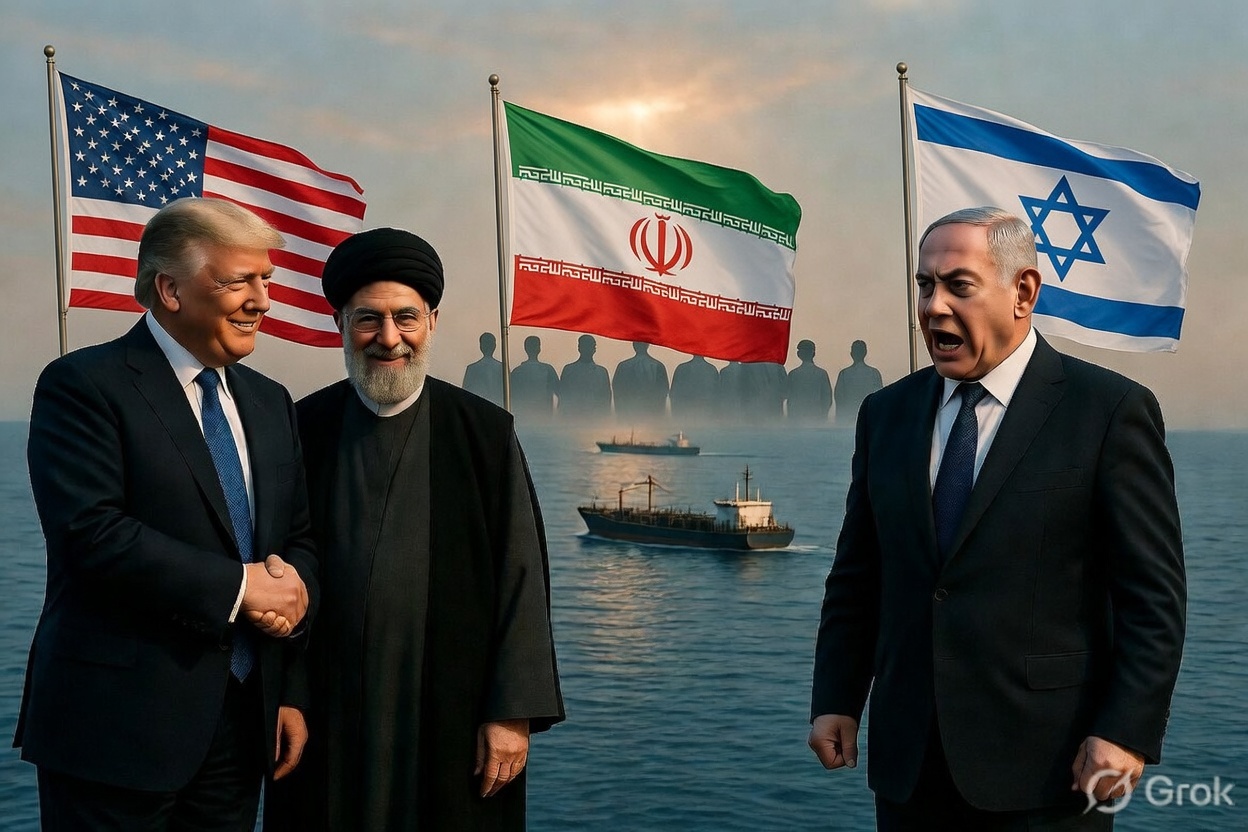
Forty Days of Middle East War: How Iran and America Stepped Back from the Brink
A new supreme leader, a negotiator’s phone, and a deal that neither side fully owns— the inside story of how a two-week ceasefire was cobbled together and what it means for the world watching the Strait of Hormuz.
Dateline: WASHINGTON / TEL AVIV/TEHRAN–It was 11:50 PM, April 7, 2026, in Washington, D.C. According to the official narrative, the B-2 stealth bombers were already warming up on the tarmac at Diego Garcia. President Donald Trump had set a deadline: 8:00 PM ET. When that clock hit zero without a deal, “a whole civilization” was supposed to die.
Instead, the phones rang.
In a bizarre, last-minute pivot that feels like the script for a political thriller, the United States and Iran have agreed to a two-week ceasefire, pulling the Middle East back from the brink of an abyss that opened 40 days ago. The truce, brokered not by a traditional European power but by unknown, hinges on the immediate reopening of the Strait of Hormuz, a vital passage for global oil transport that the US is watching closely.
But beneath the surface of Trump’s “total and complete victory” claim and Tehran’s guarded optimism lies a far more complex reality. This isn’t a peace treaty; it is a “10-point” hostage exchange—and the world is watching to see who blinks first.
What happened in the hours before the deal
The ceasefire was not inevitable. It was, by most accounts, a near miss. As recently as Monday, April 6, Iran had flatly rejected a US proposal for a temporary ceasefire, insisting on a permanent solution. Trump had threatened to bomb Iran’s power plants, bridges, and water treatment facilities— actions legal experts warned would cross into war crime territory. The US military was reportedly preparing another round of “destructive” strikes. The clock was ticking as the US managed its diplomatic relations with Iran.
What changed on the night of April 7 was negotiation. A negotiator’s a decisive call to President Trump, asking him to hold off on the next wave of strikes and give diplomacy 14 more days. Simultaneously, Iran’s Supreme National Security Council, acting on the “prudence” of Mojtaba Khamenei, decided that the moment was right— not to surrender, but to negotiate from what Tehran claimed was a position of battlefield strength. The negotiation then extended the invitation to both delegations to meet up in Islamabad on April 10.
The Curtain Behind the Curtain: The Mojtaba Moment
For 40 days, the West operated under the assumption that Iran was a rudderless ship after the assassination of Ayatollah Ali Khamenei. Political Pundits predicted chaos. They were wrong.
According to intelligence cited by Axios and confirmed by sources close to the negotiations, the true architect of this ceasefire was not the outgoing interim leadership, but Mojtaba Khamenei, the new Supreme Leader.
Understanding this ceasefire requires understanding who Mojtaba Khamenei is— and is not. He is not his father. Ayatollah Ali Khamenei spent decades in the role, built deeply entrenched networks across Iran’s military, judiciary, and clerical establishment, and had a well-known theology of resistance. Mojtaba, his second son, was elevated to the position just days after the war began. The New York Times described Iran’s new leadership as “paralyzed” in late March, with severely disrupted decision-making chains. When Mojtaba Khamenei chose to authorize the ceasefire, it carried enormous symbolic weight — a new leader sending a signal that the era of his father’s complete intransigence was open to revision, at least tactically. Iran’s SNSC statement, broadcast on state television, framed the decision as victory, not retreat: “The enemy has suffered an undeniable, historical, and crushing defeat… Iran has achieved a massive victory and forced criminal America to accept its 10-point plan.”
Whether that framing holds up in Islamabad remains to be seen. But domestically, it was a masterstroke— Mojtaba arriving on the world stage not as someone who lost 40 days of war, but as someone who forced the most powerful country America on earth to the negotiating table.
Iran’s 10-point plan: what’s in it, and what the US won’t say
Iran’s demands, delivered to the US via Pakistan, are sweeping. They are not a list of talking points — they read like terms of surrender written by the winning side.
Iran’s 10-point plan — and likelihood of US acceptance

Prime Minister Benjamin Netanyahu has publicly supported Trump’s decision to stop the bombing of Iran—for now. But in a statement that caused immediate confusion in diplomatic circles, Netanyahu’s office clarified that this ceasefire “does not include Lebanon”. Israeli PM Netanyahu is testing the limits. He views Hezbollah as the pistol pointed at his northern border.

The Strait of Hormuz: why these 14 days matter for the whole world
Regardless of the political headaches, the world breathed a literal sigh of relief on Wednesday morning.
The immediate impact was financial. Oil prices crashed.
-
Brent Crude fell nearly 16%, dropping to approximately $92 a barrel .
-
Asian stock markets surged; Japan’s Nikkei jumped 5% .
Why? The Strait of Hormuz is open. When Iran closed the Strait of Hormuz on March 8, it did not just disrupt shipping — it sent a shockwave through every economy on earth that runs on oil or natural gas. The strait is the single most critical chokepoint in global energy trade. Roughly 20% of the world’s oil and a significant share of liquefied natural gas (LNG) passes through those 33 kilometers of water between Iran and Oman. This sent LPG and energy prices skyrocketing, triggering energy emergencies in nations like the Philippines.
Under the deal, the strait will reopen under the “coordination” of the Iranian military. In a bizarre twist, the plan allows for Iran and Oman to charge tolls on passing ships. President Trump, ever the businessman, waved this through, stating, “Big money will be made. Iran can start the reconstruction process”.
For the world consumer, this means the pain at the pump may finally ease—though prices are still $20 higher than before the war began.
The mood in Iran— relief, skepticism, and flags in the dark
In the pre-dawn hours of April 8, Iranians poured into the streets of Tehran after hearing the ceasefire announcement. Videos from Enqelab Square showed people waving the Iranian flag, chanting “Death to America”, holding photographs of both Mojtaba Khamenei and his slain father, and burning US and Israeli flags not in protest of the war, but in protest of the ceasefire— an act that in Iran carries both genuine emotion and performative ritual. But not everyone was euphoric. One woman, speaking to media at the scene, was plainly skeptical: she noted that Iran had twice gone to the negotiating table after being attacked, and America had come back both times. The ceasefire, she seemed to say, was not peace. It was a pause.
That skepticism is earned. Iran has been here before— with the JCPOA, with the 2025 Oman talks, with the Rome round, with the Muscat round. Each time, the deal collapsed or was abandoned. The difference this time, if there is one, is that the Iranian state is presenting this not as a concession but as a negotiated outcome on Iran’s terms. That narrative, even if contested in Washington, may give Mojtaba Khamenei enough political cover to actually make concessions in Islamabad without his domestic audience seeing it as defeat.

The Neighborhood Moods: GCC Anxiety and Relief
How are the Gulf states reacting? With a mix of exhaustion and quiet terror.
-
Saudi Arabia & UAE: They “welcomed” the ceasefire, but their body language screams skepticism. Both nations were hit hard by Iranian retaliation during the 40-day war. Abu Dhabi’s gas facilities where ablaze just hours before the truce were called. They fear that US withdrawal means they will be left alone with a nuclear-capable Iran.
-
Oman: The happiest mediator. They stand to collect revenue from the Hormuz tolls alongside Iran.
-
Qatar: Applauded the “initial step” but is likely furious—the war severely damaged their LNG infrastructure, taking years to repair.
The GCC sees this not as a victory for peace, but as the US hitting the “pause” button to avoid an economic recession during an election year.
What Happens After 14 Days Ceasefire?
This ceasefire is not the end of a conflict. It is a recognition of limits—military, economic, and political.
Iran has demonstrated leverage. The US has acknowledged constraints. Israel has recalibrated its timeline.
What happens next will not be decided by announcements, but by concessions—quiet, incremental, and difficult.
For now, the world has 14 days of relative calm. In a region where escalation can happen overnight, that alone is significant.
After the upcoming talks, three scenarios appear plausible:
- Managed De-escalation: Limited agreements on sanctions relief and maritime security
- Stalemate: Ceasefire expires without broader consensus
- Renewed Escalation: Talks fail, and hostilities resume with greater intensity
Much will depend on whether both Washington and Tehran are willing to trade principle for pragmatism.
Till then, let’s keep finger crossed!