

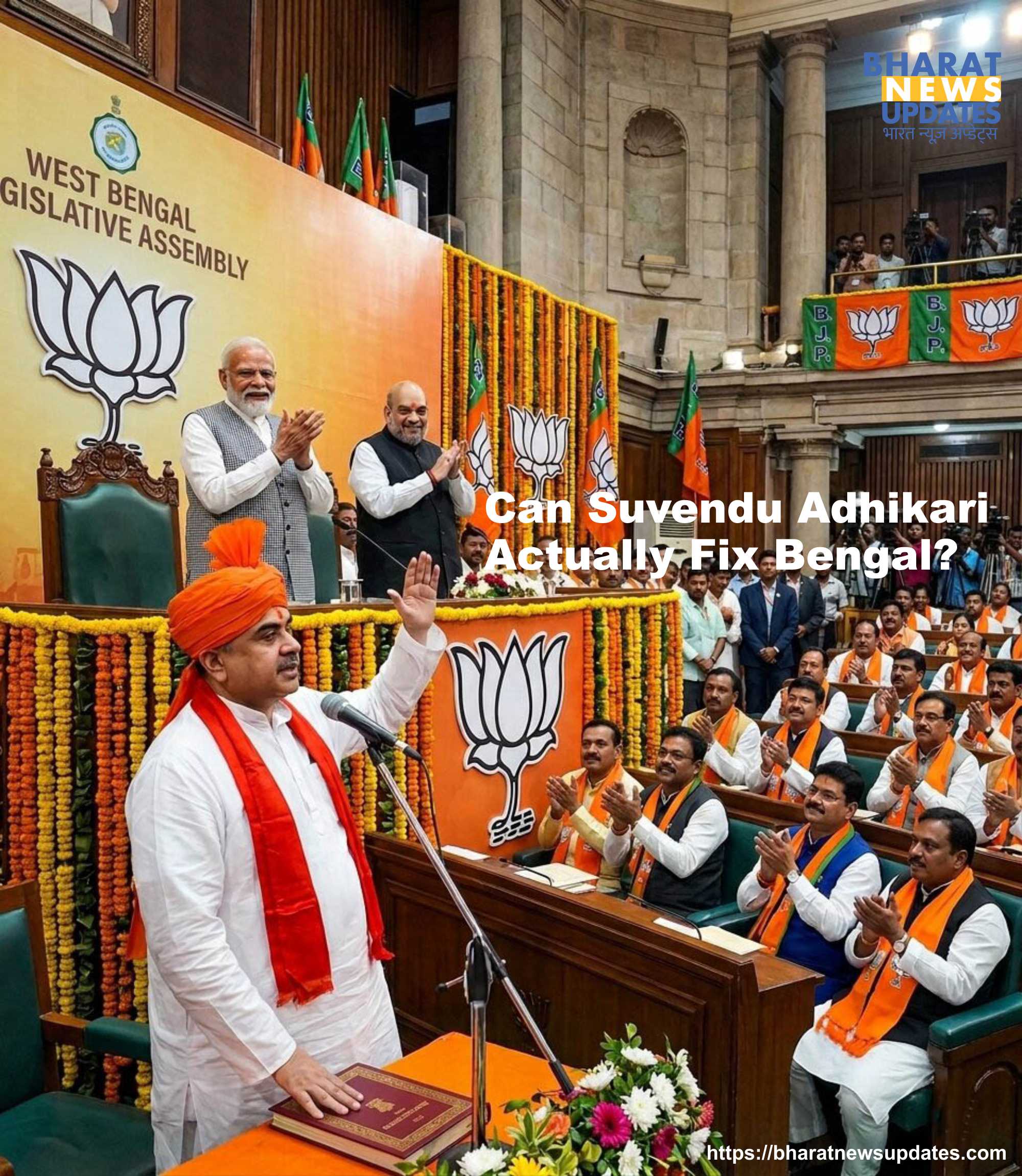
The Man Who Ended 15 Years: Why Suvendu Adhikari Is West Bengal’s Most Credible Next Chief Minister!
On the morning of May 4, 2026, as vote counts rolled in from 294 constituencies across West Bengal, one number kept growing that nobody in Kolkata’s political circles could ignore: 207. That is how many seats the BJP won. The TMC, which had ruled Bengal for 15 unbroken years, was left with 80.
And at the centre of this political earthquake stood one man— Suvendu Adhikari— who not only won from Nandigram but also walked into Mamata Banerjee’s home turf of Bhabanipur and defeated her by over 15,000 votes. The last time a sitting Chief Minister lost their own seat to someone contesting simultaneously on two constituencies was in 1967. History does not repeat itself in Bengal very often. When it does, it matters.
Who Is Suvendu Adhikari— Beyond the Headlines
Born on December 15, 1970, in Kanthi (Contai), Purba Medinipur, Suvendu Adhikari did not inherit power. He built it, slowly, over three decades, starting as a councillor in Kanthi Municipality with the Congress in 1995. He later joined the Trinamool Congress, rose through it, served as Transport Minister and Irrigation Minister between 2016 and 2020, and then in December 2020, walked away.
The reason was not just political ambition. His rivalry with Mamata’s nephew Abhishek Banerjee— who was being groomed as the TMC’s heir— made his position in the party untenable. He joined the BJP in the presence of Home Minister Amit Shah and almost immediately became the party’s most credible face in Bengal.
In 2021, he contested from Nandigram against Mamata Banerjee herself and won by 1,956 votes. The margin was narrow but the symbolism was enormous. In 2026, he repeated the feat— this time by a margin of 15,000 votes— on Mamata’s home ground.
He holds a Master of Arts degree from Rabindra Bharati University. He is a trained politician from the ground up, not a parachuted candidate. That difference matters when governing a complex, layered state like Bengal.
The Nandigram Legacy: Why It Still Defines Him
Most political careers have one defining moment. For Suvendu Adhikari, it was the Nandigram Movement of 2007— nearly two decades before he became a national face.
When the Left Front government attempted to acquire farmland for industrial projects in Nandigram, it was Adhikari who organized farmers, mobilized communities, and led resistance on the ground. That movement eventually broke the Left’s 34-year grip on Bengal and helped bring Mamata Banerjee to power.
The irony is not lost on anyone: the man who built the road for Mamata is now the one leading Bengal after her fall. His roots in rural Bengal— his understanding of what farmers need, what coastal communities fear, what border-district families live with every day— is not a campaign narrative. It is lived experience.

The Numbers Behind Bengal’s Problems
Before talking about solutions, the scale of what Adhikari will inherit needs to be clear.
West Bengal shares over 2,200 km of border with Bangladesh— one of the most porous international boundaries in South Asia. In January 2026, the Calcutta High Court had to direct the state government to hand over acquired land to the BSF for border fencing construction, stating that “national security cannot be delayed on administrative grounds.” That directive should never have been necessary. It was.
Narcotics seizures along the Bengal-Bangladesh border surged to 5,729 kg in the first seven months of 2025 alone, up from 4,988 kg in all of 2023. Gold smuggling rose from 166 kg in 2023 to 188 kg in 2024. These are not abstract security statistics— they represent organized criminal networks operating freely along Bengal’s border.
On employment, the school jobs scam became the defining corruption scandal of the TMC’s final years— thousands of teaching posts were allegedly sold for bribes, denying qualified young people legitimate careers. The BJP made this a central campaign issue, not without reason.
Women’s safety concerns intensified public debate throughout the campaign. The law-and-order narrative— post-poll violence, crimes against women, political intimidation— resonated in ways that welfare schemes could not counter.
Why Suvendu Adhikari Is the Credible Choice
There are other names being discussed in BJP’s corridors. But three factors make Adhikari the strongest contender.
First, he knows Bengal from the inside out. He served in TMC’s government. He knows where the rot is, not from opposition benches but from within. That institutional knowledge is rare and valuable when you are inheriting a broken system.
Second, he has a track record of building organization under pressure. Over five years as Leader of the Opposition, he held the BJP’s Bengal unit together through violent post-poll reprisals, legal challenges, and constant political pressure. The party’s booth-level network— one dedicated worker per 30-60 voters — was built partly through his organizational push.
Third, his grassroots connect is real. His base in Purba Medinipur, his history with farmers, his standing among the Matua community, and his outreach in border districts give him a legitimacy that a Delhi-appointed candidate would simply not carry. Bengal is sensitive about outsiders. Adhikari is not one.

What Bengal Can Realistically Expect
A change of government does not fix decades of institutional decay overnight. Anyone expecting miracles from day one will be disappointed. But there are areas where change under an Adhikari government could be concrete and measurable.
Border Fencing and Infiltration: With the Centre and State now aligned under the same party, the land acquisition and coordination blockages that stalled BSF fencing work can be cleared. The Calcutta High Court’s directive can be acted upon rather than resisted. This is a logistics and political will issue— both of which change immediately with a BJP government in Nabanna.
Industry and Jobs: Bengal was once an industrial powerhouse. Decades of Left governance followed by TMC’s political environment drove industries away. Tata’s Nano plant leaving Singur in 2008 was a symbol of that failure. Bringing industries back requires a stable law-and-order environment and investor-friendly administration. Under Adhikari, the stated priority is industrial revival in Durgapur, Kharagpur, and Howrah belts. Results will take two to three years minimum, but the direction can shift immediately.
Youth Employment: The school jobs scam exposed how deeply politicized public recruitment had become. A transparent, merit-based hiring process in government jobs— combined with CAA implementation for eligible refugee communities like the Matuas— can restore some faith. This will require breaking entrenched networks that have controlled appointments for years.
Women’s Safety: The BJP’s campaign hammered law-and-order consistently. An Adhikari government will face pressure to deliver on this. The appointment of professional, non-political police leadership in districts will be the first real test.
Ghuspethiya (Infiltration) Issue: This is politically charged but administratively complex. Identifying and acting on cases of illegal infiltration while protecting legitimate citizens— particularly Muslim communities with full documentation— requires precision, not sweeping action. Adhikari has publicly stated that BJP’s issue is with Rohingya infiltrators and fake-voter networks, not Indian Muslims. His approach here will be closely watched by both supporters and critics.
The Challenges Ahead Are Real
Suvendu Adhikari will not have an easy time in Nabanna.
The administrative machinery he inherits has been politically calibrated for 15 years— first by the Left for 34 years before that. Police officers, block-level bureaucrats, and district administrations have functioned within a culture of political patronage. Reforming that without destabilizing governance requires patience and skilled management.
The opposition, though reduced to 80 seats, will remain vocal. TMC still commands a significant minority vote base and will contest every administrative action legally and politically.
And Bengal’s economics are structurally difficult. High debt, poor industrial base, and a skilled workforce that has been migrating out for decades cannot be reversed by political will alone.
The Bottom Line
Suvendu Adhikari did not emerge from a Central BJP list. He earned his position through two decades of ground-level politics, one of the most watched electoral duels in Indian political history, and five years of holding the opposition together in a state where being in opposition carried real physical risk.
The 206-seat win is not his alone. It belongs to every voter in Bengal who decided that 15 years was enough. But the mandate to lead this new chapter — with the knowledge, the roots, and the track record — points most clearly to him.
Bengal has been waiting a long time for honest governance. The real work begins now.
BJP State President Samik Bhattacharya on Tuesday confirmed that oath taking ceremony for the next West Bengal chief minister will be held on May 9, 2026.