

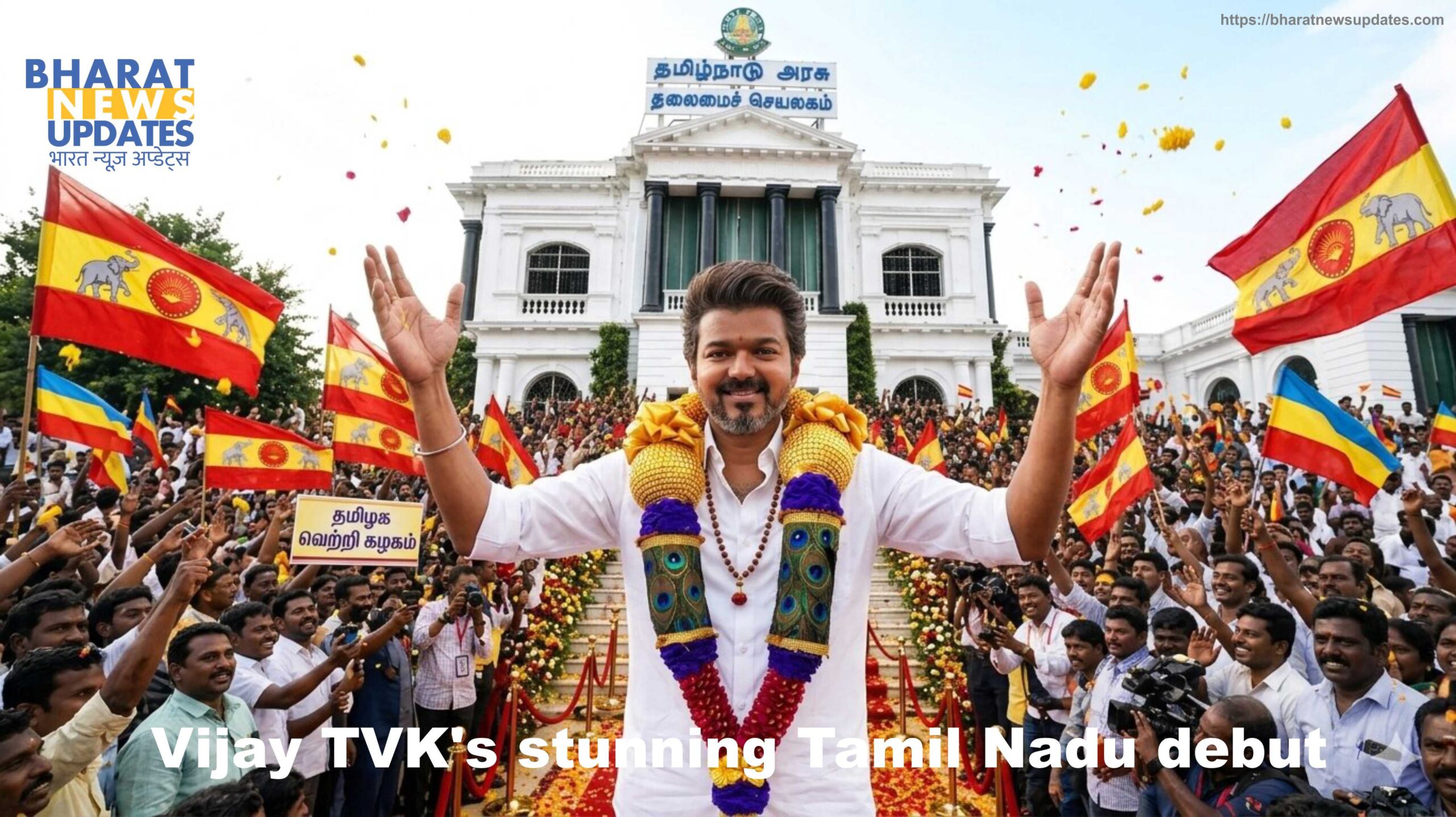
Vijay wins— but 10 seats short: inside TVK’s stunning Tamil Nadu debut
The actor who dared where Rajinikanth wouldn’t has reshaped Tamil Nadu’s political map in one election. Now comes the harder part.

For six decades, Tamil Nadu’s political story had two authors — the DMK and the AIADMK. On May 5, 2026, a third name wrote itself into that story. Actor Chandrasekaran Joseph Vijay‘s Tamilaga Vetri Kazhagam emerged as the single largest party in a 234-seat assembly, winning 108 seats in just its first election. But 108 is not 118. Tamil Nadu now has a hung assembly, and whether Vijay forms a government depends on political math he’ll have to solve fast.
What the name was trying to tell you
TVK— Tamilaga Vetri Kazhagam— wasn’t an accident of branding. When Vijay announced the party on February 2, 2024, every word was deliberate. Earlier Dravidian parties used “Dravida” in their names, a broad identity. Vijay chose “Tamilaga”— of Tamil Nadu, for all Tamils. “Vetri” means victory, and it sounds like Vijay— a nudge to every fan that the party carries his name within it. And “Kazhagam,” meaning organization, is the word Tamil voters have associated with political movements for generations. The name wasn’t just marketing. It was a positioning statement: this is not another Dravidian party— it’s something new.

How he actually won
Star power opened doors, but it didn’t win 108 seats on its own. Several things worked together.
Vijay’s TVK ran almost entirely on young, unknown candidates. Names like Rhevanth Charan in Maduravoyal (30 years old, set to be among the youngest MLAs in state history) and Ramesh from Srirangam were barely known to the public before polling day. They won anyway — often against seasoned veterans from both the DMK and AIADMK. This wasn’t coincidence. TVK assembled a large volunteer network and reached voters door-to-door in a way the older parties, resting on decades of organization, did not expect.
The party also went it alone — deliberately. Vijay rejected alliance offers when no partner agreed to share power equally, choosing to contest all 234 seats. That gamble is now validated. Chennai told the story most sharply: TVK took 14 of 16 seats in a city long considered the DMK’s stronghold.

Then there was the anti-incumbency. Corruption allegations and family-first politics had dented DMK’s credibility. MK Stalin himself lost his Kolathur seat to TVK’s AS Babu, a former DMK man. His son, Deputy CM Udayanidhi, barely held on in Chepauk. The voters weren’t just choosing Vijay — many were voting against Stalin.
And the money question. Tamil Nadu elections have long run on cash — votes bought, rallies paid for. TVK ran without that machine. The Karur stampede forced a muted campaign. Vijay’s candidates had limited funds. None of it mattered. This precedent — that an organic, grassroots campaign can beat the money game — is perhaps the most consequential thing about this result.

TVK needs 10 more votes to cross 118 and claim a majority. The most plausible path runs through Congress, CPI, CPI(M), and VCK — all currently in the DMK-led alliance, but with no loyalty that survives a DMK collapse. Congress, notably, had explored an alliance with TVK before the election and used that leverage to extract a higher seat share from the DMK — a sign those relationships were already fraying. A 2006 parallel has already been invoked: that year, a minority DMK government survived with outside support. TVK insiders believe the same is possible. A swearing-in as early as May 7 is being discussed even as backchannel negotiations continue.
The end of Dravidian politics?
Not quite — but this is the largest crack in the structure since MGR broke from Karunanidhi in 1972. The DMK has lost not just the election but its chief minister’s seat. Stalin’s defeat in Kolathur, where he won comfortably in 2021, is a personal humiliation. For the party, the question of who leads in the assembly — with Stalin no longer in the House— is now urgent. Udayanidhi, who barely survived in Chepauk, carries blame for the campaign strategy and faces questions about his succession claim.
The AIADMK is in a different kind of trouble. Edappadi Palaniswami held rural pockets but sits third in a state that no longer sees him as a serious contender for power. With smaller parties likely gravitating toward Vijay, AIADMK’s 40-odd MLAs make it a bystander — relevant enough to watch, not strong enough to matter.
Dravidian politics isn’t dead. But for the first time in six decades, neither the DMK nor AIADMK is defining what comes next. That’s a tectonic shift, even if the ideology endures elsewhere.


Vijay has done what no one before him— not Rajinikanth, not Kamal Haasan— managed to do cleanly: translate superstardom into electoral power at scale. His wave crossed caste lines, religion, urban-rural divides, and the age gap. That alone is historic. But Tamil Nadu’s voters didn’t just elect a star. They elected a government. What Vijay does with that — how he handles the bureaucracy, the opposition, the coalition arithmetic, and the gap between his promises and what’s deliverable — will determine whether May 5, 2026 was the beginning of something new or just a stunning first chapter that couldn’t find its second.
TVK Chief Vijay will be sworn as the Chief Minister of Tamil Nadu.
Date: May 7th
Vanue: Nehru Indoor Stadium, Chennai