

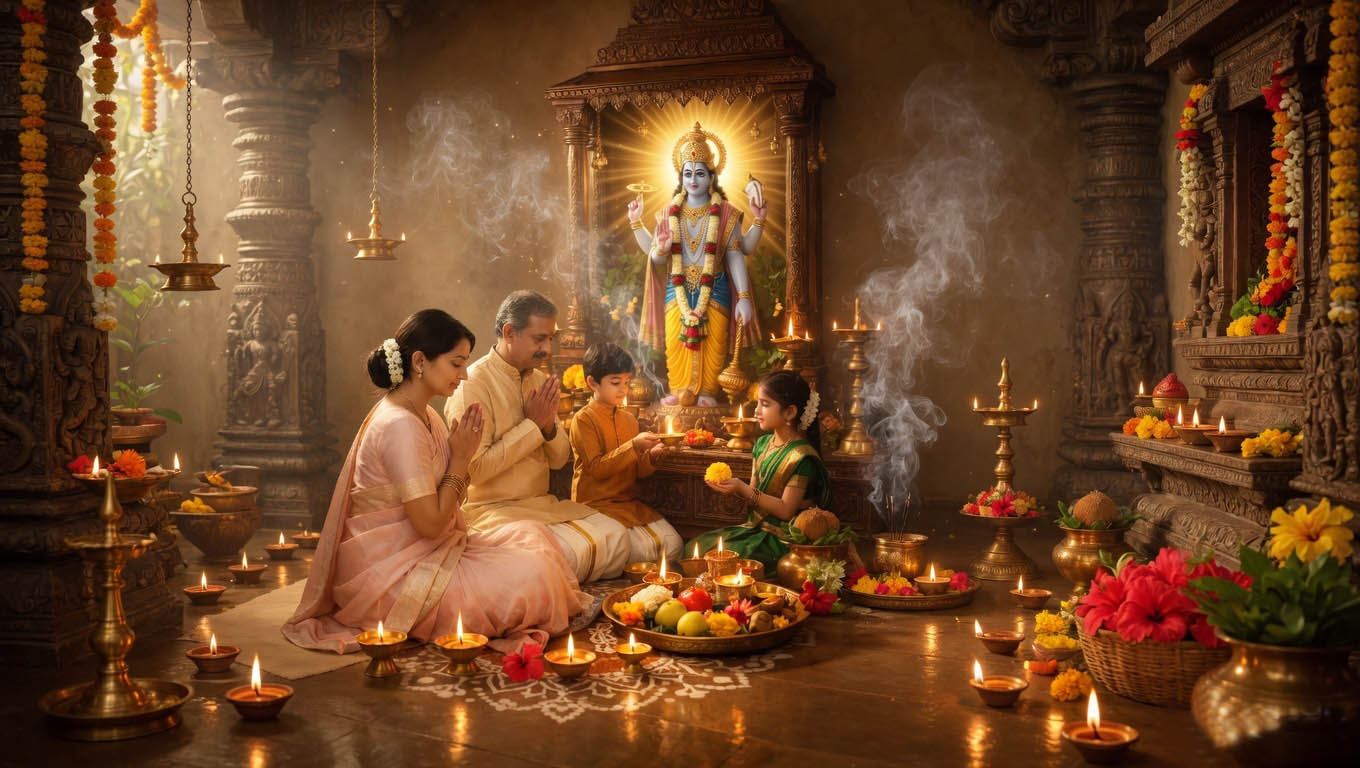
Purushottam Maas 2026: The Month That Belongs to God Himself And Why It Changes Everything
May 17 to June 15, 2026 | Adhik Jyeshtha Maas
There is a month in the Hindu calendar that doesn’t officially belong to any season, any festival cycle, or any presiding deity or at least, it didn’t used to. It was the orphan of the lunar year, the extra month squeezed in every thirty-two months or so to make the maths of the cosmos work. People called it Malmaas, the impure month and avoided it like a closed door. No weddings. No new beginnings. No celebrations.
Then Lord Vishnu gave it His own name.
What follows is the story, the science, and the living practice of Purushottam Maas beginning May 17, 2026, and running through June 15, 2026, as Adhik Jyeshtha Maas.
Why This Month Exists: The Science Behind the Sacred
Before Rome gave the world the Julian calendar, and long before Pope Gregory XIII reformed it in 1582, Hindu scholars had already solved one of astronomy’s most persistent puzzles: how to reconcile the solar year with the lunar year without letting your festivals drift across seasons.
The Hindu Panchang (almanac) is a lunisolar system, it tracks both the moon’s phases (for tithi-based rituals) and the sun’s position (for seasonal accuracy). A lunar year runs roughly 354 days. A solar year runs 365.25 days. Left unaddressed, this gap of about 11 days per year means that within 17 years, a midsummer festival would fall in winter.
The ancient Hindu astronomers, working with concepts documented in texts like the Surya Siddhanta (estimated to be over 1,500 years old), calculated with remarkable precision: every 32.5 months, one extra lunar month must be inserted. This intercalary month is called Adhik Maas literally, “the additional month.” The calculation behind it tracks a cycle called the Metonic period and uses a measure called Adhimasa to determine when insertion is needed.
Here is the uncommon detail most articles skip: not every Adhik Maas carries the name Purushottam. That name is a theological title, not an astronomical label. The astronomical event is Adhik Maas; the sacred identity granted to it by Lord Vishnu is Purushottam Maas. This distinction matters, it separates the mechanical from the meaningful.
In 2026, the extra month falls within Jyeshtha, making it Adhik Jyeshtha Maas. Since Ganga Dussehra normally falls in Jyeshtha, it will be celebrated twice this year — an astronomical quirk that becomes a devotional opportunity.

The Story the Vedas Tell: From Malmaas to Purushottam
The Padma Purana and Skanda Purana carry the mythological account with a weight that feels surprisingly human.
When the cosmos was being organized, each month received a presiding deity, a guardian who gave it identity and purpose. But the intercalary month, born from astronomical necessity rather than celestial intention, had none. No deity claimed it. No festival graced it. People saw it as Mal- impure, inauspicious, unlucky. Weddings weren’t held in it. Children weren’t named during it. No one built homes or launched ventures under its skies.
The month bore this rejection alone.
According to the Puranas, Malmaas— weeping and burdened with the shame of being unwanted finally traveled to Vaikuntha Dham, the celestial abode of Lord Vishnu. It placed its grief before Him. It did not ask for miracles or grand correction. It simply asked: will you receive me?
Lord Vishnu, moved by the month’s devotion and by its willingness to approach Him rather than remain in silent suffering, did something extraordinary. He did not merely give it a guardian deity. He gave it His own name Purushottama, meaning “the highest among beings” or “the supreme person.” The word appears in the Bhagavad Gita (Chapter 15) as one of Krishna‘s most elevated self-descriptions.
The boon that followed was sweeping: any soul who, during this month, engages in devotion, chanting, charity, and self-discipline without expectation, without ego will receive Lord Vishnu’s direct grace. The spiritual merit earned will never diminish. The month that was once abandoned became the most potent of all.
This is not merely a story. It is also a teaching. The month’s transformation mirrors the soul’s potential: what is neglected, when it turns sincerely toward the Divine, becomes most sacred.
The Hidden Contradiction Worth Acknowledging
Here is something most popular articles will not say plainly: Purushottam Maas is simultaneously considered inauspicious for worldly affairs and supremely auspicious for spiritual ones. These two facts coexist without contradiction, but they are often presented as if only one is true.
The restriction on weddings, Griha Pravesh (housewarming), property purchases, and major ventures is not because the month is spiritually inferior. It is because the month has been designated entirely for a different kind of work, the inner kind. Conducting a wedding during this period isn’t forbidden because the month is bad luck; it’s more accurate to say that the cosmic attention of the period is directed elsewhere, and worldly ceremonies conducted now simply aren’t aligned with the month’s primary frequency.
Think of it like trying to have a loud celebration in a room where deep meditation is already underway. It isn’t wrong; it’s just misaligned.
Key Dates During Purushottam Maas 2026
| Date | Event |
|---|---|
| May 17 | Purushottam Maas begins |
| May 18 | Chandra Darshan (Moon sighting) |
| May 20 | Ganesh Chaturthi fast |
| May 26 | Ganga Dussehra (First occurrence — holy dip, charity) |
| May 27 | Purushottam Ekadashi (First) |
| May 28 | Pradosh Vrat |
| June 1 | Krishna Paksha begins |
| June 11 | Purushottam Ekadashi (Second) |
| June 13 | Maha Shivaratri fast |
| June 15 | Somvati Amavasya — Purushottam Maas ends |
| June 16 | Auspicious ceremonies (Mangalik Karya) may resume |

What to Do During Purushottam Maas: Practices That Actually Matter
1. The Root Mantra — Begin Here
“Om Namo Bhagavate Vasudevaya”
This twelve-syllable mantra is the Dwadasakshari, one of the most potent Vaishnava mantras, said to invoke Lord Vishnu‘s direct presence. During Purushottam Maas, chanting it 108 times daily, especially at sunrise, is considered exceptionally fruitful. It works not through compulsion but through alignment it tunes the mind toward Vasudeva, the one in whom all existence rests.
2. The Purushottam Maas Special Mantra
“Govardhanadharam Vande Gopalam Gopivallabham.
Vishnum Jishnum Jagannatham Radhakrishnam Namo’stute.”
This mantra invokes both Lord Vishnu’s cosmic sovereignty and Lord Krishna‘s intimate accessibility. Chanting it during the month draws upon both aspects simultaneously.
3. The Maha Mantra for the Restless Mind
“Hare Krishna Hare Krishna, Krishna Krishna Hare Hare;
Hare Rama Hare Rama, Rama Rama Hare Hare.”
For those carrying anxiety, grief, or mental turbulence, this mantra functions differently than the others, it is less about petition and more about presence. It is repetitive by design. The repetition is the point.
4. Vishnu Sahasranama and Srimad Bhagavatam
Daily recitation of the Vishnu Sahasranama (the thousand names of Vishnu) or reading from the Srimad Bhagavatam even one chapter per day is encouraged. The Satyanarayan Katha, traditionally performed on full moon evenings, holds particular merit during this period.
5. Maha Dan, Great Charity Without Calculation
The texts are specific: charity given during Purushottam Maas is permanent in its spiritual return. The act should match your capacity not exceed it performatively, not fall short out of miserliness. Food, clothing, money, Deepdan (offering of light/lamps), and supporting those engaged in religious study are all mentioned. The how matters as much as the what: give without announcement, without expectation of visible return.
6. Ekadashi Fasting (May 27 and June 11)
The two Purushottam Ekadashi fasts this month carry amplified significance. Fasting on Ekadashi abstaining from grains, beans, and certain spices is a practice specifically linked to cleansing the subtle body. The Padma Purana states that the merit of observing Purushottam Ekadashi equals that of observing all other Ekadashis combined. Whether one takes this literally or symbolically, the invitation is clear.
7. Brahma Muhurta Waking
Rising before dawn roughly 96 minutes before sunrise during this month is considered particularly potent for meditation and Mantra Japa (mantra repetition). There is an atmospheric quality to this hour, before the noise of the world asserts itself, that practitioners across traditions have consistently described as uniquely receptive.
8. Sattvic Living as a Month-Long Practice
For those wishing to observe the month holistically: eat once per day, consume food free of onion, garlic, meat, and alcohol. This isn’t about dietary morality, it is about reducing the rajas (agitation) and tamas (inertia) in the body that make sustained focus on spiritual practice difficult.

What Not to Do: The Restrictions and Their Real Rationale
Avoid:
- Weddings and marriage-related ceremonies (Vivah Sanskar)
- Mundan (first haircut ceremony for children)
- Janeu Sanskar (sacred thread ceremony)
- Griha Pravesh (housewarming rituals)
- Starting a new business or major commercial venture
- Purchasing new property, vehicles, or significant gold and silver jewelry
The real rationale: The month is not a period of bad luck. It is a period of reorientation. Every rupee spent on a wedding during this time is a rupee whose energy belongs to a ceremony misaligned with the month’s purpose. Ancient Dharmashastra authors understood that human attention is finite, if you are planning a wedding, you are not sitting with the Bhagavatam. The restrictions are not punishments. They are permissions to set aside worldly preoccupations without guilt.
What is often misunderstood: Emergency situations, medical care, urgent legal matters, unavoidable necessary purchases are not prohibited. The restrictions apply to Mangalik Karya, deliberately auspicious ceremonial events, not to the practical necessities of life.
A Note on Who Benefits Most
Here is the honest part: the month benefits those who actually engage with it. A person who chants the Maha Mantra once and then forgets about the month entirely will not experience much. A person who approaches the entire thirty days as a sustained, sincere experiment in redirecting attention toward gratitude, stillness, generosity, and reflection will find something shifts.
The month is not magical in a transactional sense. It is magnetic in a devotional one. The traditions that surround it exist to create the conditions for transformation, not guarantee it on demand.
Malmaas became Purushottam Maas not because Lord Vishnu changed the astronomy. He changed the meaning. That is what is available to every person during these thirty days: a reframing of what is possible when the ordinary is consecrated.
Purushottam Maas concludes on June 15, 2026, with Somvati Amavasya. Auspicious ceremonies resume June 16.