

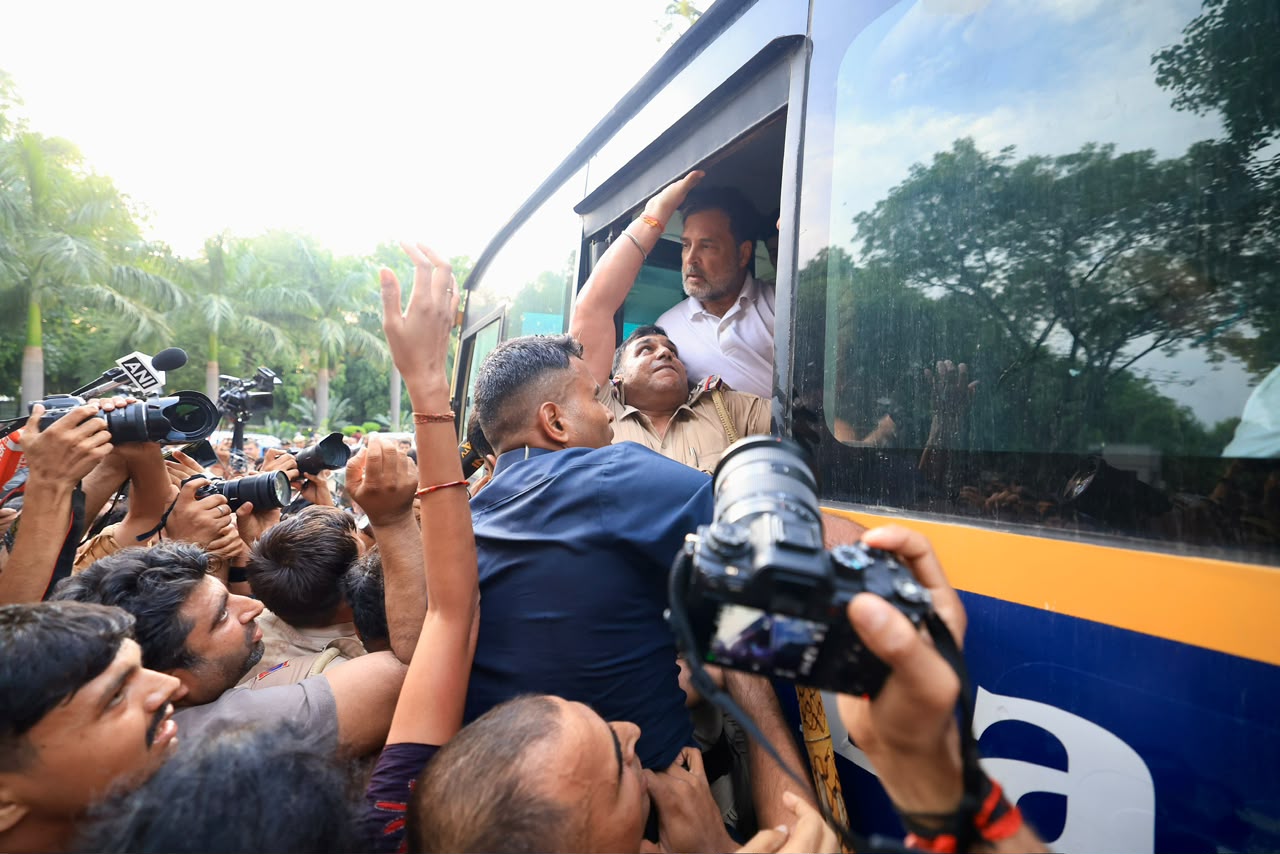
Rahul Gandhi didn’t drive to Lok Kalyan Marg. He walked roughly seven kilometres from Mallikarjun Kharge‘s residence, past barricades that kept multiplying by the hour, until he reached the gates closest to the Prime Minister’s home. That detail matters more than most headlines gave it credit for. A car ride says “protest.” A seven-kilometre walk, in Delhi’s July heat, with Priyanka Gandhi Vadra, Kharge, and a trail of MPs and workers behind him, says something closer to we’re not leaving until you look at us.
By evening, that message had turned into a full-blown standoff and one that ended, predictably, with police lifting Rahul Gandhi off the ground and carrying him away, Priyanka Gandhi Vadra pushed into a police bus, and Kharge detained alongside them.
But the real story of Tuesday isn’t the detention. Detentions of Congress leaders outside government buildings have become almost ceremonial at this point with a photo-op both sides quietly need. The real story is the twenty minutes in between, when a Union Minister Jitendra Singh walked up to LOP Rahul Gandhi in person, and a deal that should have ended the crisis fell apart over one added condition.
The Deal That Almost Happened
Here’s the part that got buried under the visuals of detention: the government actually blinked first.
Union Minister Jitendra Singh, accompanied by Home Secretary Govind Mohan, was sent to negotiate directly with the protesting leaders lead by LOP Rahul Gandhi, an unusual move for a government that typically prefers silence over engagement. According to Singh’s own account, Rahul Gandhi had initially agreed to call off the sit-in if the Centre committed to a full discussion on the NEET paper leak and the broader student agitation inside Parliament. The government said yes.

And then, as per Singh, Gandhi added a second demand mid-negotiation: Education Minister Dharmendra Pradhan’s resignation, as a precondition to actually winding down the protest.
Whether you read that as principled escalation or a moving goalpost depends entirely on which side of the barricade you’re standing on. Congress would argue that a mere “discussion” without accountability is theatre and Parliament has debated NEET irregularities before, loudly, without anyone losing a chair. Pradhan himself has previously maintained the leak was localized and rare. From the opposition’s chair, agreeing to talk isn’t the same as agreeing to fix anything.
But there’s a harder truth buried in here too: shifting the terms after the other side agrees to your original ask is exactly the kind of move that lets a government walk away looking reasonable with “we said yes, they moved the finish line” is a clean, quotable narrative, and Tuesday evening, it was Union Minister Jitendra Singh’s version making the rounds, not Congress’s.


The Uncomfortable Optics of Arriving Late
Here’s the part almost nobody in the Congress camp wants to sit with: this protest, and the anger fuelling it, didn’t start with Rahul Gandhi. It started with students. The Cockroach Janta Party’s “Chalo Sansad” march a day earlier organised by a group with no political machinery, no MP, no security cover was the one that actually got tear-gassed and lathi-charged on Monday. Their founder, Abhijeet Dipke, spent Tuesday morning apologising to injured supporters and cleaning up what was left of the protest stage after police tore down the tents overnight.
Congress arrived a full day later, with security details, media vans, and a seven-kilometre symbolic walk.
That’s not a criticism of the cause but the outrage over the NEET paper leak, the alleged UGC-NET irregularities, and the CBSE evaluation mess is real, and student deaths linked to the fallout are not a talking point, they’re a tragedy. But there’s a reason the optics of a national party stepping into a grassroots student movement on day two, and immediately making the story about the Prime Minister’s resignation rather than the students’ demands, invite an uncomfortable question: whose protest is this now?
It’s a question AAP has quietly been circling too as its leaders, including Sanjay Singh, Manish Sisodia, and Arvind Kejriwal, were visibly present at the original Jantar Mantar site well before Congress showed up at Lok Kalyan Marg, and AAP separately pushed for a Rajya Sabha discussion on the same issues through parliamentary notice, not street theatre. When two opposition parties chase the same moral high ground on the same news cycle, the “who got there first” fight tends to matter more to the parties than it does to the students who are actually the reason any of this is happening.

What Actually Changes Tomorrow
Strip away the visuals of the detentions, the walk, the police bus and ask what changes when Parliament reconvenes. Probably not much, immediately. The government has now publicly committed, on record, to a NEET discussion in the House, which gives Congress a genuine win it can bank even without Pradhan’s resignation attached. That commitment exists now because of pressure, not goodwill, and pressure from an opposition alliance, however messily coordinated got a debate on the table that might not have happened otherwise.
The resignation demand, though, is where this stalls. Governments rarely fire ministers under street pressure mid-session; it reads as capitulation. If Pradhan goes, it will likely be through a reshuffle timed to look unconnected, not a resignation announced from a protest site.
What Tuesday really revealed wasn’t a victory or a defeat for either side. It was a preview of how this entire Monsoon Session will probably run: genuine grievance, real negotiation, a half-agreement that gets reframed by both sides as either capitulation or backbone, and a student movement that started this fight now watching two much bigger parties argue about who gets to finish it.