

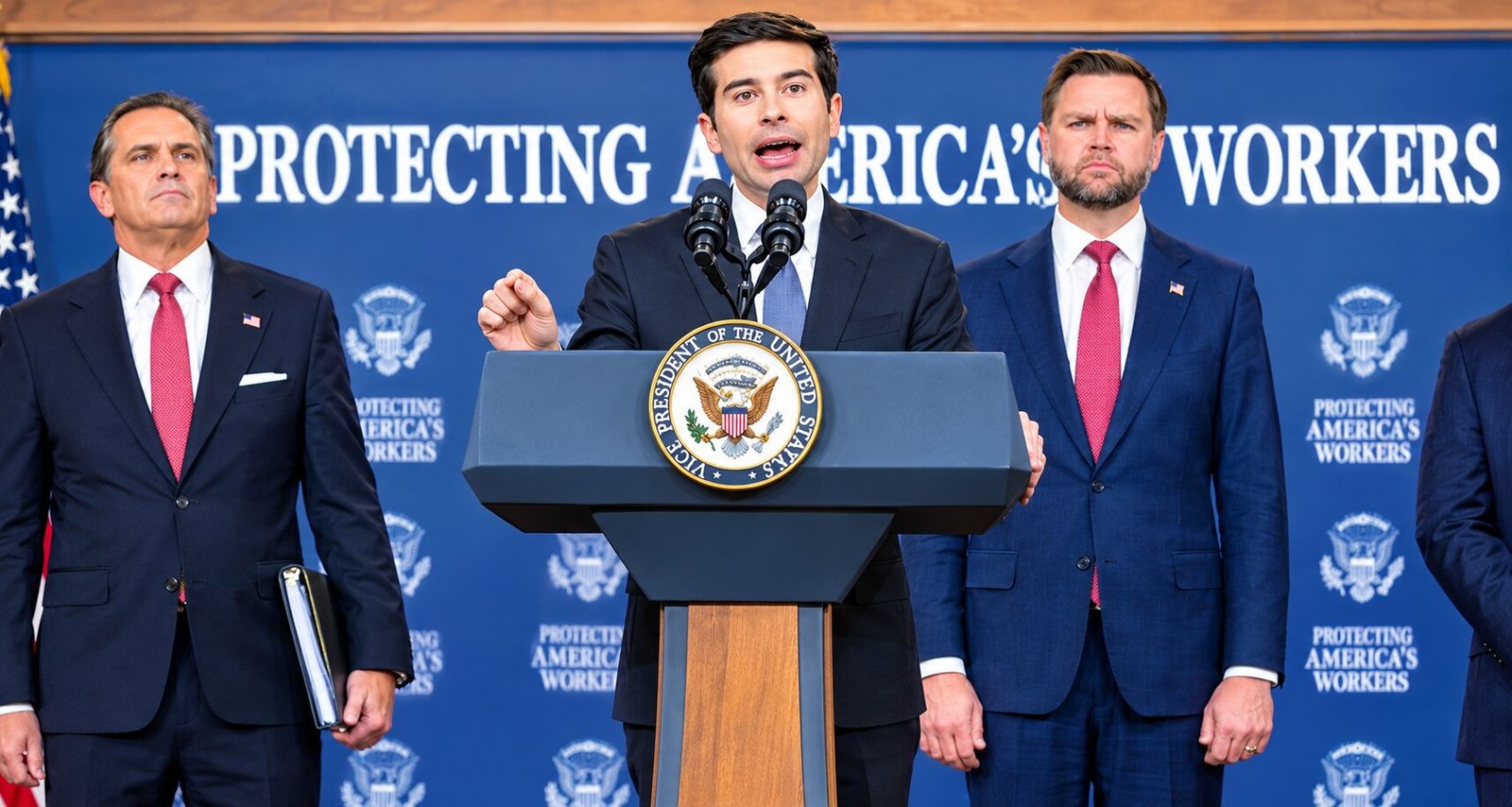
On Thursday, a White House podium did something immigration policy rarely does: it named names. Labor Secretary Keith Sonderling, with JD Vance beside him, announced that Indian IT major like Cognizant, Infosys, Tata, Wipro, HCL and Capgemini are suspended from the Permanent Labor Certification Program (PERM), and that Microsoft and Adobe are suspended too, citing multiple active federal ongoing investigations.
If you’ve never heard of PERM, think of it as the toll booth before the green card highway. Before an employer can sponsor a foreign worker for permanent residency, the Labor Department has to certify that no qualified American was available for the job. No certification, no I-140, no green card. The booth just closed for eight of the biggest names in tech world.
What the US government says
Labor Secretary Keith Sonderling’s argument rests on volume. He said the companies have requested nearly three million foreign workers since 2009, which he argues shut Americans out of the job market. Vice President JD Vance focused on Microsoft, alleging that it laid off 6,000 Americans in 2025, then received more than 6,000 H-1B approvals and filed 3,682 PERM applications, nearly 1,000 of them for roles involving laid-off workers.
What is actually frozen
The Department will neither accept new PERM applications from these companies nor process pending ones, and no end date has been announced. The same law firm notes there is no written announcement yet. Importantly, the suspension doesn’t cancel H-1B status, PERM certifications already approved, or USCIS-approved I-140 petitions.
One caution: a suspension isn’t a finding of fraud. One outlet’s roundup flagged exactly that.
India pushes back
New Delhi, has strongly rebuked US Vice President JD Vance for describing foreign tech workers as “indentured servants”, calling the comments “deeply offensive” and “unwarranted.” It also stressed that PERM is separate from H-1B, so existing visas and dependents aren’t directly affected. But the green card path for affected employees is. India’s argument is that talent mobility benefits both economies.

Who really gets hurt (analysis)
The first victims aren’t the companies. They’re the people already here: engineers who’ve paid taxes for eight or nine years, bought homes and had children, whose green card clock just stopped. For Indian nationals, who already face one of the longest green card queues, a frozen PERM adds uncertainty to a wait that was already measured in years.
A hidden risk: H-1B holders past their six-year limit can often extend only if a PERM or I-140 process started early enough. A frozen pending PERM may complicate those extensions. Whether it does will depend on guidlines not yet written.
The contradictions
- PERM sponsors people who are mostly already on the payroll. Freezing it doesn’t open a single job for an American directly. It makes existing workers harder to retain.
- Cognizant is a US-listed company, and Capgemini is French. Calling this an “Indian IT crackdown” is convenient shorthand, but it’s inaccurate.
- Vice President JD Vance has also said the H-1B programme is “completely broken” and should be scrapped. A PERM freeze may be a trial run for something bigger sooner or later.
Vance’s Microsoft math is uncomfortable, and the critics have a point. Layoffs in one team alongside sponsorships in another can look like substitution, whether or not it is. Companies that wanted public trust should have kept cleaner records. The counter-argument: a system loose enough that this looks plausible is a system Congress never fixed.
Uncommon scenarios
- The poaching wave. Mid-size US firms and non-suspended competitors can now recruit stranded talent with one pitch: “We can still sponsor you.”
- Work moves instead of people. Indian IT firms have spent years localising their US workforce. Expect their offshore delivery centres in India to absorb more work.
- The golden handcuff snaps. Sponsorship kept many employees loyal. Without it, attrition at affected firms could rise, and the people leaving may be exactly the ones the firms most wanted to keep.
- The exception. The firms that win may be the ones that never relied on any single visa route. Diversified talent pipelines will beat visa-dependent ones.
What happens to US companies?
In the short term, US clients of the affected firms could see slower project staffing and rising rates and costs. In the long term, the pressure will push companies toward remote and offshore hiring. Skilled work doesn’t vanish when visas do. It relocates. If the policy goal is American jobs, there’s a real risk it produces Indian jobs instead.
Unheard tips for affected workers
- Check your stage. If your I-140 is approved, you may keep your priority date even if you change employers. An immigration attorney can confirm this for your case.
- Don’t panic-resign. Leaving before you understand your status can cost you more than staying.
- Keep your paper trail: receipts, approval notices, pay stubs and tax records.
- Watch official notices, not WhatsApp forwards.
The bottom line
The government is saying it wants American workers hired first. The workers paying the price, though, are mostly people who were already hired, already here and already paying into the system. Whether this becomes a reasoned correction or a blunt instrument depends on what the Labor Department publishes next.
Bharatnewsupdates International Insight Team ⊥ October 2026, 9