

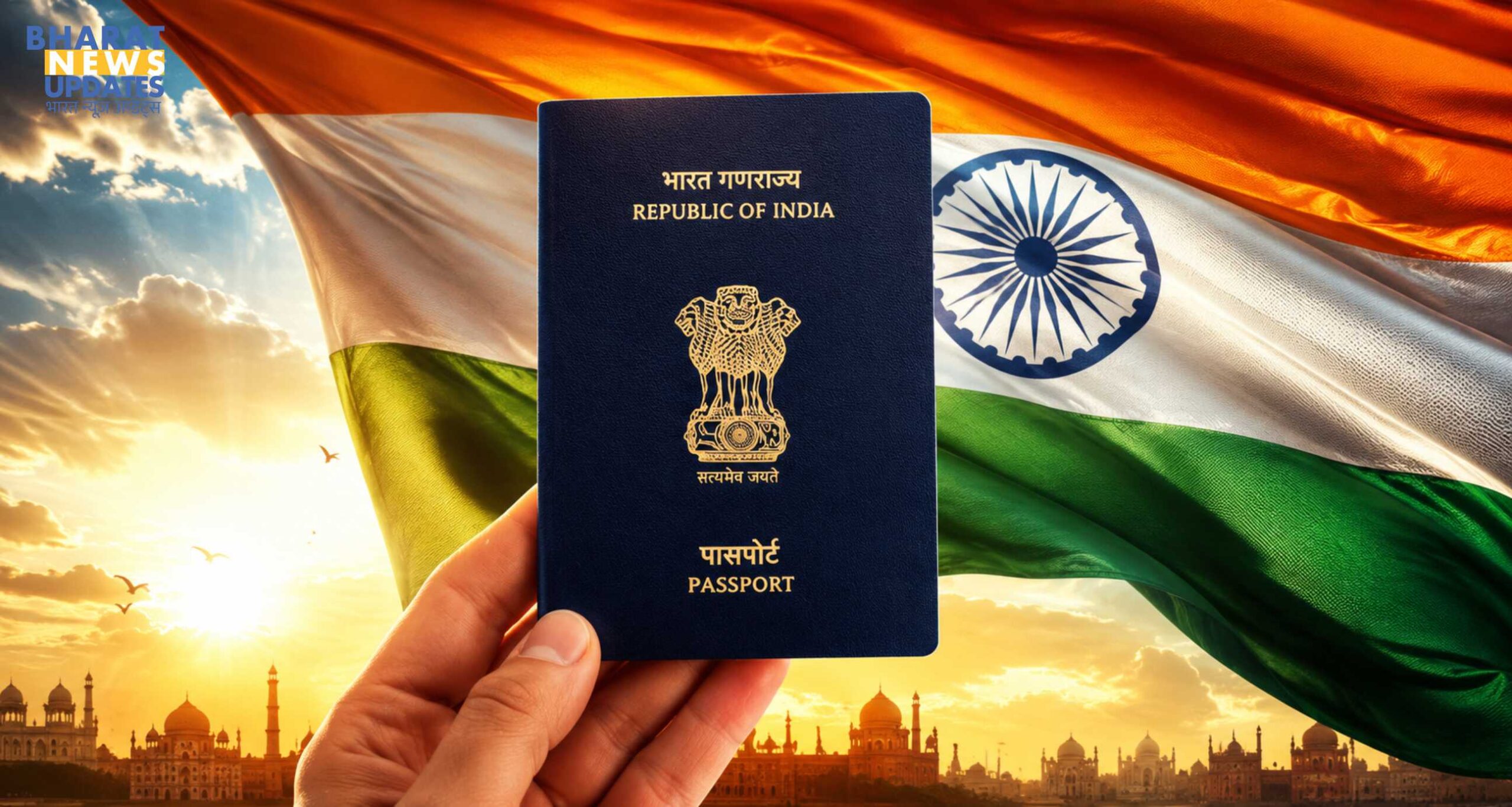
If you’ve seen three different headlines this year claiming India’s passport both climbed and fell in the Henley Passport Index, you’re not losing your mind. Both are true. That’s the first thing nobody explains properly about passport rankings, they’re not a scoreboard of your country’s strength. They’re a leaderboard, and leaderboards move even when you don’t.
Here’s the actual timeline for 2026, and it reads like a heart-rate monitor: India was 85th in 2025. It jumped to 80th in January. Climbed further to 75th in February 2026, its best showing in over a decade. Slid to 78th in May. Dropped back to 80th on July 3. And in the latest update, released July 21, it sits at 81st, with visa-free or visa-on-arrival access to 55 destinations, down from 57 last year.
So which is it and is the Indian passport getting stronger or weaker? The honest answer is: neither, really. It’s getting repositioned, and the reasons are far stranger than “India is doing better” or “India is doing worse.”
The index isn’t measuring you. It’s measuring everyone, relative to you.
The Henley Index compiled using entry data licensed from the International Air Transport Association (IATA), covering 199 passports against 227 destinations with ranks countries purely by how many places their citizens can enter without a prior visa. But because it’s a relative rank among 199 countries, your position can rise even while your actual travel access shrinks. That’s exactly what happened in early 2026: India lost destinations, but other countries lost more, so India floated upward anyway. Henley’s own chairman, Christian Kaelin, has pointed out that mobility now clusters almost entirely around wealthy, politically stable nations meaning the middle of the table shuffles constantly while the top and bottom barely move at all.
The Iran story nobody expected
Here’s the part that rarely makes it past the headline. Iran had waived visas for ordinary Indian passport holders specifically to boost tourism and strengthen Central Asian ties. It worked as Indians flocked to Tehran’s Grand Bazaar and Shiraz’s blue-tiled mosques without a single form to fill. Then, in November 2025, Iran pulled the plug entirely. Not because of diplomacy or politics, but because the free-entry route was reportedly being exploited by agents running trafficking and job scams targeting Indian travelers, according to India’s own Ministry of External Affairs. A perk built for tourists ended up dismantled because of criminals and ordinary travelers paid the price with a lost visa-free destination. Bolivia quietly shut its visa-on-arrival counter for Indians around the same time, for entirely separate administrative reasons and so is the Cape Verde and Nicaragua.
On the flip side, Malaysia extended a genuine 30-day visa-free stay (you still need a digital arrival card, so “visa-free” doesn’t mean paperwork-free), and Kazakhstan opened its doors as part of a deliberate push to court Indian tourists and investors into Central Asia. Two gained, several lost, a “two steps forward, four steps back” year, as one analysis put it.

The list, as it stands today
Genuinely visa-free: Angola, Barbados, Bhutan, British Virgin Islands, Cook Islands, Dominica, Fiji, Grenada, Haiti, Jamaica, Kazakhstan, Kiribati, Macao, Malaysia, Mauritius, Micronesia, Montserrat, Nepal, Niue, Rwanda, Senegal, St Vincent and the Grenadines, Thailand, Trinidad and Tobago, Vanuatu, and a handful more.
Visa-on-arrival or e-visa (ETA): Burundi, Cambodia, Cape Verde, Djibouti, Ethiopia, Guinea-Bissau, Indonesia, Jordan, Kenya, Laos, Madagascar, Maldives, Marshall Islands, Mongolia, Mozambique, Myanmar, Philippines, Palau, Qatar, Samoa, Seychelles, Sierra Leone, Somalia, Sri Lanka, St Kitts and Nevis, St Lucia, Tanzania, Timor-Leste, Tuvalu, and Zimbabwe.

The hidden contradiction: India ranks below China and the Maldives and it barely matters
On paper, India (81st) sits behind the UAE (2nd), China, and the Maldives. But rank position and real travel freedom for an average Indian traveler don’t line up neatly. Nepal and Bhutan, for instance, don’t even require a passport from Indians, a voter ID or an Aadhaar-linked ID gets you across the border, a privilege almost no other nationality on Earth enjoys in those two countries, “stronger” passport or not. That’s a special-treaty quirk the Henley Index counts as one line item, but for Indian travelers it’s practically a domestic hop.
Meanwhile, two entirely different global mobility trackers exist alongside Henley, and they don’t agree with each other at all. The Global Passport Index (built by Global Citizen Solutions, factoring in investment migration and quality-of-life data, not just visa rules) places India around 125th overall and 135th–136th purely on mobility, a gap of over 50 places from Henley’s number for the exact same passport. Rankings, it turns out, are opinions wearing a lab coat.
The friendliest places for an Indian passport right now
If low hassle is your goal, skip the “visa-free” label and look at actual friction. Thailand, Malaysia, Indonesia, Sri Lanka, and the Maldives run some of the smoothest entry systems for Indians anywhere mostly digital arrival cards or on-the-spot stamps, done in under two minutes. Mauritius and Seychelles pair visa-free entry with some of the least intrusive immigration questioning globally, a small but real detail frequent flyers notice. Fiji, Jamaica, and Barbados round out a surprisingly generous Caribbean-Pacific bloc most Indians don’t even think to check.
Two things happening at home that have nothing to do with any of this
While the rankings bounced around, India’s own Ministry of External Affairs clarified something many people misunderstood for years: a passport is a travel document, not proof of citizenship on its own, a statement that triggered its own round of public debate. Separately, passport fees were revised on July 1, 2026, for the first time in 14 years. Neither change has any bearing on the Henley Index, but both landed in the same news cycle, which is how confusion snowballs with three unrelated stories, one blurred narrative.
The real takeaway
Don’t read the rank number and stop there. Read the list. A 6-place slide sounds alarming until you realize it’s mostly two lost destinations reshuffling India’s position among 198 other countries also in motion. The passport in your drawer opens fewer doors than Singapore’s, sure but more than most people assume, and in places (Nepal, Bhutan, much of the Indian Ocean) where the welcome mat has less to do with any index and everything to do with history.