

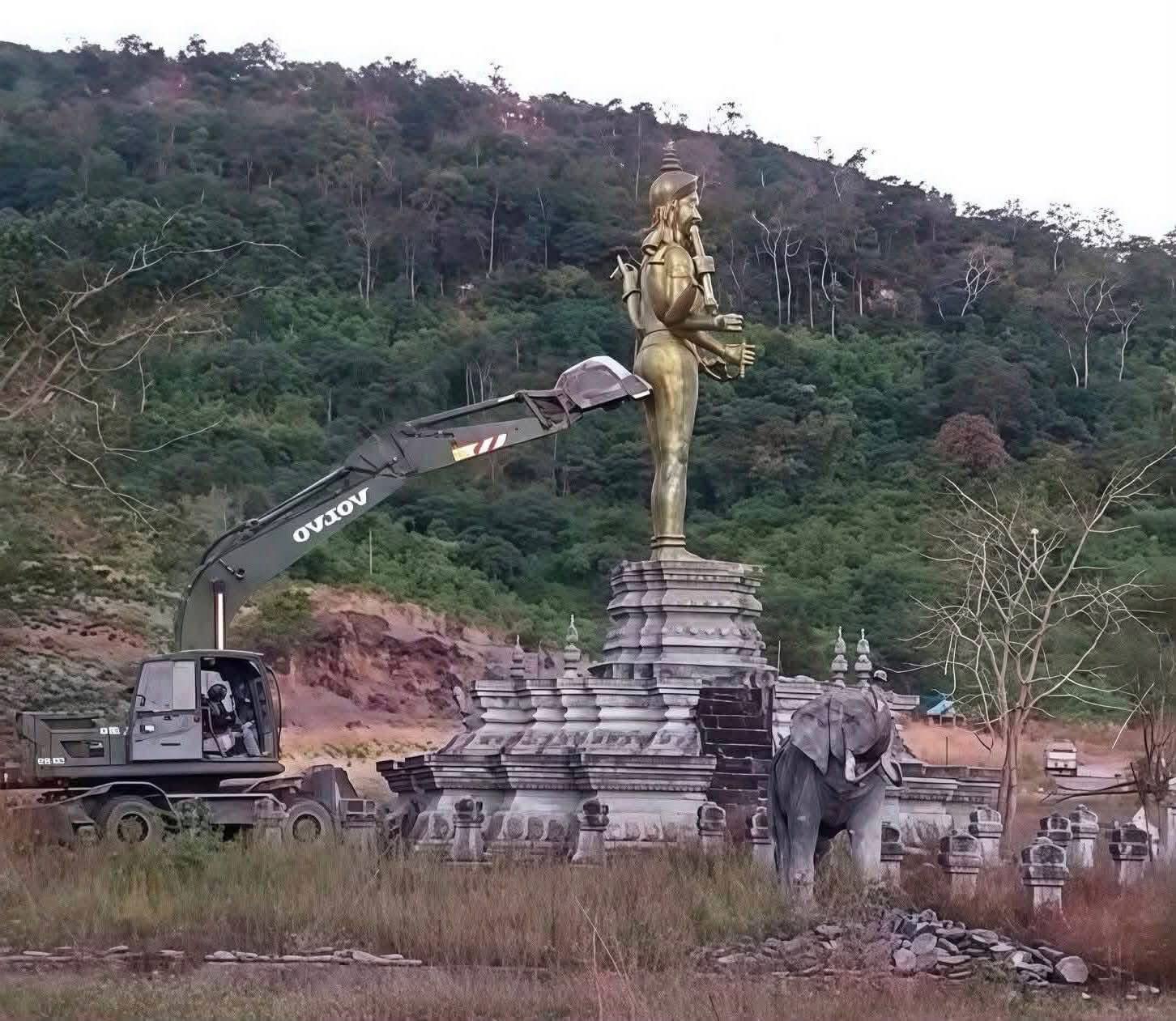
Few images and a short video, shaky and grainy, has been quietly trending across screens around the world. It shows a bulldozer demolishing into a large hindu statue of Lord Vishnu, reducing sacred idol in to pieces.
The entire demolition, reportedly carried out by Thai soldiers inside captured Cambodian territory, lasted only minutes — but its emotional and cultural pain on hindu faithful has spread far beyond the disputed border where it occurred.
This was not merely the demolition of a statue. It was the wiping out of something deeply religious — a reminder that in modern conflicts, faith and heritage are often the first silent casualties. The incident took place inside the Cambodian border recently captured by Thailand.
This is a disputed area between Cambodia and Thailand, where maps blur and history weighs heavy.
On this incident, India’s Ministry of External Affairs released a statement pointing that territorial disputes cannot justify destruction to religious symbols.
Speaking to the media, MEA spokesperson Randhir Jaiswal underlined a simple but powerful truth: when sacred icons are damaged, it is not borders that are wounded — it is the collective sentiment of believers across the world.

Lord Vishnu is revered by over a billion Hindus globally, but his presence in Southeast Asia tells a larger story. Hindu and Buddhist traditions have shaped the region’s art, architecture, and philosophy for centuries. Temples, statues, and shrines scattered across Cambodia, Thailand, Indonesia, and beyond stand as evidence of a shared civilizational inheritance, one that predates modern nation-states.
It is precisely this shared golden heritage that now appears under threat and destruction. Cambodia’s Ministry of Culture and Fine Arts has issued a strong denunciation, accusing Thai forces of carrying out deep incursions into Cambodian sovereign territory.
According to the ministry, the Vishnu statue was not an isolated incident. It was part of a broader pattern of destruction involving ancient temples, civilian homes, and cultural landmarks, including the revered Preah Vihear Temple, a UNESCO World Heritage Site.

The ministry described the destruction of both the Vishnu statue and the Ta Om statue — objects of active worship — as an act that reflects a disturbing disregard for culture, religion, and international norms. Over the past weeks, three ancient Khmer temples have reportedly been damaged, with one nearly obliterated.
Such acts resonate far beyond Southeast Asia. International conventions exist precisely to protect
cultural heritage during conflict — because once destroyed, history cannot be rebuilt. Heritage can be replaced; legacy cannot.
India, while yet to issue a formal diplomatic response, has urged restraint and dialogue. New Delhi has emphasized that escalation risks not only human lives — already lost in significant numbers — but also irreplaceable cultural memory.
The appeal is clear: peace is not only about cease-fire, but about preserving and protecting what makes peace worth having.
Encouragingly, military officials from Thailand and Cambodia have begun discussions aimed at restoring calm. The talks, though fragile, signal recognition that continued conflict serves no one. After over two weeks of clashes and dozens of deaths, the region stands at a crossroads.
The bulldozer that crushed the Vishnu statue may have been guided by military orders, but the consequences reach into the moral realm.
The question now confronting the international community is not just who controls a piece of land — but whether humanity still recognizes the value of faith, history, and restraint in times of conflict.
When sacred symbols fall, they remind us of something uncomfortable yet essential: wars do not only redraw borders —they test our collective conscience.