Connect with us

Politics

From Bankipur-Bihar, to the BJP Core Delhi – The Signal Behind BJP’s Surprise Choice of Nitin Nabin Sinha

Published

on

Nitin Nabin Sinha

On 13 December evening, Indian PM Modi wrote on X –

Shri Nitin Nabin Ji has distinguished himself as a hardworking Karyakarta. He is a young and industrious leader with rich organisational experience and has an impressive record as MLA as well as Minister in Bihar for multiple terms. He has diligently worked to fulfil people’s aspirations.

He is known for his humble nature and grounded style of working. I am confident that his energy and dedication will strengthen our Party in the times to come. Congratulations to him on becoming the BJP National Working President.

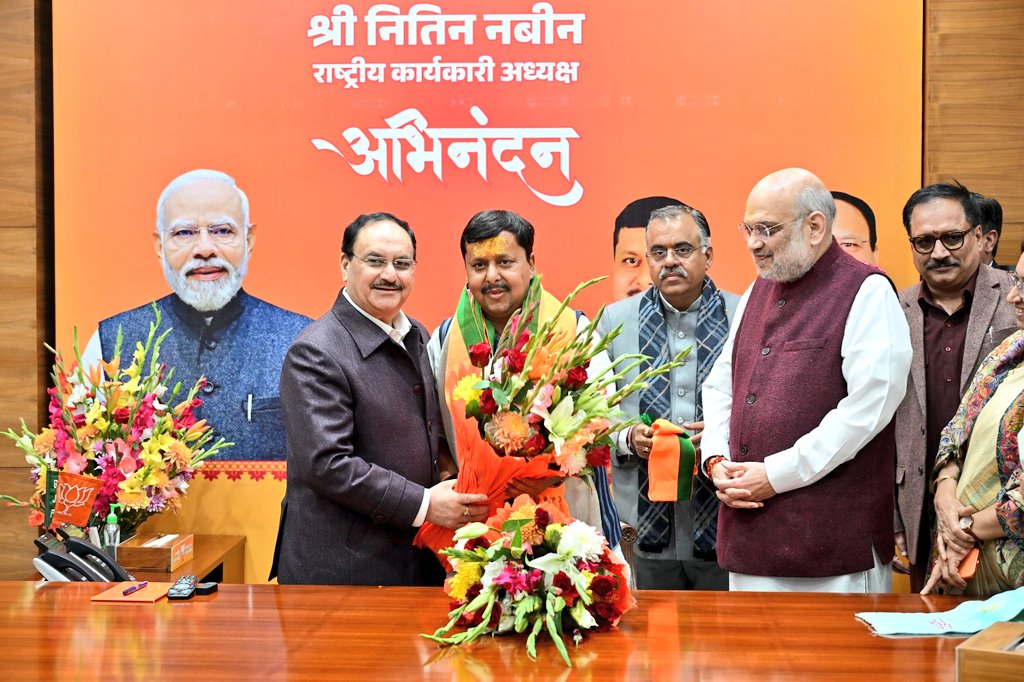
As usual the BJP gave an eye-popping surprise to everyone by announcing a young politician, a 4-time MLA from Bankipur-Bihar, Nitin Nabin Sinha as BJP National Working President till the appointment of BJP’s next president, superseding JP Nadda from Himachal Pradesh.

The outgoing BJP’s 11th national president, Jagat Prakash Nadda, appointed in January 2020, has already completed his full term. He is already on extensions and led the party for 5 years through many wins and organizational changes, including the 2024 Lok Sabha elections.

For a couple of months, the media, many distinguished political analysts, Tweeterjeevi, and Instajeevi were suggesting various names like Agriculture Minister Shivraj Singh Chouhan, Union Minister Dharmendra Pradhan, Union Minister Bhupendra Yadav, BD Sharma, former Haryana Chief Minister Manohar Lal Khattar…the more the mouth, the more the probable candidate’s name.

Who is Nitin Nabin Sinha :

Nitin Nabin Sinha is the son of late Nabin Kishore Prasad Sinha, a strong BJP leader participated in JP movement, who died at the age of 55 year when Nitin Nabin was just 26 years of age. He passed his intermediate education in 1998 from C. S. K. M. Public School, Delhi.

Carrying forward his father’s legacy, On of youngest Nabin entered the Bihar Assembly by polls in 2006 due to his father’s sudden death from the Patna West seat. After constituency delimitation, He was re-elected second time as an MLA subsequently from Bankipur, Patna district in 2010 Bihar assembly election at the age of 30 years.

He is representing the Bihar Assembly from Bankipura from 2010, 2015, 2020, and the recently held Bihar election in November 2025, defeating his nearest opponent, Rekha Kumari of RJD, by the massive margin of 51,936 votes, proves his strong on-the-ground work and hold on the masses in his constituency.

Nitin Nabin’s Role In Bihar Government :

Nitin Nabin With CM Nitish Kumar & dCM Samrat Choudhary

Nabin’s rise in the BJP has been marked by a blend of organizational acumen and administrative experience.

Nabin has successfully held the various responsibilities in the Bihar Government as a minister. He held the Road Construction Portfolio in the Bihar Cabinet from 9th February 2021 to 9th August 2022.

He took the oath as the Minister of Law & Justice from 15 March 2024 to 26 February 2025.

Presently, Nitin Nabin holds the road construction portfolio as a minister in the longest-serving Bihar CM Nitish Kumar-led JDU-BJP alliance from 20th November 2025.

As a minister, Nitin Nabin has extensive exposure related to road infrastructure development, urban housing, and welfare development, urban housing and welfare development, as well as various state welfare schemes for journalists and incentives for ASHA and Mamta workers.

His organizational devotion and the outcome are equally significant. Nabin has successfully shouldered some key positions within the Bharatiya Janata Yuva Morcha (BJYM), youth wing, including the national executive committee member, the national general secretary, and the state president in Bihar.

He was appointed as BJP’s election in-charge for Sikkim in 2019 as well as the state in-charge of Chhattisgarh, where the party won the election with an absolute margin. Due to these successful roles, a zero criminal record, and an honest track record coupled with an ordinary-level common man connection, he has been elevated today to the BJP National Working President position.

What Is BJP’s strategy by appointing young Nitin Nabin Sinha :

Being the largest and ruling party in India under the leadership of PM Modi, today BJP is in its new transitory phase, and this transition is the need of the hour.

If BJP wants to remain in power for the next 25 years, it needs to rope in on-the-ground connected minds full of intelligence and wisdom. It has to prioritize grooming ground-level talents, Yuva minds with brilliancy, to handle the key positions in time to come and Bihar-based 45-year-old Nitin Nabin fits the bill due to his past and present consistency, reliability, and taking forward the party’s national agenda to the core amongst the masses.

Today, those parties who are still sticking to or relying on leaders, who are losing mass base, have no revolutionary idea to offer have no progressive vision for the future of Indian people in mind and have no awareness of the changing geopolitical scenario.

Hence, day by day they are eroding their mass base and their footprint shrinking day by day.

In comparison, the majority of the political parties continue to be governed by long-standing or remote-controlled leadership whose authority remains largely unchallenged in the organization.

While these leaders may command allegiance and political expertise, the analyst believe that long unchallenged power at the top can destroy growth and minds due to lack of the opportunity and
the responsible vision.

Today India’s oldest grand party, Congress, is run by remote-controlled 83-year-old president Mallikarjun Kharge, and hence It’s shrinking day by day due to a lack of understanding of the nation’s pulse.

Ageing Lallu Prasad Yadav, who is not so good on the health front is the president of the family-run party RJD, and as a result, it has lost the Bihar election despite the anti-incumbency wave against JDU-BJP
ruling alliance in the state. The same is being true with many other political parties like Samajwadi, TMC, JMM, etc.

The BJP working brains are continuously identifying, investing in, and grooming leadership faces who could shape state or central politics over the next decade, allowing them to accumulate and gain governance experience at the earliest.

Selecting or re selecting the Chief Minister faces in Rajasthan, Maharashtra, Chattisgarh, Odissa, Madhya Pradesh, Tripura, Assam in itself is the case studies for the oppositions or the political analyst who are closely monitoring the BJP’s rejig strategy.

Political analysts note that the BJP’s present leadership at the top is structuring a well-planned strategy on succession planning and long-term organizational challenges. Over the past decade, the party has consistently projected fresh and effective leaders who are expected to perform politically active for years rather than relying solely on old-hand figures like LK Adavani nearing the twilight of their careers.

For many observers, the selection of Nitin Nabin as National Working President is not just about selecting a young and committed leader but also about encouraging and empowering the grassroots workers with balanced regional power representation.

With Nitin Nabin’s elevation, due to his experience and zeal to steer the party through the quickly changing political scenario, it will be effectively observed and monitored further during organizational progresses, upcoming elections and events during his tenure.


The BJP’s prominent party leaders have applauded the appointment of Nitin Nabin as the Party Working President.

The country’s one of the respected BJP leader and the CM of Uttar Pradesh Maharaj Yogi Adityanath tweeted –

“Mr. Nitin Nabin, heartfelt congratulations to you on being appointed the Working President of @BJP4India!

Under the dynamic leadership of our ideal Prime Minister, Shri @Narendra Modi, you will surely succeed in further strengthening the sacred resolve of ‘Nation First’ among every party worker.

We are confident that under your guidance, the Bharatiya Janata Party will give new dimensions to its core principles of welfare of the poor, good governance, and public participation, and will accelerate the resolve for a ‘Developed India’ at every step of the organization, reflects the sentiments and mission with which BJP is working on for the India.

Continue Reading
Click to comment

Leave a Reply

Your email address will not be published. Required fields are marked *

Politics

UP Voter List Shake-Up: Nearly 3 Crore Names Missing in Draft Roll After Special Intensive Revision (SIR), Cities Lead Deletions

Published

on

Bharatnewsupdates : UP SIR Draft 6 Jan 2026

The Election Commission’s Special Intensive Revision (SIR) of the Uttar Pradesh voter list has thrown up startling numbers. The draft electoral roll, released on Monday, shows that nearly 3 crore voters are missing compared to the previous list — a development that is likely to trigger political debate and voter anxiety ahead of future elections.

Addressing a press conference in Lucknow, Uttar Pradesh Chief Electoral Officer Navdeep Rinva said the new draft roll contains 12,55,56,025 voters, down from 15,44,30,092 voters in the existing list.

In simple terms, 18.7 per cent of voters from the old list do not feature in the new draft roll.

The exercise during SIR

According to election officials, the SIR process involved door-to-door verification by Booth Level Officers (BLOs), collection of enumeration forms, and categorization of voters based on their current status.

Out of the total electorate:

81.3 per cent voters submitted their enumeration forms
2.89 crore names were dropped from the draft list

The deletions fall into four broad categories:

Break-up of deleted voters

  1. Deceased voters: 46.23 lakh names (2.99%) were removed after being verified as dead.
  2. Shifted voters: The biggest chunk — 2.17 crore voters (14.04%) — were marked as having shifted residence and could not be traced at their registered address.
  3. Duplicate entries: 25.47 lakh names (1.65%) were deleted as they appeared more than once in the rolls.

Election officials maintain that these corrections are essential to clean up voter rolls and eliminate ghost or duplicate voters.

However, the sheer scale of “shifted” voters has raised eyebrows.

Top districts with maximum Voter deletions

  1. Lucknow – 12,00,138 voters removed
  2. Prayagraj – 11,56,305 voters removed
  3. Kanpur Nagar – 9,02,148 voters removed

Other major districts with high deletions include:

  1. Agra: 8,36,943
  2. Ghaziabad: 8,18,139
  3. Meerut: 6,65,635
  4. Gorakhpur: 6,45,625

Officials admit that in several urban districts, more than one-fifth of the electorate was marked “uncollectable” due to people moving houses, changing cities for jobs, or living at temporary addresses.

Border districts also show concern

Apart from cities, border and migration-prone districts such as Bahraich, Shravasti, Balrampur, Siddharthnagar and Maharajganj reported a large number of voters marked absent or untraceable.

These districts often see seasonal migration, cross-border movement, and weak documentation, making voter verification challenging.

How to check if your name is deleted

Bharatnewsupdates - UP EC CEO Navdeep Rinwa

Uttar Pradesh Election Commission Chief Electoral Officer (CEO) Navdeep Rinva urged citizens to check their status immediately.

Voters can visit:

ceouttarpradesh.nic.in
voters.eci.gov.in

Names are listed under the ASDDR category:

  1. A – Absent
  2. S – Shifted
  3. D – Dead
  4. D – Duplicate
  5. R – Refused enumeration

The SIR 2026 draft roll is available for download on the ECI website.

What to do if your name is missing

If a voter’s name does not appear in the draft list:

Form-6: For inclusion of name (new or deleted voters)
Form-6A: Overseas voters
Form-7: Objections or removal
Form-8: Corrections in details

Forms can be submitted through:

  1. Booth Level Officers (BLOs)
  2. Voter Registration Centres at tehsil offices
  3. ECINET mobile app
  4. voters.eci.gov.in

Key dates to remember

Claims & objections period: January 6 – February 6, 2026
Disposal of claims: Till February 27, 2026
Final voter list publication: March 6, 2026

Election officials insist that no genuine voter will be left out if they file claims on time. But with nearly 3 crore names missing in the draft, the coming weeks will be crucial — not just for voters, but for the credibility of the electoral process itself.

Continue Reading

Politics

Karthigai Deepam Must Be Lit: Madras High Court Rejects State’s ‘Imaginary’ Law and Order Fears at Thiruparankundram

Published

on

Bharatnewsupdtes : Illustration of Karthigai temples

In a sharp and unusually candid verdict, the Madras High Court has allowed the lighting of Karthigai Deepam at the Deepathoon (stone lamp pillar) atop Thiruparankundram Hill, firmly rejecting the Tamil Nadu government’s claim that the ritual would disturb public peace.

The Division Bench of Justice G. Jayachandran and Justice K.K. Ramakrishnan observed that it was “ridiculous and hard to believe” that a once-a-year religious ritual, performed by temple representatives on temple land, could threaten law and order—unless such disturbance was “sponsored by the State itself to achieve a political agenda.”

The Court’s words were not casual. They were a direct response to the State administration’s repeated attempts to block the ritual, citing vague and unsubstantiated fears of communal tension due to the presence of a nearby dargah.

What the Court Ordered

Bharatnewsupdates : Madras HC Verdict Deepam

Disposing of a batch of writ appeals, the Bench directed that:

  1. The Temple Devasthanam shall light the Karthigai Deepam at the Deepathoon during the Tamil month of Karthigai.
  2. Only a limited team of 50 temple representatives may access the site.
  3. Public entry will remain restricted, and
  4. The District Collector shall coordinate the event, with safeguards imposed by the Archaeological Survey of India (ASI) to protect the monument.

The Court made it clear that administrative convenience or speculative fears cannot override constitutionally protected religious practices.

Background of the Dispute

The controversy arose after a single-judge Bench directed the temple authorities to light the Deepam at the stone pillar on the hill, a practice
claimed to be part of long-standing tradition.

The State government challenged the order, arguing that:

  • The ritual violated Agama Shastra,
  • It was a newly invented custom, and
  • It posed a serious law and order risk due to the proximity of the Suji Saint dargah.

The Hindu Religious and Charitable Endowments (HR&CE) Department also echoed these concerns, warning that allowing the ritual could “create disharmony.”

Court’s Findings: Law Over Fear

Bharatnewsupdates : Madras HC

Madras HC Madurai Bench Verdict – Court rejects law and order fears, allows controlled lamp lighting at Thiruparankundram hill

The High Court rejected these arguments one by one.

It held that lighting the Karthigai Deepam is a deeply rooted religious and cultural practice, followed across Tamil Nadu and neighbouring regions from time immemorial. Denying such a practice, the Court said, directly impacts Article 25 (freedom of religion), Article 19(1)(a) (freedom of expression), and Article 29(1) (right to conserve culture).

Bharatnewsupdates : Madras HC Verdict Screenshot

On the State’s law and order argument, the Court was blunt. It termed the apprehension an “imaginary ghost”, created more for administrative convenience than public safety.

“Projecting the ritual as a threat to peace is either an exposure of the State’s incapacity to maintain law and order or its hesitation to foster communal harmony,” the Bench noted.

A Larger Constitutional Question

Beyond the immediate dispute, the judgment raises a deeper question: Can a secular State selectively suppress Hindu religious practices under the pretext of public order, while failing to produce any concrete evidence of risk?

The Court answered this decisively in the negative.

It reminded the administration that neutral governance does not mean suspicion towards one faith, and that secularism under the Constitution demands equal respect—not selective restraint.

The Bench also rejected claims that the Deepathoon belonged to the dargah, noting that historical records, including earlier judicial findings, confirmed the land as temple property. The Waqf Board, the Court held, had no locus in the matter.

Verdict with a Message

Bharatnewsupdates : Lord Murugan

By allowing the ritual with clear safeguards, the Court struck a careful balance—protecting religious freedom while ensuring public order.

But its strongest message was reserved for the State.

  • Fear cannot be manufactured.
  • Law and order cannot be hypothetical.
  • And governance cannot be driven by political optics at the cost of constitutional rights.

As per court order, the number of participants in the festival has been restricted to fifty with no animal sacrifice, and the official respondents shall strictly enforce the above directions.

The Karthigai Deepam will now be lit at Thiruparankundram—not because of sentiment, but because the law demands it.

Case Title: The Executive Officer Arulmigu Subramanian Swamy Temple, Thirupparankundram, Madurai v. Rama.Ravikumar and Ors.
[W.A(MD) Nos.3188, 3189, 3204, 3211, 3212, 3213, 3217, 3218, 3219, 3220, 3221, 3222, 3223, 3225, 3226, 3227, 3229, 3230, 3231, 3232 of 2025]

Advocates who appeared in this case:

For the Petitioner: Niranjan S. Kumar for H. Velavadhas
For the Respondents: R. Baskaran, Additional Advocate General a/w M. Muthumanikam, Government Advocate; Veera Kathiravan, Additional Advocate General a/w S. Ravi, Additional Public Prosecutor, S. Vanchinathan; Chandrasekara.

Continue Reading

News

Delhi Riots Case: Supreme Court Denies Bail to Umar Khalid and Sharjeel Imam, Cites Prima Facie Terror Link

Published

on

Bharatnewsupdates-Delhi 2020 Riot Bail Plea Verdict 5 Jan 2026

The Supreme Court of India has refused to grant bail to Delhi riot accused Umar Khalid and Sharjeel Imam in the case related to the alleged larger conspiracy behind the February 2020 Delhi riots. The decision, delivered by a Bench of Justices Aravind Kumar and N.V. Anjaria, holds that the material placed on record by the prosecution discloses a prima facie case against the two accused under the Unlawful Activities (Prevention) Act (UAPA).

With this ruling, both Khalid and Imam will continue to remain in judicial custody, more than five years after their arrest. At the same time, the Court granted bail to five other accused persons in the same case, underlining that bail decisions must be based on individual roles and cannot be decided by treating all accused as equals.

What the Court Found

Reading out key portions of the judgment, the Bench observed that the prosecution material suggests that Umar Khalid and Sharjeel Imam were not mere participants in protests but were allegedly involved in the planning and coordination of events that ultimately led to large-scale violence and deaths. According to the Court, the allegations, if taken at prima facie case at this stage, attract the statutory bar on bail under the UAPA.

The Court noted that the alleged acts went beyond ordinary law-and-order issues. It held that the material indicates deliberate actions that disrupted essential services, caused widespread fear, and posed a serious threat to public order and the economy. Such conduct, the Court said, could fall within the definition of a “terrorist act” under Section 15 of the UAPA, at least for the limited purpose of deciding bail.

Importantly, the judges clarified that at the bail stage, the Court is not required to examine the truth or falsity of the allegations in detail. The legal test is only whether the accusations, on their face, disclose an offence under the special law and whether the evidence shows a reasonable connection between the accused and the alleged acts.

UAPA and the Question of Liberty

The judgment also dealt at length with the tension between personal liberty and national security. The Bench acknowledged that Article 21 of the Constitution, which guarantees the right to life and personal liberty, occupies a central place in India’s constitutional framework. The Court reaffirmed that pre-trial detention should not become a form of punishment.

However, it also pointed out that Parliament, through the UAPA, has laid down stricter conditions for granting bail in cases involving terrorism-related offences. Once the Court is satisfied that the statutory threshold under the UAPA is met, bail cannot be granted merely on grounds such as the passage of time or delay in trial.

The judges made it clear that delay alone does not automatically entitle an accused to bail in UAPA cases, unless the delay becomes so excessive that it renders continued detention arbitrary or unjustified.

Individual Assessment of Accused

A significant aspect of the ruling is the Court’s emphasis on individual assessment. While rejecting bail for Khalid and Imam, the Supreme Court allowed the bail pleas of Gulfisha Fatima, Meeran Haider, Shifa Ur Rehman, Mohd Saleem Khan, and Shadab Ahmad.

The Court held that all accused persons cannot be placed on the same footing. The prosecution material, according to the Bench, suggested a hierarchy of participation, requiring courts to carefully examine the specific role attributed to each individual.

In this context, the judges observed that Khalid and Imam stood on a “qualitatively different footing” compared to the other accused. This distinction, the Court clarified, does not amount to a finding of guilt but is relevant for determining whether the statutory bar on bail applies.

Background of the Case

The case arises out of the violence that broke out in north-east Delhi in February 2020, during protests against the Citizenship (Amendment) Act (CAA) and the proposed National Register of Citizens (NRC). The riots resulted in the death of 53 people, injuries to more than 700 others, and large-scale destruction of property. In the aftermath, Delhi Police registered 753 FIRs across the city.

The prosecution has alleged that the violence was the result of a planned conspiracy aimed at destabilizing the government. According to the police, the accused sought to create conditions of unrest and communal polarization, with the larger objective of “regime change.”

The Supreme Court’s verdict came on appeals challenging a September 2023 order of the Delhi High Court, which had also denied bail to Khalid, Imam, and others, describing their alleged roles as “grave” and holding that their speeches and actions were prima facie aimed at communal mobilization.

Reactions to the Judgment

The ruling drew sharp political and emotional reactions. BJP spokesperson Shahzad Poonawalla welcomed the decision, claiming that it vindicated the stand that the Delhi riots were “organized and sponsored” rather than spontaneous. He also criticized opposition parties for previously defending the accused.

From the victims’ families, reactions were mixed. Hari Solanki, whose son Rahul Solanki died during the riots, said he was thankful that bail was denied to Khalid and Imam. At the same time, he expressed anguish over the bail granted to other accused, reflecting the continued pain and anger among those who lost family members.

On the other hand, Sarim Javed, counsel for Gulfisha Fatima, welcomed the grant of bail to five accused persons, noting that they would be released after spending over five and a half years in jail. He also pointed out that the Supreme Court has directed the trial court to conduct the trial expeditiously and complete the examination of witnesses within one year.

What Lies Ahead

While the Supreme Court has closed the door on bail for Umar Khalid and Sharjeel Imam for now, it has left open the possibility of a fresh bail application after one year. The trial, meanwhile, is expected to proceed at a faster pace, as directed by the apex court.

The judgment once again highlights the difficult balance courts must strike between safeguarding personal liberty and addressing allegations of serious crimes under stringent anti-terror laws. As the trial unfolds, the final determination of guilt or innocence will rest on the evidence tested in court—not on the conclusions drawn at the bail stage.

Continue Reading

Trending