Connect with us

Politics

From Bankipur-Bihar, to the BJP Core Delhi – The Signal Behind BJP’s Surprise Choice of Nitin Nabin Sinha

Published

on

Nitin Nabin Sinha

On 13 December evening, Indian PM Modi wrote on X –

Shri Nitin Nabin Ji has distinguished himself as a hardworking Karyakarta. He is a young and industrious leader with rich organisational experience and has an impressive record as MLA as well as Minister in Bihar for multiple terms. He has diligently worked to fulfil people’s aspirations.

He is known for his humble nature and grounded style of working. I am confident that his energy and dedication will strengthen our Party in the times to come. Congratulations to him on becoming the BJP National Working President.

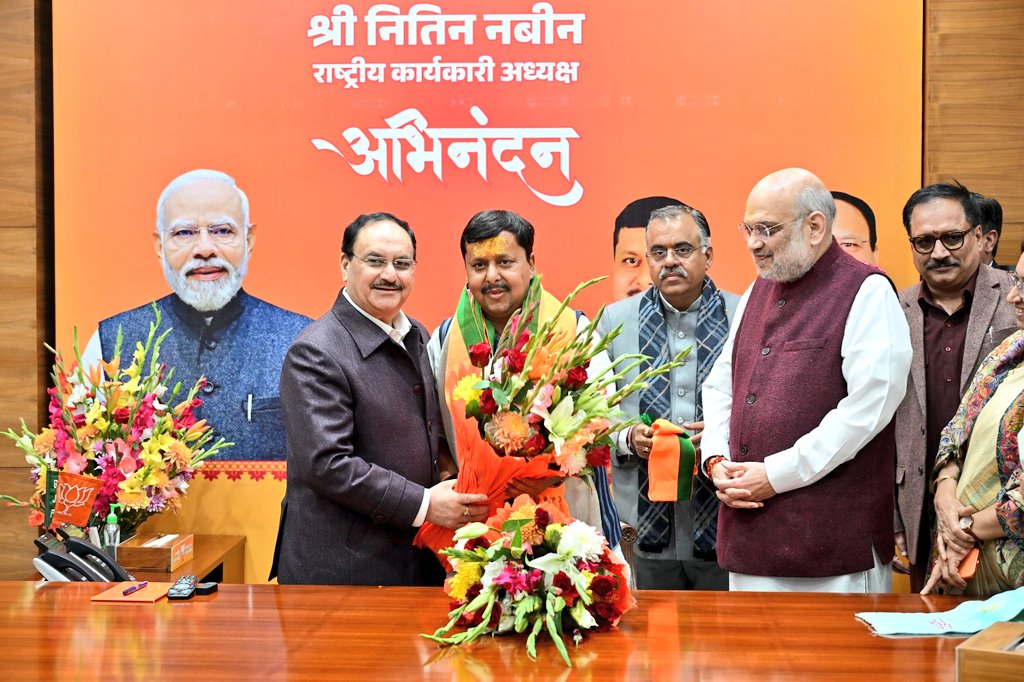
As usual the BJP gave an eye-popping surprise to everyone by announcing a young politician, a 4-time MLA from Bankipur-Bihar, Nitin Nabin Sinha as BJP National Working President till the appointment of BJP’s next president, superseding JP Nadda from Himachal Pradesh.

The outgoing BJP’s 11th national president, Jagat Prakash Nadda, appointed in January 2020, has already completed his full term. He is already on extensions and led the party for 5 years through many wins and organizational changes, including the 2024 Lok Sabha elections.

For a couple of months, the media, many distinguished political analysts, Tweeterjeevi, and Instajeevi were suggesting various names like Agriculture Minister Shivraj Singh Chouhan, Union Minister Dharmendra Pradhan, Union Minister Bhupendra Yadav, BD Sharma, former Haryana Chief Minister Manohar Lal Khattar…the more the mouth, the more the probable candidate’s name.

Who is Nitin Nabin Sinha :

Nitin Nabin Sinha is the son of late Nabin Kishore Prasad Sinha, a strong BJP leader participated in JP movement, who died at the age of 55 year when Nitin Nabin was just 26 years of age. He passed his intermediate education in 1998 from C. S. K. M. Public School, Delhi.

Carrying forward his father’s legacy, On of youngest Nabin entered the Bihar Assembly by polls in 2006 due to his father’s sudden death from the Patna West seat. After constituency delimitation, He was re-elected second time as an MLA subsequently from Bankipur, Patna district in 2010 Bihar assembly election at the age of 30 years.

He is representing the Bihar Assembly from Bankipura from 2010, 2015, 2020, and the recently held Bihar election in November 2025, defeating his nearest opponent, Rekha Kumari of RJD, by the massive margin of 51,936 votes, proves his strong on-the-ground work and hold on the masses in his constituency.

Nitin Nabin’s Role In Bihar Government :

Nitin Nabin With CM Nitish Kumar & dCM Samrat Choudhary

Nabin’s rise in the BJP has been marked by a blend of organizational acumen and administrative experience.

Nabin has successfully held the various responsibilities in the Bihar Government as a minister. He held the Road Construction Portfolio in the Bihar Cabinet from 9th February 2021 to 9th August 2022.

He took the oath as the Minister of Law & Justice from 15 March 2024 to 26 February 2025.

Presently, Nitin Nabin holds the road construction portfolio as a minister in the longest-serving Bihar CM Nitish Kumar-led JDU-BJP alliance from 20th November 2025.

As a minister, Nitin Nabin has extensive exposure related to road infrastructure development, urban housing, and welfare development, urban housing and welfare development, as well as various state welfare schemes for journalists and incentives for ASHA and Mamta workers.

His organizational devotion and the outcome are equally significant. Nabin has successfully shouldered some key positions within the Bharatiya Janata Yuva Morcha (BJYM), youth wing, including the national executive committee member, the national general secretary, and the state president in Bihar.

He was appointed as BJP’s election in-charge for Sikkim in 2019 as well as the state in-charge of Chhattisgarh, where the party won the election with an absolute margin. Due to these successful roles, a zero criminal record, and an honest track record coupled with an ordinary-level common man connection, he has been elevated today to the BJP National Working President position.

What Is BJP’s strategy by appointing young Nitin Nabin Sinha :

Being the largest and ruling party in India under the leadership of PM Modi, today BJP is in its new transitory phase, and this transition is the need of the hour.

If BJP wants to remain in power for the next 25 years, it needs to rope in on-the-ground connected minds full of intelligence and wisdom. It has to prioritize grooming ground-level talents, Yuva minds with brilliancy, to handle the key positions in time to come and Bihar-based 45-year-old Nitin Nabin fits the bill due to his past and present consistency, reliability, and taking forward the party’s national agenda to the core amongst the masses.

Today, those parties who are still sticking to or relying on leaders, who are losing mass base, have no revolutionary idea to offer have no progressive vision for the future of Indian people in mind and have no awareness of the changing geopolitical scenario.

Hence, day by day they are eroding their mass base and their footprint shrinking day by day.

In comparison, the majority of the political parties continue to be governed by long-standing or remote-controlled leadership whose authority remains largely unchallenged in the organization.

While these leaders may command allegiance and political expertise, the analyst believe that long unchallenged power at the top can destroy growth and minds due to lack of the opportunity and
the responsible vision.

Today India’s oldest grand party, Congress, is run by remote-controlled 83-year-old president Mallikarjun Kharge, and hence It’s shrinking day by day due to a lack of understanding of the nation’s pulse.

Ageing Lallu Prasad Yadav, who is not so good on the health front is the president of the family-run party RJD, and as a result, it has lost the Bihar election despite the anti-incumbency wave against JDU-BJP
ruling alliance in the state. The same is being true with many other political parties like Samajwadi, TMC, JMM, etc.

The BJP working brains are continuously identifying, investing in, and grooming leadership faces who could shape state or central politics over the next decade, allowing them to accumulate and gain governance experience at the earliest.

Selecting or re selecting the Chief Minister faces in Rajasthan, Maharashtra, Chattisgarh, Odissa, Madhya Pradesh, Tripura, Assam in itself is the case studies for the oppositions or the political analyst who are closely monitoring the BJP’s rejig strategy.

Political analysts note that the BJP’s present leadership at the top is structuring a well-planned strategy on succession planning and long-term organizational challenges. Over the past decade, the party has consistently projected fresh and effective leaders who are expected to perform politically active for years rather than relying solely on old-hand figures like LK Adavani nearing the twilight of their careers.

For many observers, the selection of Nitin Nabin as National Working President is not just about selecting a young and committed leader but also about encouraging and empowering the grassroots workers with balanced regional power representation.

With Nitin Nabin’s elevation, due to his experience and zeal to steer the party through the quickly changing political scenario, it will be effectively observed and monitored further during organizational progresses, upcoming elections and events during his tenure.


The BJP’s prominent party leaders have applauded the appointment of Nitin Nabin as the Party Working President.

The country’s one of the respected BJP leader and the CM of Uttar Pradesh Maharaj Yogi Adityanath tweeted –

“Mr. Nitin Nabin, heartfelt congratulations to you on being appointed the Working President of @BJP4India!

Under the dynamic leadership of our ideal Prime Minister, Shri @Narendra Modi, you will surely succeed in further strengthening the sacred resolve of ‘Nation First’ among every party worker.

We are confident that under your guidance, the Bharatiya Janata Party will give new dimensions to its core principles of welfare of the poor, good governance, and public participation, and will accelerate the resolve for a ‘Developed India’ at every step of the organization, reflects the sentiments and mission with which BJP is working on for the India.

Continue Reading
Click to comment

Leave a Reply

Your email address will not be published. Required fields are marked *

Politics

From “Kerala” to “Keralam”: The 2,000-Year Journey, From Emperor Ashoka’s Edicts to PM Modi’s Cabinet

Published

on

Bharatnewsupdates - Kerala To Keralam

The Union Cabinet, under the leadership Prime Minister Narendra Modi, approved the proposal to rename “Kerala” as “Keralam.”

For many Malayalis scrolling through their phone screens, the first reaction was: “Wasn’t it always Keralam?”

And honestly, they’re not wrong!

The History Behind Keralam Identity

The land we call home has been “Keralam” in our hearts and tongues for as long as anyone can remember. When we say “Ente Keralam” (my Kerala), the word rolls off the tongue naturally in Malayalam.

But in the Constitution’s First Schedule, it’s been officially recorded as “Kerala” since the states were reorganized on linguistic basis back on November 1, 1956.

But here’s something interesting – the name itself is ancient. Way ancient.

Archaeologists and historians point to Emperor Ashoka’s Major Rock Edict II from 257 BCE, where the term “Keralaputo” appears in Prakrit. That’s “Keralaputra” – son of Kerala.

“एवमपि प्रचंतेसु यथ चोडा, पाडा, सतियपुतो, केरलपुतो, तंबपंनी, अंतियको योनराजा…”

Then there’s Patanjali’s Mahabhashya from around the 2nd century BCE, which uses the exact word “Kerala” while explaining Sanskrit grammar rules.

The Ramayana and Mahabharata? They mention “Kerala” and “Keralas” too. In the Kishkindha Kanda, when Sugriva sends search parties for Sita Maa, he specifically names the Cholas, Pandyas, and “Keralas” in the south.

नदीं गोदावरीं चैव सर्वमेवानुपश्यत । तथैवान्ध्रांश्च पुण्ड्रांश्च चोलान् पाण्ड्यान् केरलान् ।।

By the 11th century, Chola inscriptions at the Brihadisvara Temple in Thanjavur proudly record victories over Chera kings, and there it is – “Kēraḷam” with that distinctive -am suffix that Malayalis instinctively add. The 14th-century grammar text Lilatilakam refers to the region as “Keralam” and calls the local language “Kerala-bhasha.”

So the word “Keralam” isn’t some new invention. It’s been around for centuries. The Keralolpathi, a 17th-century text about Parashurama creating the land, has the word right there in its title.

Why Now? The Politics Behind the Keralam

Here’s where things get a bit tangled.

The Kerala Legislative Assembly passed a resolution on June 24, 2024, unanimously appealing to the central government to change the name from “Kerala” to “Keralam” in the Constitution. The resolution pointed out something obvious – the state’s name in Malayalam has always been “Keralam,” so why not make it official?

The Chief Minister Pinarayi Vijayan-led LDF government sent this request to the Centre. And then…they waited. And waited.

For nearly two years, the file sat somewhere in the corridors of North Block. The Ministry of Home Affairs, under Amit Shah, had to consult the Department of Legal Affairs and the Legislative Department. Everyone had to agree. Concurrence notes had to be written. Files had to
move from one desk to another.

Now, in 2026, with elections not too far away in political calculations, the cabinet has finally given its nod.

The Process Behind Name Change

For those wondering why a state can’t just rename itself – the Constitution has rules for this. Article 3 gives Parliament the power to alter the name of any state. But there’s a process.

First, the state legislature has to pass a resolution. LDF government in Kerala did that in 2024.

Then, the central government considers it. Which they just did.

Next, the President will refer a bill – officially the Kerala (Alteration of Name) Bill, 2026– back to the state assembly for its views. Yes, even though the assembly already passed a resolution, the Constitution wants this specific step. The assembly will express its views (likely the same ones), and then the bill goes to Parliament.

The Ministry of Home Affairs, under Amit Shah, had examined the proposal in consultation with the Law Ministry.

Finally, Parliament votes on it, and if passed, the First Schedule of the Constitution gets amended. “Kerala” becomes “Keralam.”

Even after approval, several administrative steps will be required, including changes in official records, government signage, educational documents, passports, and international references.

Will This Benefit The BJP In Kerala?

Now for the question everyone’s whispering about: Is this a political move?

Kerala has 20 Lok Sabha seats. The BJP has never won a single one. In the 2021 assembly elections, they managed to open their account with two seats, but that’s still a minor presence in the 140-member house.

The BJP has been trying for years to gain a foothold in Kerala. They’ve tried Hindutva, they’ve tried development talk, they’ve tried courting Christian and Muslim communities. Nothing has really worked.

Kerala’s political landscape has traditionally been dominated by the Left Democratic Front (LDF) and the Congress-led United Democratic Front (UDF).

So a name change that the Kerala government itself requested – and that coincide with cultural sentiments – might seem like an easy win.

The BJP can say, “See, we respect your identity. We cleared what your elected state government has asked for.”

But will common Malayalis buy it? The average person on the street in Thiruvananthapuram or Kochi knows that this request has been pending for two years. They know elections are approaching. They’ve seen this game before.

There’s also the fact that renaming doesn’t solve any real problems. It doesn’t fix potholes, create jobs, or improve schools. It’s symbolic politics – sometimes meaningful, sometimes just a distraction.

The Buzz Amongst Malyalis

Walk into any chai kada in Kerala, and you’ll hear mixed reactions. Some people shrug: “We already say Keralam. What changes?” Others are more cynical: “The BJP wants credit for something we asked for ages ago.”

There’s also the practical question: How much will this cost? Name changes mean updating official documents, signboards, government stationery, maybe even maps. That’s public money that could have gone elsewhere.

But there’s genuine sentiment too. For many, seeing “Keralam” in the Constitution feels like respect for the language. Malayalis are fiercely proud of their mother tongue, and if the official records can match what they speak at home, why not?

The Bigger Picture

India has seen many name changes – from Bombay to Mumbai, Madras to Chennai, Calcutta to Kolkata, Orissa to Odisha. Sometimes it feels organic, sometimes politically motivated. But in each case, the argument has been about shedding colonial hangovers or matching local pronunciation.

Kerala’s case is slightly different. “Kerala” isn’t exactly wrong – it’s the Sanskrit version that’s been used for millennia alongside “Keralam.”

The state’s own website is kerala.gov.in. Malayalam newspapers use both.

What makes this interesting is the timing. The BJP, which runs the central government, is approving something a Left-front state government asked for. In India’s polarized politics, that’s almost unusual. It suggests that on cultural-linguistic matters, there can still be some consensus.

Looking Forward

The bill still has to go through Parliament. With the NDA comfortably in power, passage seems certain. By the end of 2026, “Keralam” could officially be on the world map.

Whether this translates into votes for the BJP in 2026 for state election or 2029 for Lok Sabha is another question. Kerala voters are sophisticated. They watch, they analyze, and they rarely vote based on symbolism alone.

For now, though, Malayalis can smile a little. Their state’s name, the one their grandparents used, the one that appears in ancient inscriptions and modern conversations alike, is finally getting its due place in the Constitution.

Keralam it is. Always was, always will be!


Continue Reading

Politics

Youth Congress Leader’s Shirtless Protest: Sparks Shame & Embarrassment for India at AI Summit 2026

Published

on

At moments when a nation stands before the world to present its progress and promise, politics must pause at the threshold of national interest. The recent protest by the Indian National Congress Youth wing at a prestigious AI summit 2026, Delhi did the opposite — it pulled domestic confrontation into a space meant for global collaboration, turning a moment of pride into one of discomfort.

The summit was not a partisan gathering. It was a national platform where global leaders, policy experts, and technology CEOs assembled to witness India’s expanding role in the future of artificial intelligence. Events of such scale are diplomatic theatres as much as policy forums, where perception shapes partnerships and credibility fuels investment.

Yet the shirtless protest “PM is Compromised” led by Indian National Congress youth leaders, with political messaging linked to Rahul Gandhi, diverted attention from innovation to agitation. What should have been remembered for technological ambition instead risked being reduced to headlines of protest and confrontation. In international forums, optics matter — and the optics here were deeply unfortunate.

Democratic dissent is the lifeblood of any republic. But democracy also carries a responsibility: to recognize context, timing, and consequence. Not every stage is appropriate for protest, and not every grievance demands expression at moments of national representation. When political theatre intrudes upon diplomatic showcases, it does not weaken a government alone — it risks diluting the country’s collective image.

What makes the episode particularly troubling is the symbolism. Gate-crashing a summit hosting international delegates sends a message of internal discord at precisely the moment India seeks to project stability, confidence, and technological leadership. The world watches not only policy announcements but political behaviour. The difference between constructive dissent and disruptive spectacle lies in whether the action strengthens national discourse or undermines national credibility.

Some actions, regardless of political motivation, cannot be justified under the broad shield of democratic freedom. Freedom of expression is not a license to disregard national dignity, especially in spaces where India speaks to the world as one voice. Political disagreements are inevitable, but their expression must be measured against the larger canvas of national interest.

India’s rise in emerging technologies is a collective achievement, built across governments, industries, and institutions. Moments that showcase this progress should unite rather than divide. The AI summit was one such moment — and the protest that overshadowed it serves as a cautionary reminder that political competition must never eclipse national representation.

In the end, nations are judged not only by their technological prowess but by their political maturity. When the global spotlight shines, restraint is not weakness; it is statesmanship

Developing Story :

Delhi Police detain four IYC workers at the AI Summit protest; they will be produced in Patiala High Court. New Delhi.

Continue Reading

Politics

Shankaracharya, Shikha and UP Political Storm: From Batuk Beating to Batuk Puja

Published

on

When Faith Meets the Rulebook: The Magh Mela Lesson India Must Not Ignore

The confrontation involving Shankaracharya Swami Avimukteshwaranand Saraswati in Prayagraj has moved far beyond a dispute over a ceremonial chariot procession. What unfolded during the Magh Mela is now a layered controversy — part administrative crisis, part symbolic injury, and part political chessboard ahead of future electoral battles in Uttar Pradesh.

This investigative feature examines what really happened, and why the episode matters far beyond a single religious gathering.

The Story So Far

On the peak bathing day of Mauni Amavasya, the Shankaracharya sought to proceed for the holy dip in a palanquin/chariot procession. Authorities denied this citing crowd control and a strict no-vehicle protocol, applicable to all participants. Police insisted the seer walk to the Sangam like other devotees.

When followers resisted, tension escalated. Police forcibly removed disciples; videos showing some Batuks dragged by their tuft (choti) went viral, triggering outrage.

The seer staged a protest claiming disrespect and denial of religious dignity, while officials maintained the action was purely for safety amid crores of pilgrims.

Government position: law over status

Chief Minister Yogi Adityanath defended the administration:

  • No VIP movement allowed on peak Snan day

  • Public safety took precedence amid massive crowds

  • “No one is above the law” and the Shankaracharya title has a defined process

The government’s argument is rooted in logistics. With more than 22 crore pilgrims attending the Mela, strict crowd management was essential to avoid stampede-like risks.

Deputy CM Brajesh Pathak’s damage-control outreach

Deputy CM Brajesh Pathak took a softer line:

  • Said pulling Batuks’ Choti was a “great sin” and action should be taken against guilty personnel.

  • Later invited 101 Batuks to his residence and performed ritual honouring as a symbolic reconciliation gesture

Political observers interpret this as image repair toward the Brahmin community, where resentment was reportedly building.

Opposition narrative

Opposition parties framed the incident as:

  • Insult to saints and Sanatan tradition

  • Excessive police force

  • BJP’s alleged “selective respect” toward religious figures

However, the ruling side countered by recalling earlier instances of confrontation with Shankaracharya Swami Avimukteshwaranand Saraswati at Varanasi during previous Samajwadi Party government, accusing opposition of selective outrage.

This mutual historical blame game reflects India’s familiar pattern: religious controversies becoming political ammunition across regimes.

Is Brahmin anger real or exaggerated?

Reality appears nuanced:

Reasons for resentment

  • Viral visuals of Batuks’ treatment hurt symbolic religious sentiments

  • Perception of disrespect toward a Shankaracharya

  • Existing caste-political undercurrents and policy grievances

Reasons anger may be overstated

  • BJP still retains strong Brahmin leadership and representation in UP

  • Government narrative of equal law appeals to broader voters

  • Pathak’s outreach and investigation assurances may diffuse tension

Thus, anger exists emotionally and online, but whether it translates into electoral shift remains uncertain.

Political impact on upcoming UP elections

Possible risks for BJP

  • Micro-level Brahmin dissatisfaction in select constituencies

  • Opposition mobilization using symbolism of saint disrespect

  • Social media narrative amplification

Possible gains

  • Law-and-order consistency image among neutral voters

  • Reinforcement of “no VIP culture” message

  • Ability to neutralize controversy through outreach

Historically, UP elections hinge more on coalition arithmetic and welfare politics than single religious incidents. Hence, this controversy is unlikely to be decisive alone, but may influence perception margins.

Bigger takeaway: faith vs governance dilemma

The episode highlights a recurring tension in Indian public life:

  • Religious hierarchy expects ceremonial recognition

  • Modern administration prioritizes uniform rules and safety

  • Viral visuals convert administrative actions into emotional debates

The truth lies in the grey zone — both dignity of saints and crowd safety are legitimate concerns.

Conclusion

The Prayagraj Magh Mela controversy is less about one saint or one police action and more about the complex negotiation between tradition, protocol and politics. Government action appears administratively defensible, yet the optics of force created emotional backlash. Political outreach suggests recognition of this sensitivity.

Whether the issue fades as a temporary storm or leaves a deeper caste-political ripple will depend on how narratives evolve beyond social media outrage.

Continue Reading

Trending