

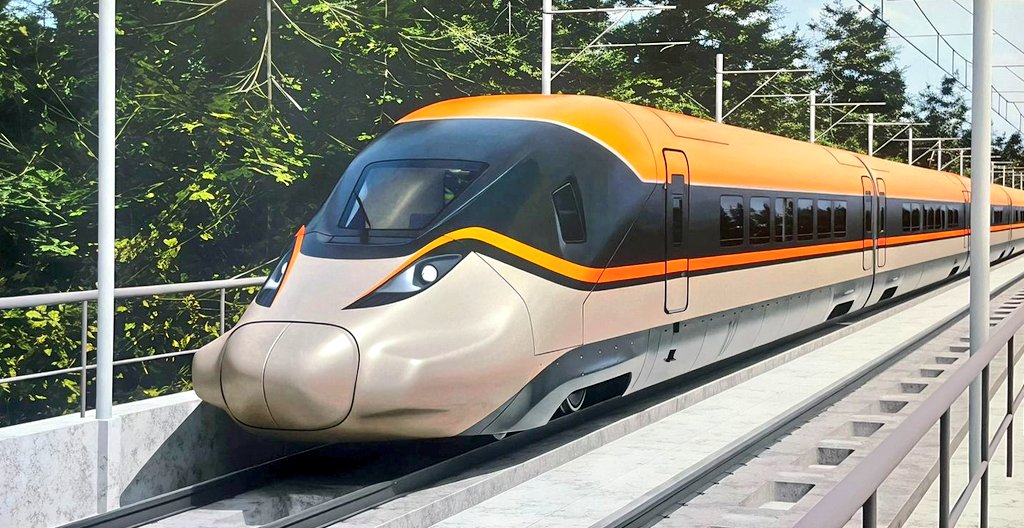
India’s Bullet Train Is No Longer a Dream on a Poster, It’s Now a Poster That Became a Machine
BEML’s B28 Concept Unveiled at Ministry of Railways | Prototype Due March 2027 | Commercial Run August 2027
A photograph doesn’t usually signal a revolution. But when a picture of India’s first indigenous bullet train, the BEML B28 was installed at Gate Number 4 of the Ministry of Railways in New Delhi, it wasn’t just décor. It was a declaration. After a decade of delays, diplomatic friction, pandemic disruptions, and political turbulence, India’s ₹1.08 lakh crore bullet train dream is finally picking up speed. And this time, there’s steel being cut, tunnels being bored, and a factory in Bengaluru humming to prove it.

The PM’s Vision: “Make It Indian, Make It Fast”
When Prime Minister Narendra Modi and Japanese Prime Minister Shinzo Abe jointly laid the foundation stone of the Mumbai–Ahmedabad High-Speed Rail Corridor in Ahmedabad in September 2017, the symbolism was unmistakable. Two bullet train nations, one that invented the Shinkansen in 1964, and one that aspired to build its own version, standing together on the same platform.
Modi’s vision was never simply about getting from Mumbai to Ahmedabad faster. It was about repositioning India in the global infrastructure conversation alongside Japan, France, and China as a country capable of designing, building, and operating 250 km/h trains. The ₹16 trillion high-speed rail roadmap now being championed by Railway Minister Ashwini Vaishnaw is a direct extension of that original ambition: not just to import speed, but to manufacture it.
The B28 designed by Bharat Earth Movers Limited (BEML) in partnership with the Integral Coach Factory (ICF) is the tangible answer to that question. With a maximum design speed of 280 km/h and an operational speed of 250 km/h, it sits comfortably in the same league as European and Japanese high-speed stock. India, which once assembled Japanese trains under supervision, is now designing its own.
The India–Japan Partnership: A Loan, a Dream, and a Complicated Marriage
The Mumbai–Ahmedabad High-Speed Rail corridor is, at its financial core, an India–Japan joint venture unlike any other. Approximately 81% of the project’s funding comes from a soft loan from the Japan International Cooperation Agency (JICA), a 50-year loan at a near-zero interest rate of just 0.1%. It is arguably the most generous infrastructure financing deal in Indian history.
Japan’s skin in the game goes beyond money. The primary rolling stock for the full corridor remains the Japanese E10 Series Shinkansen, the next evolution of the iconic bullet train. Japanese engineers, consultants, and technology partners have been embedded in the National High Speed Rail Corporation Limited (NHSRCL) from the outset. India’s own signalling system on this corridor will follow ETCS Level-2 standards, compatible with Japanese safety protocols.
But here’s the contradiction that rarely makes headlines: even as the B28 is being celebrated as an indigenous achievement, it is explicitly designed as a prototype and trial trainset, not the main workhorse of the corridor. The E10 Shinkansen remains the intended primary fleet. The B28‘s role, while significant for capability-building and Atmanirbhar Bharat optics, is technically supplementary. This is not a criticism, it is an honest picture of where India stands: capable enough to build its own, but also prudent enough to rely on proven Japanese technology for the primary corridor.


The Hiccups Nobody Likes to Talk About
Every great infrastructure project carries hidden chapters of failure. India’s bullet train project has several.
The original deadline was 2022. Then 2023. Then 2026. Now 2027 and even that is partial, covering only the 97-km Surat–Vapi section. The full Mumbai–Ahmedabad corridor of 508 km, with its 12 stations, remains years away from completion.
The biggest villain for years was land acquisition in Maharashtra. While Gujarat moved swiftly, completing over 97% of land acquisition early, Maharashtra dragged its feet, partly due to political opposition from the then-Uddhav Thackeray government, which was philosophically opposed to a project it associated with the BJP. At one point, Maharashtra had acquired barely 30% of the required land, while Gujarat was nearly done. The project was staring at an enforced two-phase structure: operate Ahmedabad to Vapi first, and figure out Mumbai later.
Then came COVID-19 in 2020, which froze construction, froze financing conversations, and froze the supply chains for specialised components that could only come from Japan.
Then came a quieter diplomatic wrinkle: by late 2024, Indian officials were reportedly frustrated with Japan’s pace on delivering rolling stock commitments. The E5 Series Shinkansen, originally proposed for the corridor, was dropped after disputes over cost and the extent of modification needed for Indian climatic conditions, the heat, dust, humidity, and monsoon-level rainfall that Japanese trains weren’t designed for. Negotiations were terminated. India turned to European suppliers as a contingency even as it simultaneously accelerated the B28 indigenous program.
There’s a deeper engineering reality here too. The Mumbai tunnel, a 21-km section that includes a 7-km undersea passage beneath Thane Creek is genuinely unprecedented in India. The Tunnel Boring Machines (TBMs) now being assembled at Vikhroli are the largest ever deployed for rail construction in the country. Each TBM weighs over 3,000 tonnes. The 350-tonne cutterhead alone arrived in five separate shipments and required 1,600 kg of high-precision welding just to assemble. This is not routine infrastructure, this is Indian engineers doing something they have never done before, under a city of 20 million people.
Where Things Stand Today: The 2027 Promise
Railway Minister Ashwini Vaishnaw inaugurated BEML’s ‘Aditya’ High-Speed Rail Complex in Bengaluru on April 25, 2026, a state-of-the-art facility equipped with robotic laser welding systems designed specifically for bullet train coach production. The first B28 prototype is formally targeted for completion by March 2027, with commercial services on the Surat–Vapi stretch planned for August 15, 2027, Independence Day, naturally.
The B28 design specification is genuinely impressive for an indigenous product:
- Maximum design speed: 280 km/h
- Operational speed: 250 km/h
- Trainset: 8 coaches, chair car and executive class
- Passenger capacity: 500+
- Climate range: −5°C to 50°C, engineered for dust, humidity, and monsoon
- Traction: Distributed, IGBT-based converters
- Braking: Microprocessor-controlled, bolsterless bogies
- Fire safety: EN 45545 compliance
- Daily operational target: ~2,000 km per trainset
An order for 16 additional B28 trainsets, worth approximately ₹4,000 crore is in advanced stages, with BEML and Medha Servo Drives as the likely consortium. The future B35 variant, targeting 350 km/h, is already on the drawing board.
When the Surat–Vapi section opens, Mumbai–Ahmedabad travel time will eventually compress to 1 hour 57 minutes. Even more striking: the corridor’s geometry, when extended south, could reduce Mumbai–Pune to just 48 minutes, a journey that currently takes 3 hours by road on a good day.
The Bigger Picture: India’s Transport Identity Is Shifting
There’s something worth stepping back to appreciate. India ran its first passenger train in 1853. For most of the 170 years since, it has been a nation defined by slow trains, crowded compartments, and iron tracks laid by colonial hands. The bullet train changes that story not just in speed, but in ambition.
The B28’s display at the Ministry of Railways isn’t just a photograph on a wall. It’s a country telling itself: we designed this. And in March 2027, when that prototype rolls out of the Bengaluru factory and onto the tracks in Gujarat, India will join a very short list of nations that have built high-speed rolling stock from domestic engineering.
The deadline is tight. The challenges are real. But the machine is being built