Connect with us

Business

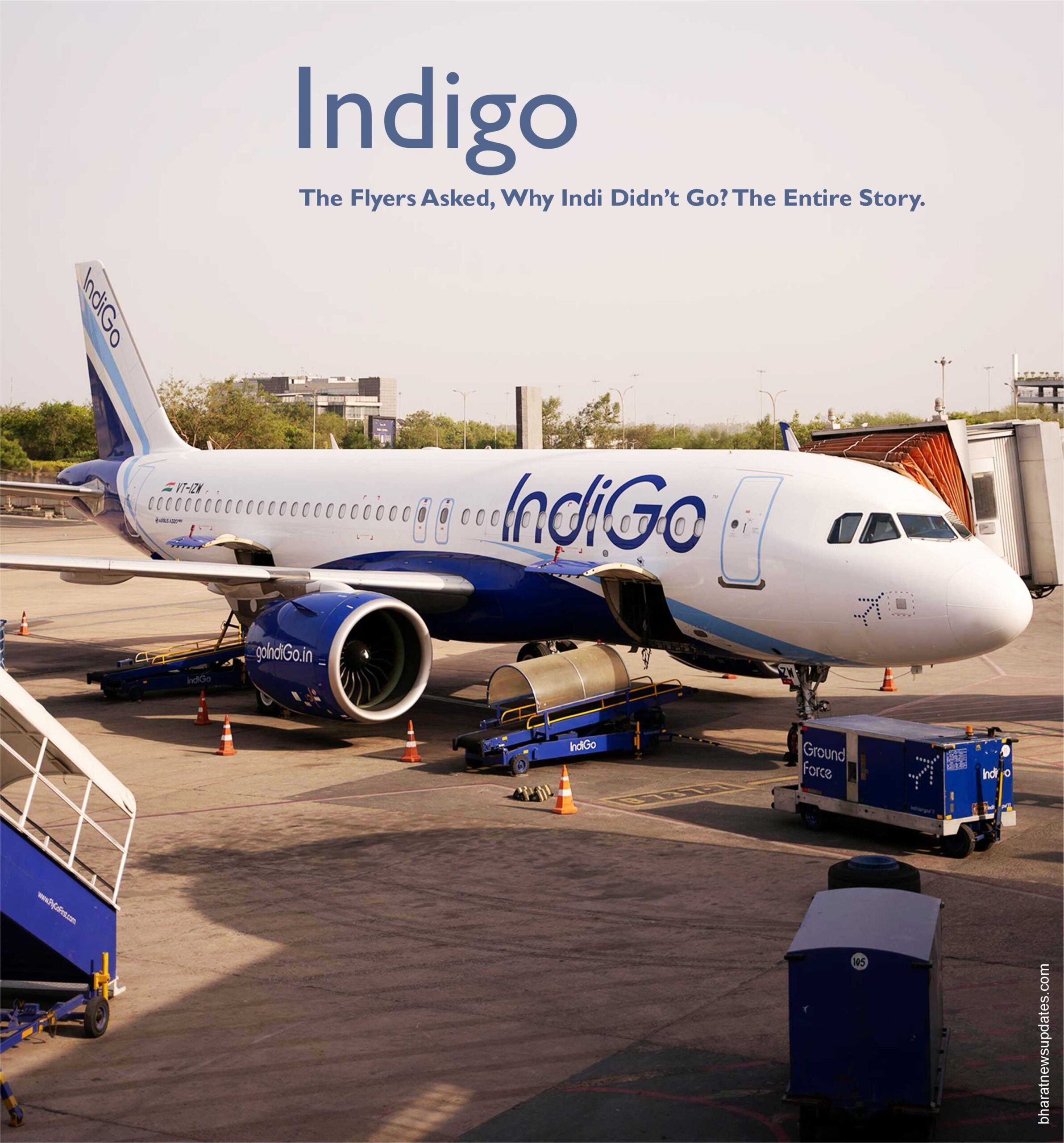
Indigo—The Flyers Asked—Why Indi Didn’t Go? The Entire Story.

Published

on

Bharatnewsupdates Indigo Flight Cancellations

Over the past few days, numerous Indigo Airlines flights have been cancelled and today, majority of the flights from Delhi have been either cancelled, delayed due to ongoing pilot shortage.

Thousands of people are stranded at airports, delays are occurring for hours, and flight cancellations are causing financial losses for people. Plans made over months have been ruined… corporate meetings, medical travel, family travel, marriage… everything has been disrupted. Millions of people are stranded.

However, the biggest question here is that there are many airlines in India, and then why is only Indigo affected?

People are blaming the Flight Duty Time Limitation (FDTL) rule for the problems at Indigo. Some are blaming the government for implementing the rule in a hurry, and the public is suffering. And now the government has withdrawn the rule, because millions of people were being affected. Some blamed the government for implementing the rule, when it was supposed to be withdrawn.

It is important to understand this fact.

First, it is important to understand that flying an airplane is not an easy task. You must fly from Delhi to Pune. The flight takes less than two hours, but the required preparation is endless. Whether it is the pilot, the ground staff, or the technical crew, everyone works 12-16 hours a day.

Among these, the pilot’s role is crucial. They must fly for hours, often without rest. And most importantly, the pilot is responsible for the entire airplane operation. If they are tired or have not had enough sleep, an accident could occur, putting the lives of hundreds of people at risk.

Overworked pilots and staff have long demanded reductions in their duty and flight hours. This problem exists in all airlines.

However, IndiGo’s situation is on a different level.

indigo

The Directorate General of Civil Aviation (DGCA) issued a new FDTL rule on May 31, 2024. For those who are saying that the new rule was imposed… This rule was announced 18 months prior.

The minimum weekly rest period for pilots, previously set at 36 hours including two local nights, has been extended to 48 hours. Furthermore, the definition of nighttime has been adjusted, now spanning from 0.00 to 6:00 AM instead of 0.00 to 5:00 AM.

Consequently, the maximum number of landings permitted during night time has been reduced from six to two.

The rationale for these SOPs or rules is to minimize pilot fatigue, thereby ensuring passenger safety remains stringent.

This new regulation was scheduled for implementation in two phases: the first phase commencing on July 1, 2025, and the second phase on November 1, 2025. This time line afforded IndiGo approximately 18 months from the announcement to the enforcement of the new rules to adjust its staffing and recruitment strategies accordingly.

However, the airline failed to take any action.

They persisted with their previous operational methods, overworking their pilots and staff to maximize profits. Their assumption was that as India’s largest airline, the Directorate General of Civil Aviation (DGCA) would grant an extension to the rule, given their perceived lack of capacity elsewhere.

However, when November 1, 2025 landed and the new rule became effective, the DGCA firmly declined to extend its implementation. As a result, pilots began to adjust their schedules in accordance with the new regulations, and due to IndiGo’s lack of readiness, their operations started to suffer.

A month has since passed, and this situation has now escalated into widespread disruption, leading to the daily cancellation of hundreds of flights.

It’s unclear who bears responsibility in this situation.

Without understanding the full context, individuals are attributing all problems to the government. Some are criticizing the nation’s perceived leadership, others are commending Modi, and some are creating emotional content to gain attention.

Frankly, the responsibility for this situation rests entirely and exclusively with Indigo. They attempted to postpone the policy’s enforcement by exerting pressure on the government.

Indigo fails to grasp that such overt avarice and policies driven by greed will ultimately jeopardize its own survival.

Nevertheless, there remains an expectation that the company will navigate this challenging period successfully, particularly for the roughly 40,000 employees who are blameless, merely performing their duties, and enduring public criticism.

Concurrently, Indigo is attempting to leverage its dominant market standing.

Currently, the DGCA and the government have rescinded this regulation due to pressure, but this action is misguided, as it directly concerns the safety of both employees and customers, an area where compromise should never occur.

If an incident were to happen in the future, who would be held accountable? The government should engage with Indigo’s leadership to devise improvements in this area. If other airlines can achieve this, why not Indigo, given their substantial financial and material resources?

The IndiGo crisis is unending as the government has mandated that the airline issue all passenger refunds for flights that have been cancelled or delayed by tomorrow.

Additionally, fare caps have been implemented on domestic flights to safeguard consumers, following the cancellation of over 2,000 flights in the past four days, with more than 400 flights cancelled yesterday alone.

The airline is also being required to speed up baggage returns as the operational issues enters into their fifth day.

Govt Imposes Nationwide Cap on Airfares

After massive disruptions at IndiGo led to cancellations, reduced capacity and steep ticket-price spikes, the Ministry of Civil Aviation has ordered a nationwide cap on domestic airfares.

New Maximum Fare Limits

1. ₹7,500 — routes up to 500 km

2. ₹12,000 — 500–1,000 km

3. ₹15,000 — 1,000–1,500 km

4. ₹18,000 — routes above 1,500 km

Continue Reading
Click to comment

Leave a Reply

Your email address will not be published. Required fields are marked *

Business

Vedanta Group Chairman Anil Agarwal’s Grief Beyond Words: “My Beloved Son Agnivesh Left Us Far Too Soon”

Published

on

Today is the darkest day of my life.

My beloved son, Agnivesh, left us far too soon. He was just 49 years old, healthy, full of life, and dreams. Following a skiing accident in the US, he was recovering well in Mount Sinai Hospital, New York. We believed the worst was behind us. But fate had other plans, and a sudden cardiac arrest snatched our son away from us.

No words can describe the pain of a parent who must bid goodbye to his child. A son is not meant to leave before his father. This loss has shattered us in ways we are still trying to comprehend.

I still remember the day Agni was born in Patna on 3 June, 1976. From a middle-class Bihari family, he grew into a man of strength, compassion, and purpose. The light of his mother’s life, a protective brother, a loyal friend, and a gentle soul who touched everyone he met.

Agnivesh was many things – a sportsman, a musician, a leader. He studied at Mayo College, Ajmer, went on to set up one of the finest companies Fujeirah Gold, became Chairman of Hindustan Zinc, and earned the respect of colleagues and friends alike. Yet, beyond all titles and achievements, he remained simple, warm, and deeply human.

Vedanta Group Chairman Anil Agarwal With Son Agnivesh

To me, he was not just my son. He was my friend. My pride. My world.

Kiran and I are broken. And yet, in our grief, we remind ourselves that the thousands of young people who work across Vedanta are also our children.

Agnivesh believed deeply in building a self-reliant India. He would often say, “Papa, we lack nothing as a nation. Why should we ever be behind?”

We shared a dream to ensure that no child sleeps hungry, no child is denied education, every woman stands on her own feet, and every young Indian has meaningful work. I had promised Agni that more than 75% of what we earn would be given back to society.

Today, I renew that promise and resolve to live an even simpler life.

There was so much life ahead of him. So many dreams yet to be lived. His absence leaves a void for his family and friends. We thank all his friends, colleagues and well-wishers for always being there for him.

Beta, you will live on in our hearts, in our work, and in every life you touched.

I do not know how to walk this path without you, but I will try carrying your light forward.

Life gives no warnings. One moment we are planning tomorrow, the next we are learning how to breathe without someone we love. A child’s absence is not something a parent ever overcomes — it is something one learns to carry, quietly, every day.

May we remember how fragile life is, how little control we truly have, and how important it is to love deeply while we can. Those we lose do not disappear; they live on in our memories, our values, and the work we do in their name.

May Agnivesh’s noble soul find peace.
May his light continue through every life he touched.
And may no parent ever have to walk this path alone.

Continue Reading

Business

Remembering Aequitas’ Siddhartha Bhaiya: A Life of Conviction, A Market of Memories!

Published

on

Bharatnewsupdates-Siddhartha Bhaiya

There are some losses the markets feel quietly.

Not in index points or fund flows, but in the sudden absence of a voice that made you pause before placing a trade, a mind that reminded you that capital is precious, and a conviction that discipline matters more than applause. The passing of Siddhartha Bhaiya is one such loss.

Bharatnewsupdates : Aequitas Press Release

Press Release Courtesy : Aequitas

At just 47, Siddhartha Bhaiya—Managing Director and founder of Aequitas Investment Management—left the world far too early. A sudden cardiac arrest while on a family vacation in New Zealand took away one of Indian equities’ most thoughtful and independent thinkers. For those who truly followed the markets, this was not merely the loss of a fund manager. It felt like losing a compass.

Dalal Street has seen many successful investors. Very few earn trust. Fewer still earn respect across cycles. Siddhartha Bhaiya belonged to that rare category.

A Chartered Accountant by profession and a market practitioner by instinct, his journey through institutions like Stratcap, Principal PNB, Reliance Capital, and later Nippon India Mutual Fund gave him a deep understanding of how capital market behaves—especially when it misbehaves! But it was in 2012, when he chose to step away and build Aequitas, that his true philosophy found a home.

Aequitas was never built as a factory of equity and brokerage. It was built as a house of profit with patience.

Under Siddhartha’s leadership, the firm grew into a respected PMS and AIF platform managing nearly INR 7,700 crore. The numbers were extraordinary—over 2800 percent absolute returns since inception and a long-term CAGR of around 33%-34%—but he never wore them lightly. For him, returns were an outcome, not a headline.

What truly set him apart was not just his ability to identify small, undiscovered companies that later became multibaggers, but his willingness to do nothing when nothing made sense. In a market addicted to momentum, Siddhartha Bhaiya had the courage to hold cash. When valuations ran ahead of fundamentals, he did not rationalize exuberance—he questioned it.

Over the last couple of years, while the broader market celebrated relentless rallies, Siddhartha Bhaiya stood almost alone in his caution. His funds held unusually high cash levels. He openly spoke about “epic bubble” in Indian equities at a recent concluded Moneycontrol Deserv Wealth Summit in December 2025, stretched valuations, and the risks of blind participation. “Holding cash is the easiest thing to do right now,” he once said—not as an act of fear, but of discipline.

“Before you jump into the markets with your pot of savings. Please spend 2 minutes to read what our team has to say. Take investment decisions carefully and not emotionally. Stock markets are raw brutal and like the animal kingdom, they don’t understand emotions.” Siddhartha Bhaiya wrote on X on June 5, 2024,  after BJP lead NDA got less than the required majority in Lok Sabha to form the government.

Read what he attached with the tweet on X.

This was Siddhartha Bhaiya’s essence: intellectual honesty over popularity.

He blended value with growth, conviction with humility, and contrarian thinking with deep research. He believed markets eventually reward patience, punish excess, and expose emotional decision-making. His frequent reminders to retail investors—to think independently, to observe promoter behaviour, to avoid emotional investing—came not from theory, but from lived experience.

Within Aequitas, he was more than a portfolio manager. He was the intellectual backbone, the cultural anchor. He believed institutions outlive individuals, and he worked quietly to build one that could stand without him. A young team, clear processes, and a long-term world view were central to that vision.

Yet beyond balance sheets and portfolios, those who interacted with him remember something rarer—kindness without pretense. He spoke plainly, never minced words, but was always generous with time and guidance. To many younger market participants, he was a guru who taught not what to buy, but how to think.

There is a cruel irony in his passing. A man deeply conscious about health, often reminding others to take care of their bodies, was taken away suddenly. It serves as a quiet reminder that markets give us cycles, but life gives no such warnings.

Siddhartha Bhaiya once said, “My goal is to always be the best fund manager in the country. Whether I achieve it or not is a different thing.” That sentence reveals everything.

For him, excellence was a pursuit, not a destination.

Today, the screens will continue to blink. Trades will execute. Markets will open and close. But something fundamental has changed. A rare voice of caution, clarity, and integrity has fallen silent. His insights will no longer come through interviews or notes—but they live on in portfolios built with care, in investors taught to respect risk, and in an institution shaped by principles rather than noise.

The markets have lost a brilliant mind. Aequitas has lost its founder. And many of us have lost a guide we didn’t realize we depended on so deeply.

Aum Shanti.

Continue Reading

International News

Russia’s FESCO Ships Vital Supplies to India’s Antarctic Stations in High-Stakes Polar Mission

Published

on

Russia’s transport group FESCO has once again taken on one of the toughest routes in global shipping—an Antarctic supply run—by dispatching its diesel-electric vessel Vasily Golovnin to support India’s polar research stations.

The ship is currently sailing toward Antarctica after departing from Cape Town, carrying essential shipment for India’s Bharati and Maitri research stations at Antarctica. The shipment includes fuel, food supplies, and specialized equipment required to sustain scientific exploration through the extreme cold and inhospitable environment.

This voyage is part of a long-standing arrangement between FESCO and India’s National Centre for Polar and Ocean Research (NCPOR), under the Ministry of Earth Sciences. Over the years, the partnership has made FESCO one of the few operators worldwide with consistent experience in servicing Antarctic stations. Along with cargo, the vessel is also transporting Indian scientists who will replace
outgoing station personnel—a routine but critical rotation that keeps year-round research running.

The expedition is expected to continue until April 2026, in line with the narrow navigation window allowed by Antarctic weather and sea ice conditions.

What place this tough mission challenging is not the distance, but the difficulty of the final delivery. India’s Antarctic stations lack traditional port facilities, meaning supplies must be transferred directly from ship to shore under unforeseeable conditions. To execute this, the Vasily Golovnin is adequately equipped with onboard cranes and a self-propelled cargo vessel for coastal unloading.

Two helicopters are also deployed for exploration, personnel transport, and cargo drops when sea access is restricted. Such operations demand precise coordination between maritime and aerial teams, constant weather monitoring, and a crew trained for extreme environments. Even small delays or errors can have serious consequences in Antarctica, where resupply options are virtually non-existent once the season closes. According to Nikolai Chvertkov, Director of FESCO’s Vladivostok branch, the company’s involvement in Antarctic missions dates back several decades. Russian vessels have supported polar expeditions since the 1970s, with international scientific collaborations expanding steadily since the early 2000s.

For the past seven years, the Vasily Golovnin and its crew have been a regular presence in India’s Antarctic logistics chain. Beyond Antarctica, India and Russia are also deepening cooperation in Arctic operations. India has conveyed interest in gaining operational expertise in polar conditions, including icebreaker construction and energy supply logistics in the Russian Arctic—region where Russia holds long-standing prowess.

In polar shipping, success is measured less by fleet size and more by experience. Operating in sub-zero temperatures, landing cargo on undeveloped arctic seaside, protecting human life, and combining sea and air logistics are capabilities that take years to develop. Against this backdrop, FESCO’s continued role in international polar missions highlights how specialized logistics providers remain essential to vital global scientific expedition. Despite changing geopolitical and economic scenario, such operations show that cooperation in extremely harsh environments continues where trust, reliability, and technical skill matter most.

For the broader logistics industry, these missions offer a peek into future demand—particularly for Arctic routes, scientific infrastructure projects, and operations along the Northern Sea Route, where only a handful of players possess the know-how to operate safely and consistently.

Continue Reading

Trending