

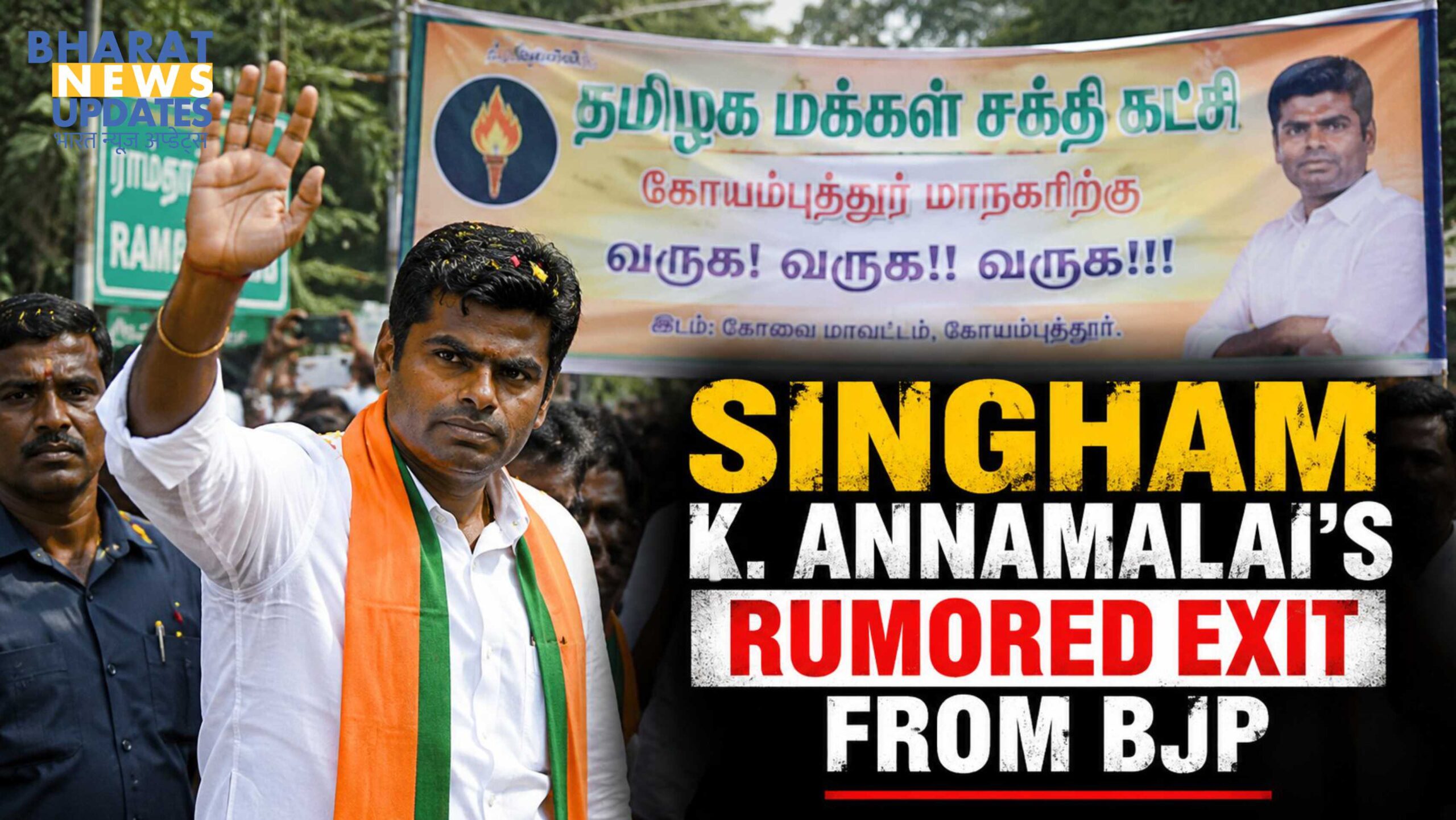
The Singham Who Outgrew His Cage: The Untold Story of Annamalai’s Rumored Break with BJP
Bharatnewsupdates | June 2, 2026
There is a peculiar irony in the political life of K. Annamalai. The man who walked away from a decorated police career because he refused to be boxed in by a broken system has now walked away from a political party for the same reason. The “Singham of Karnataka Police,” once heralded as the BJP’s great southern hope, is leaving the building. And this time, there may be no looking back.
On Monday, Annamalai flew to Delhi not to negotiate, not to lobby, but to thank. Sources close to the former Tamil Nadu BJP president confirm what political circles have whispered for months: the meeting with BJP national president Nitin Nabin was a courtesy call, a dignified goodbye wrapped in party protocol. The man who once told an internal BJP meeting that he would resign if the party allied with the AIADMK may now make good on that promise, just in a slower, quieter, more devastating way.
The Cop Who Chose the Ring
To understand what the BJP may be losing, you have to understand what Annamalai brought to the table and how rare it was.
Born in Thottampatti, Karur district- Tamilnadu, into the politically formidable Gounder community of western Tamil Nadu, Annamalai relocated to his village to take up organic farming after his IPS resignation, before entering politics. His 2018 yatra to Kailash Mansarovar had, by his own account, helped him reprioritize his life. The spiritual reset and the death of a mentor-officer who had exposed illegal mining both pushed him to ask harder questions about purpose. That kind of introspection is rare in Indian politics, where most leaders enter not to question but to acquire.
When he joined the BJP in 2020, initially drawn to the orbit of Rajinikanth’s never-born party, he carried into politics what few bring: an outsider’s honesty, a cop’s directness, and a young man’s genuine conviction that Dravidian politics had calcified into dynastic theatre. He quickly rose through the ranks and was appointed the party’s Tamil Nadu president in 2021, just 11 months after joining. For the BJP, still groping for a southern foothold, it seemed like providence.
The Internal Power Struggle And Aggression
The resistance to Annamalai was never a conspiracy hatched in a backroom. It was quieter, more bureaucratic, and therefore more lethal, the slow accumulation of grievances from people who had been in the BJP long before he arrived, who had waited in queue, and who found his style not just aggressive but personally dismissive.
The first crack appeared in a closed-door state unit meeting in Chennai when Annamalai told assembled party office-bearers that he was against any alliance with the AIADMK and that the BJP should go solo if it was serious about becoming an alternative to the Dravidian parties. He is also understood to have said he would resign from his post if the central leadership decided to align with the AIADMK. What followed was revealing: BJP Mahila Morcha chief and Coimbatore (South) MLA Vanathi Srinivasan and vice-president Narayanan Thirupathy sought clarification from Annamalai, pointing out that such decisions are taken by the BJP Parliamentary Board in New Delhi not by a state president in Chennai. The subtext was unmistakable: who exactly do you think you are?
Vanathi Srinivasan was not a newcomer rattled by a combative outsider. She has been a BJP member since 1993 and held various party positions since 1999, a quarter-century in the organization when Annamalai was still policing Udupi. For her, and for veterans like Pon Radhakrishnan and Nainar Nagendran, Annamalai’s arrival and instant elevation was not an inspiration. It was an institutional affront. According to critics within the party, Annamalai ran his own 24×7 war room to boost his image, had little patience for resolving party issues, and had no qualms about muzzling dissenting voices — with veteran leaders such as Pon Radhakrishnan, Vanathi Srinivasan, and Nainar Nagendran either sidelined or ignored.
The most damning public signal came after the 2024 Lok Sabha defeat. Former Tamil Nadu BJP president Tamilisai Soundararajan, after losing from the Chennai South constituency, publicly stated that an electoral alliance with the AIADMK would have paid the BJP rich dividends, and that it was Annamalai who did not want such an alliance warning the BJP IT cell against putting out memes criticising her. This was not an anonymous whisper. A former Governor, a woman who had built the party’s base through years of thankless ground-level work, was openly indicting the man at the top. That moment cracked the dam.
The final act was clinical. When the BJP moved to revive its ties with the AIADMK, one of the regional party’s key demands was a change in the leadership of the state unit. Annamalai was replaced by Nainar Nagendran. The man chosen to replace him was not a political outsider or a fresh face Nagendran had once contested on a BJP ticket from Tirunelveli all the way back in 2021, a quiet, consensus-friendly operator who would not embarrass Edappadi K. Palaniswami at a press conference.
When HM Amit Shah convened a meeting of Tamil Nadu BJP leaders in New Delhi to deliver instructions on working unitedly with the AIADMK ahead of the 2026 elections, Annamalai skipped it entirely, citing prior engagements. Sources indicated he had told the high command that he did not want to contest the 2026 elections. The man who had walked every one of Tamil Nadu’s 234 constituencies on foot refused to show up to a room where his own political burial was being arranged.
The final humiliation arrived through the seat-sharing exercise for the 2026 Assembly elections. Annamalai and Vanathi Srinivasan were both reportedly eyeing the Coimbatore North constituency. Despite intervention by Union Minister Piyush Goyal, the standoff could not be resolved and the seat went to Vanathi Srinivasan. Annamalai was left without a single constituency. The seats widely considered winnable for him went elsewhere, sharpening the sense of deliberate exclusion.
This is not the story of an ideological purge. It is the story of what a political party does when one man’s visibility threatens everyone else’s relevance when the institution cannot tell the difference between someone who is difficult and someone who is right. As recently as February 2026, the BJP leadership was signalling it was not keen on projecting Annamalai as the face of the campaign, with sources suggesting the party had asked him to lie low as it shifted its focus to the 2031 elections. In other words: wait your turn. Again. For a man who resigned an IPS career because he refused to wait in someone else’s queue, that answer was never going to hold
What add to this is the another dimension of caste equation underneath it, too. Both Edappadi K. Palaniswami and Annamalai belong to the Gounder community and caste calculations, alongside alliance equations, were behind the probable another reason to replace him with Nagendran, who hails from the Thevar community. In Tamil Nadu’s political chessboard, even exits are silently caste-coded.
The Oxford Interlude: A Cooling-Off or a Reckoning?
After the 2024 Lok Sabha setback, the BJP sent or perhaps allowed Annamalai to step back. He had been selected for the Chevening Gurukul Fellowship for Leadership and Excellence, a UK Foreign Office programme. It was framed publicly as a break. Privately, insiders suggest, both sides needed distance.
What happened in Oxford matters. A man of Annamalai’s intellectual ambition, IIM Lucknow trained, a reader of political philosophy didn’t come back from a fellowship on leadership with a softened spine. He came back with clarity. The party may have hoped the fellowship would smooth his edges. It likely sharpened his sense of what he was being asked to sacrifice.
His reduced role became more apparent during the 2026 Assembly election when his name was absent from the BJP’s candidate list entirely. For a man who had covered all 234 constituencies on foot through his En Mann, En Makkal yatra, not being allowed to contest a single seat was not an oversight. It was a message.
The Vijay Paradox: His Vindication, Not His Defeat
Here is the contradiction that the BJP’s central leadership must now sit with: the rise of C. Joseph Vijay as Tamil Nadu’s Chief Minister is, in a perverse way, Annamalai’s political testament.
Annamalai had argued consistently, loudly, at the cost of his career, that Tamil Nadu voters were hungry for a non-Dravidian alternative. He was mocked for it. The BJP chose to bet on the AIADMK’s dying infrastructure instead. And while the saffron party played alliance chess, Vijay’s TVK walked into the vacuum Annamalai had identified and partially created.
The bitterest irony? Despite raising the BJP’s visibility, the party struggled to translate that momentum into electoral breakthrough not because Annamalai’s thesis was wrong, but because the BJP pulled its own architect off the project halfway through construction.
What’s Next: Movement, Party, or Myth?
Sources confirm Annamalai will launch a people’s movement that could later be turned into a political party and that the name of the movement may be a phrase popularized by Rajinikanth. The Rajinikanth connection is not accidental. Annamalai was once being groomed to lead the superstar’s never-launched party. That the circle may now close with Annamalai borrowing the superstar’s language to launch his own venture has the quality of a screenplay too neat for fiction.
Posters with his face and the words “Fearless minds have no limits” have surfaced across Coimbatore. His supporters on X are already debating flag designs and party names “Tamilaga Makkal Sakthi Katchi” being a frontrunner. Some Delhi sources, more cynical, suggest that the new-party buzz could be leverage a final bid to extract a cabinet berth before crossing the Rubicon. A Minister of State post, they say, might still pull him back.
But people who know Annamalai well say that ship has sailed. A man who resigned a prestigious IPS position at the height of his powers doesn’t negotiate his way into mediocrity. He leaves. And this time, he’s may be leaving with a base, a brand, and a biography that no manufactured BJP replacement can match.
The BJP’s Tamil Nadu Problem: Now Permanent
Lose Annamalai, and what does the BJP have in Tamil Nadu? Nainar Nagendran, a decent administrator but not a mass mobiliser. Vanathi Srinivasan capable but constrained. And an AIADMK alliance built on the quicksand of a post-Jayalalithaa party that has not won a mandate in years.
The BJP’s southern strategy was always a long game. What Annamalai provided was the rare thing no strategy document can manufacture: authentic anger. His fury at the Dravidian establishment was real because he had grown up watching it, breathed it, then chosen to fight it by leaving behind everything comfortable.
When he leaves, the party won’t just lose a face. It will lose the argument that it could offer Tamil Nadu something genuinely new.
Tamil Nadu politics has a long memory. It remembers that MGR broke from the DMK and built an empire. It remembers that Vijayakanth spent years in the wilderness before becoming the largest opposition. If K. Annamalai’s instincts about the state’s political appetite have been right all along and the Vijay phenomenon suggests they were, then this exit from the BJP may not be a career ending. It may be the beginning of the story he actually want to re-write.