Connect with us

Spiritual

The Chandala Dialogue: Beyond Caste, Beyond Form, Shankaracharya’s Greatest Realisation

Published

on

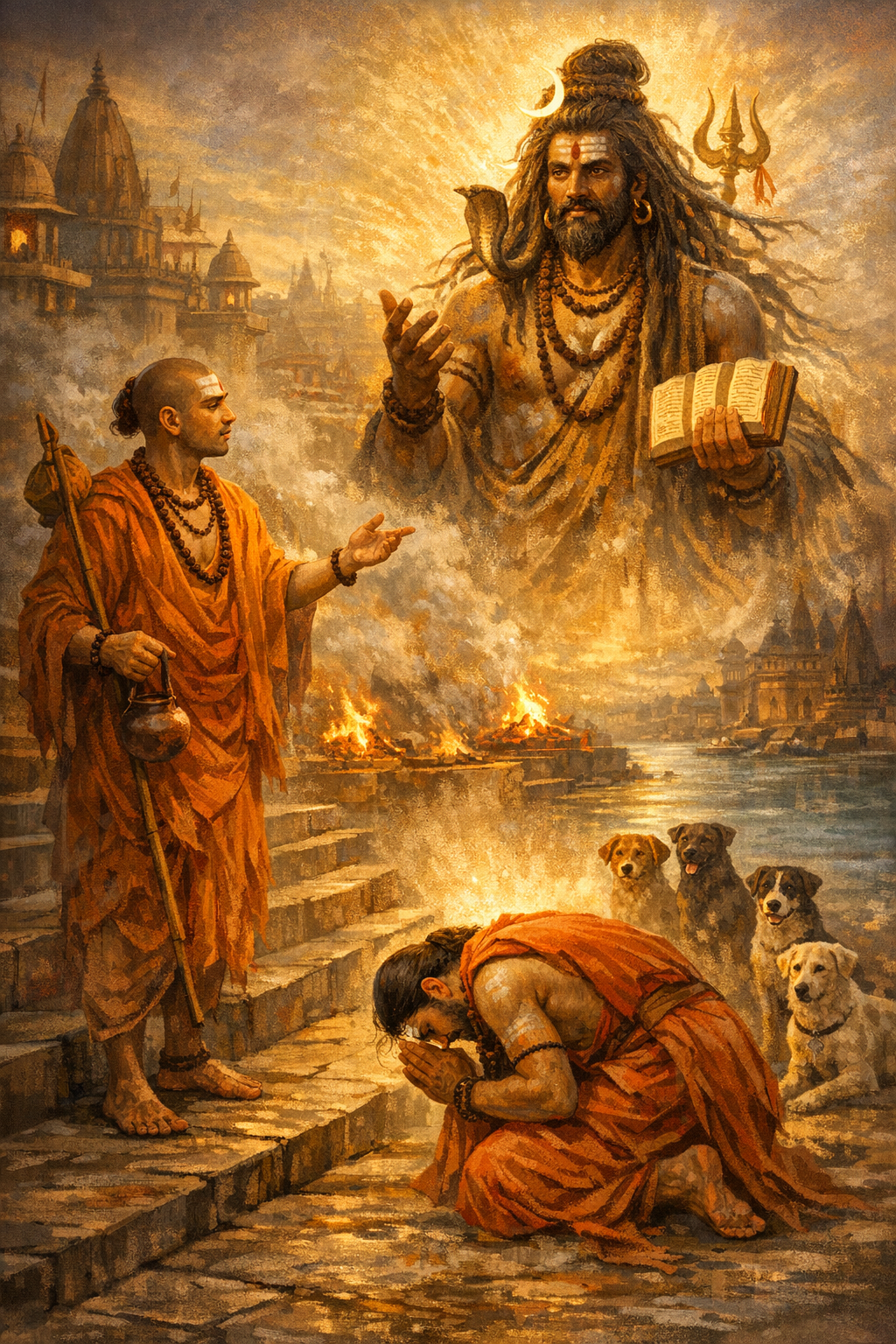
This story is one of the most loved spiritual episodes from the life of Adi Shankaracharya, the founder of Advaita Vedanta. It is traditionally linked with Manikarnika Ghat in Varanasi, where Shankara is said to have encountered Chandala who later revealed himself as Shiva.

Let’s expand the story with deeper context, symbolism, and philosophy.

The setting: a test disguised as an encounter

Shankaracharya, already a brilliant young monk and philosopher, was walking toward the sacred river Ganga River after completing ritual duties.

He was not merely a scholar — he was the torchbearer of Advaita Vedanta, the doctrine that teaches:

  •  Reality is one
  • The Self (Atman) and the Absolute (Brahman) are identical
  • Differences are created by ignorance (avidya)

Yet, spiritual traditions often show that knowledge must be tested in lived experience.

And that test arrived.

The encounter

A Chandala appeared in Shankara’s path — traditionally considered an outcaste engaged in cremation work.

For a fleeting moment, Shankara reacted socially rather than spiritually and asked him to move aside.

The Chandala’s reply shattered the illusion:

“Who should move — the body made of matter, or the Self that is everywhere?”

This question was not a challenge of ego — it was a mirror of Advaita itself.

The philosophical shock

The Chandala’s words strike at multiple levels:

1. Body vs Self

He reminds Shankara that:

  • Bodies differ due to karma and social constructs

  • The Self is identical in all beings

Thus discrimination based on caste is ignorance at the level of spiritual truth.

2. Non-duality applied to social reality

Advaita is often intellectually grasped but socially ignored.

The Chandala’s question exposes the contradiction:

 If all is Brahman, how can one human be “pure” and another “impure”?

This moment represents Advaita becoming lived ethics.

3. Guru can appear anywhere

In Indian spirituality, wisdom is not bound to status.

The Chandala becomes Shankara’s teacher in that instant.

This echoes a core teaching:
Truth speaks through whoever embodies it.

Shankara’s transformation

Realization dawned immediately.

Shankaracharya bowed and composed the famous Manisha Panchakam, whose central idea is:

One who knows the Self — whether Brahmin or Chandala — is my Guru.

This was a radical spiritual statement in its historical context.

Revelation of Shiva

Tradition says the Chandala revealed himself as Lord Shiva, sometimes accompanied by four dogs symbolizing the Vedas.

Symbolically, this means:

  • Shiva is the destroyer of ignorance

  • Truth tests even the enlightened

  • Divine grace appears through unexpected forms

  • Spiritual pride is the final illusion

Deeper symbolic meaning of the story

1. Ego survives even in the enlightened

The episode teaches that intellectual realization does not guarantee complete dissolution of conditioning.

Spiritual growth is continuous.

2. Radical equality of consciousness

The story is often interpreted as a critique of caste hierarchy at the metaphysical level.

Advaita asserts:
Difference belongs to the body, unity belongs to consciousness.

3. Philosophy must become perception

The Chandala’s question forces Shankara to move from:

  • conceptual Advaita → experiential Advaita

4. Shiva as cosmic teacher

Shiva’s disguise shows:

  • The Divine tests humility

  • Wisdom appears in paradox

  • Reality hides in ordinary encounters

Historical vs symbolic reading

Scholars debate whether this is literal history or spiritual allegory.

But in Indian tradition, the value lies in its teaching rather than historical verification.

It is remembered as a pedagogical story illustrating Advaita ethics.

Why this story still inspires today

The episode speaks powerfully to modern issues:

  • Social discrimination

  • Spiritual hypocrisy

  • Identity vs essence

  • Moral application of philosophy

  • Humility in leadership

  • Seeing divinity in all beings

It transforms Advaita from abstract metaphysics into socially transformative spirituality.

Essence of the story

At its heart, the story conveys:

  •  Wisdom without humility is incomplete
  •  Truth can speak through anyone
  • Social identity dissolves before spiritual identity
  • The Divine often appears as the “other”
  • Real knowledge is seeing oneself everywhere

Continue Reading
Click to comment

Leave a Reply

Your email address will not be published. Required fields are marked *

Spiritual

Mahashivratri – The Great Night of Inner Awakening

Published

on

Bharatnewsupdates - Shiva Parvati

What is Mahashivratri?

Mahashivratri means “The Great Night of Shiva.” It is one of the most sacred nights in the Hindu calendar, dedicated to Lord Shiva — the one who represents transformation, stillness, and deep awareness.

Every month there is a Shivratri, which falls on the fourteenth day of the dark half of the lunar month. But the Shivratri that comes in the month of Phalguna (February–March) is called Maha Shivratri — the greatest of them all. This night is considered highly powerful for prayer, meditation, and inner cleansing.

Mahashivratri is not just a festival of rituals. It is a night of spiritual opportunity.

Bharatnewsupdates - ShivParvati Tandav

Why is Mahashivratri Celebrated?

There are many stories connected with this sacred night, and each carries a deep meaning.

1. The Divine Marriage

One popular belief is that this is the night when Lord Shiva married Goddess Parvati. Their union represents the coming together of consciousness and energy — Shiva and Shakti.

Spiritually, this marriage is not just about two divine beings. It symbolizes balance within us. When our mind (Shiva) and our energy (Shakti) work together in harmony, life becomes peaceful and meaningful.

For many families, Mahashivratri is a celebration of devotion, love, and faithfulness.


2. The Night of Stillness

In the yogic tradition, Lord Shiva is known as the Adi Yogi — the first yogi and the first guru. It is believed that on this night, he entered into deep meditation and became completely still.

This stillness is important. In our busy lives, we are always running — in thoughts, emotions, desires. Mahashivratri reminds us to pause. To sit quietly. To turn inward.

When the mind becomes silent, we begin to understand ourselves better.


3. The Night of Transformation

Another sacred story tells us about the Samudra Manthan — the churning of the cosmic ocean. During this event, a deadly poison called Halahala emerged. To save the world, Lord Shiva drank the poison and held it in his throat, which turned blue. That is why he is also called Neelkanth.

This story teaches us sacrifice and strength. Sometimes life brings difficulties and bitterness. Mahashivratri reminds us that we too can hold our pain with courage and transform it into wisdom.

What is the Spiritual Significance?

Mahashivratri falls on the darkest night of the month — just before the new moon. Normally, people are afraid of darkness. But in spiritual understanding, darkness is not negative. It represents the unknown, the vast space from which everything is born.

The word “Shiva” itself means “that which is not.” It points to the silent, invisible presence behind all creation.

On this night, many devotees stay awake. They meditate, chant “Om Namah Shivaya,” and keep their spine straight while sitting. It is believed that on Mahashivratri, there is a natural rise of energy within the human body, especially in the northern hemisphere of the Earth. Staying awake helps one use this energy for spiritual growth.

But beyond beliefs, the deeper truth is simple: this night gives us a chance to rise above our limited thinking and connect with something greater.

Bharatnewsupdates - Shiv Parvati

How Mahashivratri Impacts Our Life

Mahashivratri is not only about visiting temples or performing rituals. It is about self-reflection.

Here is how this sacred night can change us:

• It Teaches Self-Control

Many people fast on this day. Fasting is not just about food. It is about discipline. When we control our senses, our mind becomes stronger.

• It Encourages Forgiveness

This night is a good time to let go of anger, ego, and negative thoughts. Shiva is known as the destroyer — not of people, but of ignorance and pride.

• It Strengthens Faith

Spending a whole night in prayer builds inner strength. It reminds us that spiritual life requires effort and patience.

• It Brings Mental Peace

Chanting mantras and meditating calm the mind. In today’s world full of stress and noise, Mahashivratri gives us a sacred pause.

How is Mahashivratri Celebrated?

Devotees visit Shiva temples and offer water, milk, honey, and bilva leaves to the Shiva Lingam. Abhishekam (ritual bathing of the Lingam) is performed with devotion. Many people observe a fast — some take only fruits and milk, while others keep a complete fast.

Throughout the night, bhajans are sung, mantras are chanted, and prayers are offered. Pilgrims visit sacred temples like Kashi Vishwanath Temple, Kedarnath Temple, Somnath Temple, and Mahakaleshwar Jyotirlinga.

But even if one cannot visit a temple, simply sitting quietly at home, lighting a lamp, and remembering Shiva with sincerity is enough.

A Night of Awakening

Mahashivratri is not just about staying awake physically. It is about waking up spiritually.

It is a reminder that within each of us there is strength, silence, and deep awareness. Shiva is not far away in the mountains of Kailash. He lives in our own consciousness.

This sacred night invites us to look within and ask:

  • Who am I beyond my fears and desires?
  • What is the truth of my existence?

Mahashivratri gives us the courage to face the darkness within and discover the light hidden inside it.

May this Mahashivratri not just be a festival on the calendar, but a turning point in our inner journey.

Maha Shivaratri 2026 – Date, Sacred Timings & Powerful Mantras

Maha Shivaratri is not just a date on the calendar. It is a night many devotees wait for with quiet excitement — a night of prayer, silence, surrender, and deep connection with Lord Shiva.

If you are preparing to observe this sacred night in 2026, here are the important details you should know.

Bharatnewsupdates - Shiva Paravati Marriage


Continue Reading

Trending