

HUNTED IN IRAN: The 48-Hour Nightmare— And Rescue— That Hollywood May Script In Future!
An F-15E goes down over enemy territory. Iran puts a bounty on a US airman’s head. A CIA tracker, a mountain crevice, and one of the most daring special forces missions in American history follow.
The missile detonated roughly fifteen feet from his head.
One moment, Colonel was hurtling through Iranian airspace at hundreds of miles per hour in an F-15E Strike Eagle — one of the most lethal aircraft ever built. The next, the sky exploded, the aircraft disintegrated around him, and he was ejecting into the dark, hostile skies above southwestern Iran.
He hit the mountains alive. And that’s when the real fight began.
Downed Over Enemy Territory
On April 3, an F-15E Strike Eagle— a twin-engine, two-seat interdiction fighter built for deep strikes into defended airspace— was shot down over southwestern Iran during ongoing US military operations. Both crew members ejected. The pilot was recovered quickly, within hours of the shoot-down. But the second crew member, the weapons systems officer, the man responsible for guiding bombs onto targets from the back seat— he vanished into the mountains.
For Iran, this was a gift. For the United States, it was a crisis.
Iranian military officials announced a $60,000 bounty for any information leading to the airman’s capture. State media broadcast the offer. Civilians were urged to join the search. Iranian forces fanned out across the rugged terrain of the Zagros mountain region— one of the most unforgiving landscapes on earth— certain they would find him before sunrise.
They were wrong.

One Man. One Handgun. Forty-Eight Hours.
What happened next belongs in the annals of military survival— not because it was clean or cinematic, but because it was brutally real.
The colonel had trained his entire career for this exact nightmare. Every US military aircrew member completes SERE— Survival, Evasion, Resistance, and Escape— a classified training program that simulates capture, deprivation, and pursuit in hostile territory. The program doesn’t teach you to be comfortable. It teaches you to keep moving when every instinct says stop.
Armed with a handgun, a communication device, a tracking beacon, and everything his training had drilled into him, the airman disappeared into the Iranian mountains. He found a crevice in the rock and hid. He moved when he had to. He kept his breathing controlled, his decisions cold.
At one point, with Iranian forces tightening their perimeter, he made a choice that took extraordinary physical and psychological nerve: he hiked up— scaling a 7,000-foot ridgeline to get above the search teams closing in below him.
For more than 24 hours, even the United States military didn’t know exactly where he was.
Retired Brigadier General Houston Cantwell, now at the Mitchell Institute for Aerospace Studies, described the psychological shock of ejection: “You’re like, ‘Oh my God, I was in a fighter jet two minutes ago… and a missile just exploded, literally 15 feet from your head.'”
That shock must pass in seconds. Because in enemy territory, hesitation is fatal.


The CIA Finds Him— Before Iran Does
Somewhere in the mountains of Iran, a man was hiding from an entire government’s military apparatus. And the CIA found him first.
Using what officials described only as “unique capabilities”— likely a combination of signals intelligence, satellite imagery, and signals from his personal locator beacon— the agency tracked him as he moved through the terrain, piecing together his position as he evaded search parties. When his precise location was confirmed, it was immediately shared with the White House, the Pentagon, and US Special Operations Command.
The decision was made quickly: go in.
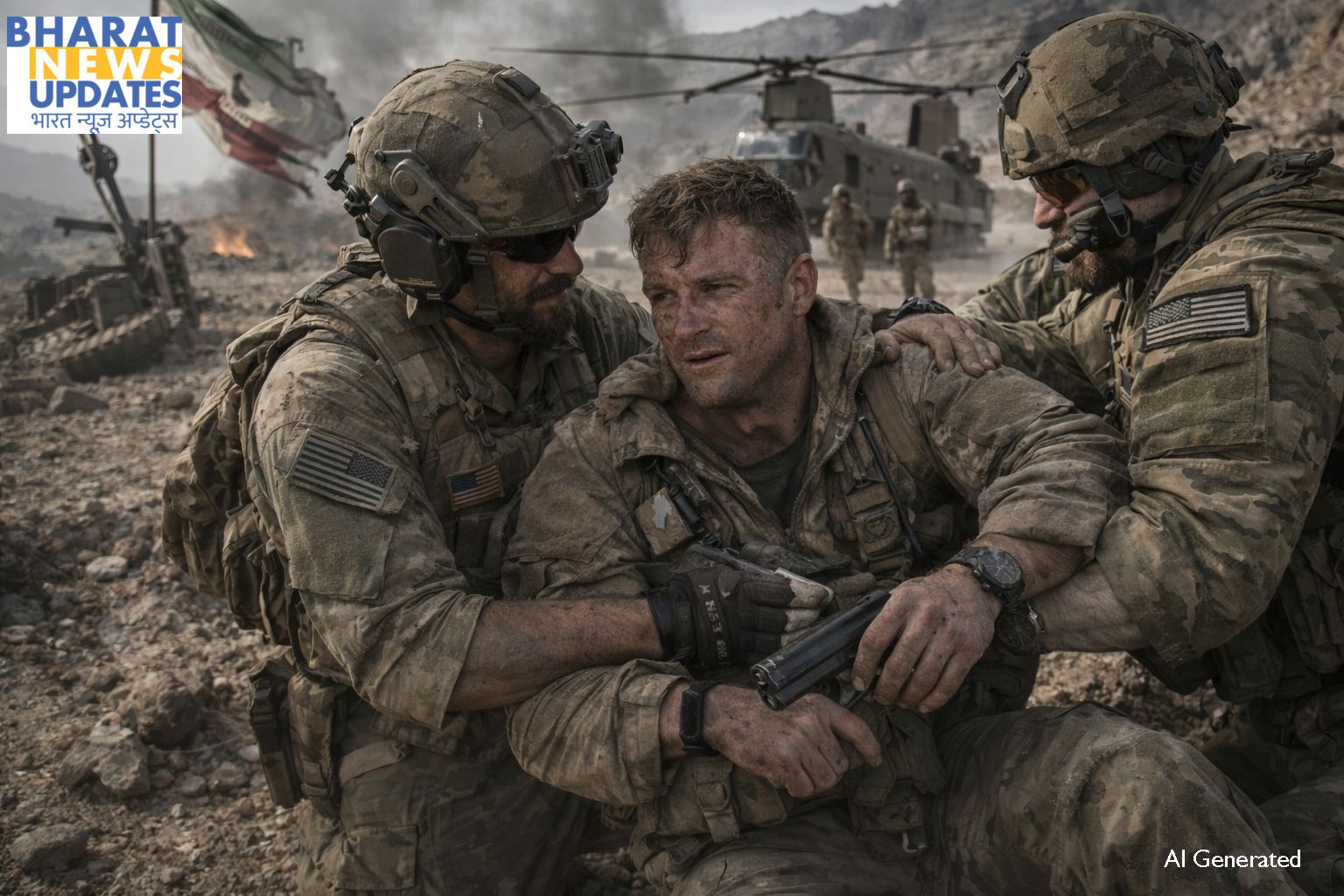
On Saturday night, a special forces team was inserted into a location near the airman‘s position— deep inside Iranian territory, completely covert, operating in blackout. The details of the insertion remain classified, and likely will for years. What is known is that the team reached him.
The colonel was injured, but alive.
The Rescue: “The Most Daring in US History”
President Donald Trump called it “the most daring search and rescue operation in US history”— one that he said would “someday make for an amazing Hollywood thriller.”
The numbers back up the drama. The airman spent nearly 48 hours alone in enemy territory, hunted by a foreign military with a cash bounty on his head. He was recovered without a single American commando killed or wounded. Trump described it as “the first time in military memory that two US pilots have been rescued, separately, deep in enemy territory.”
Iran’s military told a different story— or tried to. Military spokesman Ebrahim Zolfaghari claimed the US operation was “completely foiled,” alleging two C-130 transport planes and two Black Hawk helicopters were destroyed. No evidence was provided. No wreckage was shown. The statement carried the unmistakable smell of propaganda designed to salvage face after a humiliating intelligence and military failure on Iranian soil.
The airman is recovering. He will be fine.
What This Tells Us
This story isn’t just about one man’s courage, though that alone is extraordinary. It’s about what happens when training, intelligence, technology, and sheer human will converge at exactly the right moment.
SERE training, often dismissed as an obscure checkbox in a military career, kept a man alive for two days in one of the world’s most hostile environments. CIA tracking capabilities found him when nothing else could. And a special forces team executed a near-impossible extraction without a single casualty.
For one colonel who spent 48 hours hiding in a mountain crevice in Iran, hunted, injured, and alone— it all worked exactly as it was supposed to.
That’s the part no Hollywood script will fully capture.