Connect with us

Politics

Mamata Banerjee v/s ECI: Voter Verification or Voter Exclusion? Battle Reaches Supreme Court

Published

on

Bharatnewsupdates : Chief Minister Mamata Banejee

Mamata Banerjee Became The First Sitting Chief Minister To Argue Her Case against ECI’s SIR Process In Supreme Court Of India!

The Special Intensive Revision (SIR) of electoral rolls in West Bengal was meant to be a routine administrative exercise. Instead, it has triggered a political, legal, and constitutional confrontation — one that has now reached the Supreme Court, carrying with it anxieties far beyond the borders of West Bengal.

At the center of this moment stands West Bengal Chief Minister Mamata Banerjee, who has taken the unusual step of personally appearing before the apex court to challenge the Election Commission of India (ECI). For some, her move signals political courage. For others, it smacks of calculated drama. But strip away the optics, and what remains is a serious democratic question: how does India balance electoral purity with voter protection?

What the SIR Is — and Why It Has Sparked Fear

The SIR process aims to update voter lists by removing inaccuracies — duplicate entries, deceased voters, mismatched details, or suspicious records. In theory, this is essential for free and fair elections.

The controversy arises from how the exercise is being conducted in West Bengal.

The state government’s petition before the Supreme Court alleges that the SIR is being rushed through within months instead of years, with limited transparency and unclear communication. It warns that lakhs of voters — particularly migrant workers, women, elderly citizens, daily wage earners, and the medically vulnerable — could lose their right to vote simply because they lack the time, access, or paperwork to respond.

A key concern is the classification of voters under the “Logical Discrepancy” (LD) category. According to the petition, lists of such voters were not uploaded online despite court directions, denying affected citizens the opportunity to know what was wrong or how to fix it. If voters are unaware they are under scrutiny, how can they defend their democratic rights?

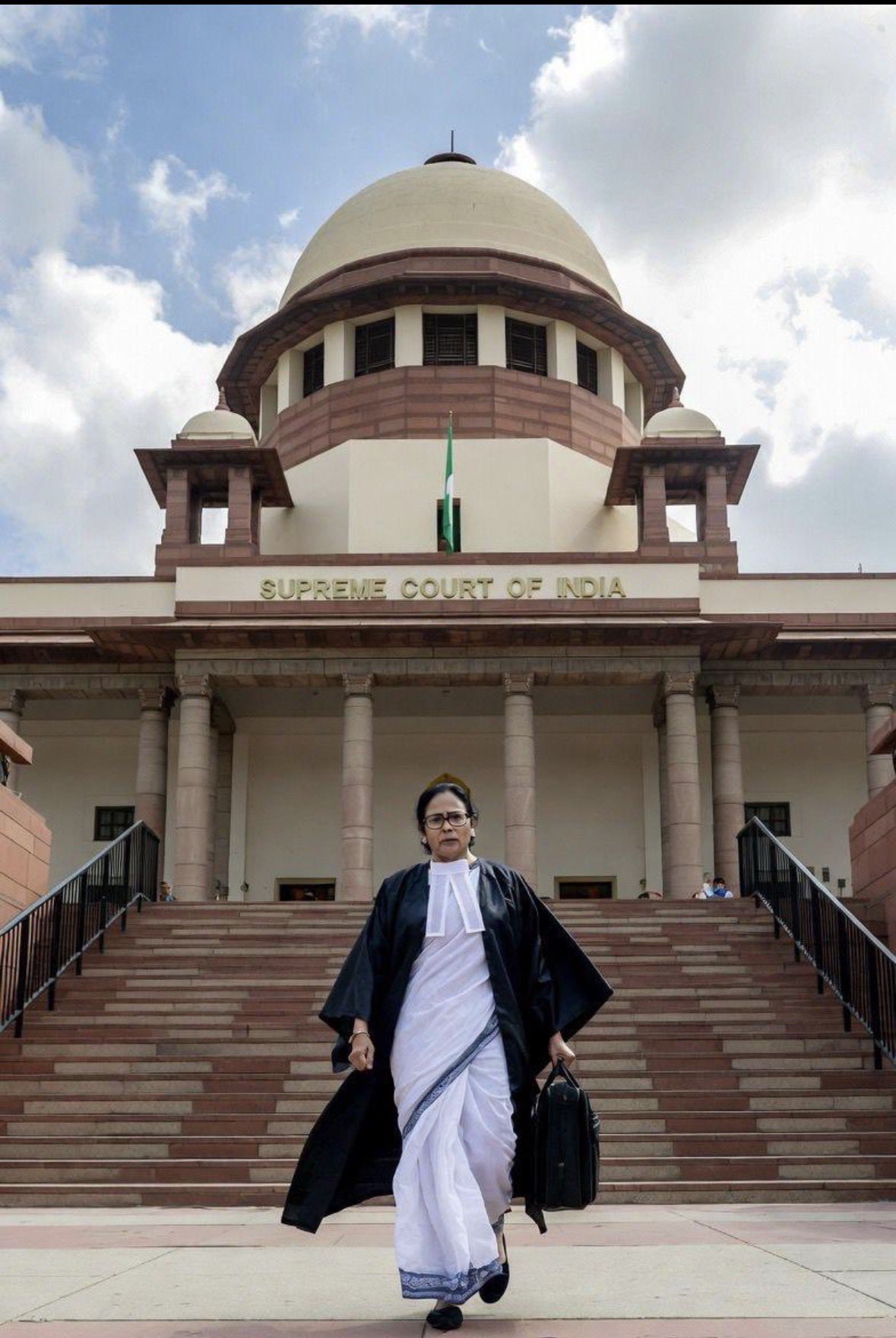
A fiery Chief Minister Steps Into Court

Bharatnewsupdates - Courtroom

The Image Is For Representation Purpose Only

Mamata Banerjee’s appearance in the Supreme Court instantly turned legal proceedings into a national spectacle. Sitting Chief Ministers rarely argue cases themselves, and her decision to do so added both symbolism and scrutiny.

Mamata Banerjee had in advance submitted an application under Article 32 of the Constitution, soliciting consent to personally appear in the court. She was present in the court arguing along with her legal team headed by her Senior Counsel Shyam Divan.

In court, Banerjee questioned the intent and timing of the exercise. Why compress a process that usually takes years into three months? Why initiate such revisions predominantly in election-bound states? Why, she asked, were repeated letters from the state government to the ECI left unanswered?

Supporters saw a leader refusing to delegate the fight for her people’s votes. Critics dismissed it as emotional overreach. Yet the courtroom atmosphere — attentive listening, judicial remarks allowing her to continue — suggested that the questions resonated beyond political loyalties.

West Bengal Electoral Rolls & SIR: Data Snapshot (Official & Reported)

Metric                                            Figure                        Source/Context

Electors in West Bengal
(Jan 2025) ~                            7.66 crore                     Election Commission, draft SIR rolls data

Electors after draft SIR
(Dec 2025) ~                           7.08 crore                    Draft roll reduction reported after phase 1

Names deleted in draft roll ~ 58.2 lakh                   Removed due to death, relocation,                                                                                                               duplication, absent voters

Dead voters identified (to Dec 1) ~ 21 lakh             Based on BLO reporting to ECI

Total votes flagged for                   1.67 crore           ECI figures on data mismatches needing
“logical discrepancies” ~                                               verification   

Unmapped voters
(no 2002 linkage) ~              30.6 lakh                      Estimated unmapped in draft phase

New enrolments vs deletions ~
deleted                                  3.24 lakh new v/s 58.2 lakh   CEO office comparison

Overall increase in voters
since 2002 +66 %              (4.58 cr → 7.63 cr)       ECI comparison of rolls over 23 years

District-Level Trends (Border Areas)

Here’s how voter lists changed between 2002 and 2025 in key west Bengal districts (ECI data):

District                Increase in Registered Voters                        Notes

Uttar Dinajpur              105.49 %                                         Highest surge among districts

Malda                               94.58 %                                         Border district with Bangladesh

Murshidabad                  87.65 %                                         Border district with major increases

South 24 Parganas       83.30 %                                          Another large increase

North 24 Parganas       72.18 %                                          Near Bangladesh border

Nadia                               71.46 %                                          Border district demographic rise

Note: Nine of the top ten districts with the highest increases are border districts — highlighting concentrated growth near the India–Bangladesh frontier.

Key Implications from Data

Large-Scale Deletions~58 lakh names were removed in the first draft of the SIR process.
Of these, ~24 lakh were identified dead, ~19 lakh shifted permanently, with other categories including “unmapped” and duplicates.

This shows that the SIR is actively removing entries from the rolls, not just flagging them for later hearsay.

Huge Increase Since Last SIR (2002)

West Bengal’s electorate has grown by ~66 % since 2002 — far faster than natural demographic expectations alone would predict.

Analysts point out that nine of the ten districts recording the sharpest growth share a border with Bangladesh — a fact difficult to ignore when discussing illegal migration, demographic pressures, and security concerns.

Discrepancies & Verification Bottlenecks

  • Over 1.67 crore entries are flagged for logical discrepancies — mismatches that will require hearings, proofs, or re-enrolment.
  • Around 30 lakh voters lacked a direct match to the 2002 roll, making them candidates for scrutiny.

This means that the next phase is not only about deletion — it’s about re-verifying huge swathes of entries to separate genuine voters from suspicious ones.

Additional Context

New enrolments during audit period were modest (~3.24 lakh) compared with the scale of deletions, underscoring that the exercise is primarily about roll correction rather than expansion.

Muslim-majority districts have seen a higher share of SIR notices compared with lower-minority areas — suggesting differential impact and raising further questions about implementation patterns.


The ECI and BJP’s Counter-Claim

The Election Commission and the BJP reject accusations of bias or political motive. According to them, the SIR is necessary precisely because electoral rolls in West Bengal have been compromised over years.

Leader of Opposition Suvendu Adhikari has accused the state machinery of protecting fake voters, inflating rolls, and deliberately ignoring illegal entries. From this perspective, SIR is not disenfranchisement but correction — an overdue effort to restore credibility to elections.

This counter-argument cannot be ignored. Electoral fraud, if left unchecked, corrodes democracy just as surely as voter exclusion does.

The Question Beneath the Question

Much of the debate around the Special Intensive Revision (SIR) has been mired in procedural arguments — timelines, forms, portals, document categories, and lists of logical discrepancies.

While such details are important, they obscure the real and urgent issue at stake:

national security and the integrity of India’s electoral democracy. West Bengal shares the longest stretch of the India-Bangladesh border, over 2,200 km, much of it riverine and difficult to monitor. That geography has historically made the state a route for both refugees and undocumented migrants, driven by economic distress, climate pressures, and socio-political factors across the border.

Concerns over illegal migration are not fringe claims. Independent research suggests that West Bengal’s electoral roll may have contained over 1 crore names more than the estimated legitimate electorate — about 13.7 % more than expected given demographic trends, birth cohorts, deaths, and verified migration data.

Bharatnewsupdates - Illegal Bangladeshi Immigrants

Between 2002, when the last comprehensive SIR was carried out, and 2025, the state’s electoral rolls expanded from about 4.58 crore to over 7.63 crore registered voters — a 66 % increase that far outpaces demographic growth rates in most other large states.

Most of this growth is concentrated in border districts — Uttar Dinajpur, Malda, Murshidabad, South 24 Parganas, North 24 Parganas, and others — all sharing a frontier with Bangladesh and all reporting disproportionately high increases in voter registrations and “logical discrepancies” flagged under SIR.

This is not mere speculation. The Election Commission and security officials have flagged unusual patterns of voter roll expansion in these areas, patterns that coincide with longstanding concerns about illegal migration, document fraud, and porous border control — issues that directly affect both national security and the legitimacy of political representation.

At the same time, the SIR exercise has already resulted in the removal of over 58 lakh names from draft rolls due to routine factors like deaths, permanent relocation, duplication, and failure to submit required documentation.

Critics argue about whether every extra name is an “illegal migrant.” Yet a democracy that does not actively and transparently verify eligibility opens itself to exploitation and erosion of trust — not just in one state, but nationwide.

This is the real constitutional fault line: a sovereign republic cannot treat citizenship as a casual claim or a negotiable status. It must protect the right to vote for genuine citizens while ensuring that illegal or fraudulent entries — whether arising from porous borders, lax documentation controls, or deliberate manipulation — do not distort electoral outcomes.

Conversely, reforms like SIR also matter because they protect lawful voters from dilution of their voice. Allowing false entries to remain undermines the essence of electoral power and shifts influence from citizens to whoever can game the system.

India faced a similar dilemma during the Assam NRC process, where verification took centre stage, but the deeper question — how to balance inclusion with security — remained unresolved. The SIR debate now forces that question back into the open, and it must be addressed with both clarity and urgency.

Because at stake is not just a list of names.

It is the very trust that underpins India’s democracy — that citizens’ votes count fairly, that the State protects its territorial and electoral integrity, and that the republic remains sovereign in both law and in practice.

What the Supreme Court Now Faces

The Supreme Court has listed further hearings and sought mechanisms to correct discrepancies. Its final ruling will do more than settle a dispute between a state government and the ECI.

It will define how far electoral authorities can go in the name of verification, and how firmly voter rights must be protected when efficiency threatens exclusion.

Why This Matters Beyond Bengal

This is not just a West Bengal story. It is a warning for the entire country.

A democracy becomes stronger when its lawful, native citizens can vote fearlessly, confident that their voice carries full weight. But that same democracy becomes fragile when illegal immigrants and non-citizens are allowed to enter the electoral system, quietly diluting the will of those who rightfully belong.

As elections grow more competitive and increasingly data-driven, the power of the State to verify, flag, and correct voter rolls will inevitably expand.

This power is not dangerous by itself. What weakens democracy is not verification — it is inaction, opacity, or the political reluctance to confront illegal inclusion.

Strip away party slogans and courtroom drama, and the conflict is not about Mamata Banerjee versus the BJP, or Bengal versus Delhi. It is about a republic drawing a clear line between citizenship and intrusion, between democratic participation and demographic manipulation.

The uncomfortable truth is this:a democracy cannot remain confident if its elections are influenced by those who do not legally belong to it.

Protecting the vote of the genuine Indian citizen is not exclusion — it is the foundation.

News

Sunetra Pawar Vahini: From Quiet Yet Strong Strength Of Ajit Dada to Maharashtra’s First Woman Deputy Chief Minister

Published

on

bharatnewsupdates : Sunetra Ajit Dada Pawar

Sunetra Pawar “Vahini”: A Quiet Life of Purpose Steps Into Maharashtra’s Most Demanding Role


History does not always arrive with slogans or drumbeats. Sometimes, it walks in softly, carrying both grief and responsibility in the same breath.

At 62, Sunetra Ajit Pawar is poised to step into one of the most consequential roles in Maharashtra’s political landscape —Deputy Chief Minister— not as a political heir by accident, but through a lifetime of disciplined service, organizational leadership and quiet determination.

Her oath-taking on January 31, 2026 at around 5.15pm, marks a powerful first in the state’s history: she will be the first woman to ever hold the Deputy Chief Minister post.

Her elevation comes just days after a personal tragedy that shook Maharashtra’s political landscape. On January 28-2026, Deputy Chief Minister Ajit Dada Pawar lost his life in a plane crash, leaving behind not just a grieving family, but a vacuum in governance and leadership. In the silence that followed the shock, Sunetra Ajit Dada Pawar’s name emerged—not as a symbol of sympathy, but as a figure of steadiness.

For many in Maharashtra, she has long been known simply as “Vahini”—a respectful, affectionate presence at public events, standing quietly beside one of the state’s most influential leaders. But that familiarity often hid a deeper truth: Sunetra  Pawar has always lived a life of work, discipline, and independent purpose.

Early Roots: A Legacy of Social Seva

Born on October 18, 1963, in Ter (now part of Dharashiv district), Sunetra’s early life was steeped in the rhythms of public life. Her father, Bajirao Patil, was a respected local leader, and her brother, Padamsinh Bajirao Patil, made his mark in regional politics during the 1980s. Growing up in a family rooted in community work gave her both confidence and an intuitive grasp of grassroots realities.

She pursued a Bachelor of Commerce from SB College in Aurangabad — a choice that would later anchor her practical roles in institutions, industries, and social initiatives that touched thousands of lives.

Beyond Politics: Business, Education and the Environment

Long before politics formally entered her life, Sunetra Pawar was deeply involved in work that rarely made headlines. In Baramati, As chairperson of the Baramati Textile Company, she played a key role in the development of the High-Tech Textile Park, a large industrial project that brought employment to rural Maharashtra. What set the project apart was not its scale alone, but its people—over 15,000 women, many from villages, found stable livelihoods there. For Sunetra Vahini, empowerment was never a slogan. It was about income, dignity, and self-reliance.

Her engagement with education is equally deep. As a trustee of Vidya Pratishthan, one of Maharashtra’s prominent educational institutions offering K12 level schools, Degree Courses and Engineering studies at various locations in and around Maharashtra, she has worked to strengthen governance, academic quality and institutional planning for more than 25,000 students.

Sunetra’s commitment to the environment is also notable. She founded the Environmental Forum of India (EFOI), and under her guidance, and since its inception in 2009, the main objective has been to conserve mother nature and serve the community in various ways for the betterment of society. The eco-village model — first piloted in Katewadi — emphasised water conservation, renewable energy and local
livelihood sustainability. Her environmental advocacy has won respect across civil society.

Bharatnewsupdates : Ajit & Sunetra Pawar Family

A Political Journey Forged in Purpose

Though not a seasoned politician initially, Sunetra stepped into formal politics with purpose and conviction. She was elected to the Rajya Sabha in June 2024, representing Maharashtra — a recognition not just of her lineage, but of her organizational credibility and broad vision.

In the 2024 Lok Sabha elections, she contested from Baramati but lost narrowly — a moment she described publicly as a catalyst to deepen her engagement rather than retreat from it.

She listened, reflected, and continued to work, understanding that public life is a long journey, not a single verdict.

Now, in the most unexpected and painful circumstances, that journey has brought her to Mantralaya as a Deputy Chief Minister.

Historic Elevation in a Time of Transition

With the untimely death of Ajit Dada Pawar on January 28, 2026, the Nationalist Congress Party faced both emotional grief and strategic decisions for leadership continuity. The party’s legislature wing gathered and unanimously elected Sunetra as its leader — a move that binds respect for legacy with confidence in her capability.

Her selection as leader of the NCP legislature party was unanimous—not out of sentiment alone, but trust. Those who have worked with her speak of her calm temperament, her ability to listen, and her habit of making decisions without theatrics. As Deputy Chief Minister, she is expected to take charge of portfolios previously held by Ajit Pawar, except finance and planning—a responsibility that would test even the most seasoned politician.

What makes this moment historic is not only that Sunetra Pawar is the first woman Deputy Chief Minister of Maharashtra, but that she represents a different kind of leadership—one shaped in classrooms, factory floors, village meetings, and years of silent work.

Her oath is not just a political transition. It is a reminder that strength does not always announce itself. Sometimes, it has been preparing quietly for decades.

A Personal Journey: Strength in Grace

Those close to her describe Sunetra Vahini as grounded, empathetic and thoughtful — qualities forged as much in personal loss as in public life. Her story is not one of inheritance, but of evolving readiness: a woman who walked her own path, stepped into leadership with resolve, and now stands ready to serve a state in transition.


Continue Reading

News

Shock, Silence, and a Political Vacuum in Maharashtra: An NDA Ally, Deputy Chief Minister, and NCP Chief Ajit Dada Pawar Dies in a Plane Crash

Published

on

Bharatnewsupdates - Ajit Dada

Today morning, Maharashtra wakes up not to headlines, but to Shock, disbelief and grief.

The name that Maharashtra has spoken for over four decades—with familiarity, disagreement, admiration, and dependence: Ajit Dada Pawar is no more.

Bharatnewsupdates - Ajit Pawar

The fiery, outspoken, intelligent, visionary and a people’s leader sixty-six year-old Maharashtra Deputy Chief Minister, NDA ally and Nationalist Congress Party (NCP-AP faction) leader Ajit Dada Pawar was among five people killed on Wednesday 28th January 2026 morning when their Bombardier Learjet-the aircraft, a business jet crashed while landing around 8:45 a.m. at Baramati airport section amid poor visibility. The Dada was flying from Mumbai to attend Zilla Parishad election events at Baramati, district Pune.

The Directorate General of Civil Aviation (DGCA) has confirmed that all five people on board the plane have been killed. According to Flight Radar, the flight took off from Mumbai at 8:10 a.m. and it disappeared from radar around 8:45 am. There were five people on board when the aircraft crashed at 8:50 a.m., a police official said in a statement.

The Aircraft Accident Investigation Bureau (AAIB) will launch a probe into the fatal Baramati plane crash. The AAIB team will soon visit the crash site.

Maharashtra’s Deputy CM Ajit Pawar and four others were killed in the crash, today.

The news of the plane crash is going to be altered the course of the state’s politics, and of a name that has been inseparable from Maharashtra’s power structure for over four decades: Ajit Dada Anantrao Pawar. The atmosphere that now grips Maharashtra—a mix of shock and question.

For Ajit Dada Pawar was not merely another office-holder. He was an institution of work, authority, and relentless governance.

Remain As A Memory – Maharashtra CM Devendra Fadnavis, Maharashtra Dy CM Eknath Shinde with Maharashtra Dy CM Late Ajit Dada Pawar

Born on 22 July 1959, an eight-term MLA from Baramati Assembly Constituency, a former MP, a six-time Deputy Chief Minister, and a finance minister trusted even in unstable coalitions, Ajit Dada Anantrao Pawar was known less for oratory and more for outcomes.

A 21 Yr old would’ve been embarrassed looking at his energy at 66 Yrs. used to get up at 5 am. Used to start his official work at 6 am. Day never used to end up before late midnight. But never a sign of tiredness on his face. A true grassroot leader.

Much of who Ajit Dada Pawar became cannot be spoken of without mentioning Sharad Pawar, his uncle, mentor, and towering presence in Indian politics. Sharad Pawar did not merely introduce him to public life; he shaped his instincts. From him, Ajit Pawar learned the grammar of power in Maharashtra—how rural cooperatives breathe, how sugar belts decide elections, how irrigation is not just water but politics, livelihoods, and dignity.

Yet, over time, Ajit Pawar stepped out of that shadow, forging an identity that was unmistakably his own: decisive, impatient with indecision, fiercely administrative.

He spoke bluntly, often impatiently but with honesty, sometimes controversially. But few questioned his grasp of governance or his ability to move the system. Minister of several departments (Finance and Planning, Energy, Water Resources, Rural Development, Water Supply and Sanitation, Irrigation, etc.)- his imprint was everywhere.

As the Finance Minister, Ajit Dada never let the economic clock of the state slip. He made financial provisions for many development projects in the state. Lakhs of people in Maharashtra along with the workers of Nationalist Congress party have a feeling of being defeated and leaderless today.

The kingdom has suffered immense losses due to the demise of Ajit Dada as He was, to many, the embodiment of relentless work.

The Baramati plane crash did not claim only Ajit Dada’s life. Besides Ajit Dada, the mentioned individuals also died in this tragic accident: Sumeet Kapoor: Pilot, Sambhavi Pathak: Co-pilot, Videep Jadhav: PSO. Pinky Mali: Crew Member

MP Supriya Sule cousin, Ajit Dada Pawar’s wife Sunetra Pawar and son Parth Pawar reached Baramati following the tragic plane crash that claimed the life of Maharashtra Deputy Chief Minister Ajit Dada Pawar. Visibly overcome with grief at the airport, Supriya Sule broke down and said, ‘Sabka ladla chala gaya’, remembering her cousin and ‘Dada’, as family members and supporters gathered to mourn the loss.

The last rites of Maharashtra Deputy Chief Minister Ajit Pawar, killed in a plane crash, will be held with full state honours on Thursday (January 29, 2026) in Baramati, Pune district.

Union Home Minister Amit Shah, BJP National President Nitin Nabin, Maharashtra CM Devendra Fadnavis, Maharashtra Deputy CM Eknath Shinde, Maharashtra Governor Acharya Devvrat and many leaders from various opposition parties are expected to attend the last rites, which will be held at Vidya Pratishthan ground, Baramati at 11 a.m. with full state honours to acknowledge Ajit Dada whose working relationship with power was respected even by opponents.

The Condolence from some leaders

Maharashtra Dy CM Ajit Dada Pawar With PM Narendra Modi, Maharashtra Dy CM Eknath Shinde And Others.

PM Narendra Modi wrote on X- Shri Ajit Pawar Ji was a leader of the people, having a strong grassroots level connect. He was widely respected as a hardworking personality at the forefront of serving the people of Maharashtra. His understanding of administrative matters and passion for empowering the poor and downtrodden were also noteworthy. His untimely demise is very shocking and saddening. Condolences to his family and countless admirers. Om Shanti.

Maharashtra CM Devendra Fadnavis wrote on X- Dada is no more!
My dear friend and colleague, a mass leader with a strong people’s connect, Deputy Chief Minister Ajitdada Pawar lost his life in a plane accident. This is an extremely shocking, heart wrenching news. I’m numb. I do not have any words to express these devastating emotions.
I have lost my brave friend with a huge heart.
This is a tragic and personal loss for me. And it is irreparable loss! I pay my deep, humble, heartfelt respects to dear Dada. My deepest condolences to his entire family and NCP family. We stand together with them in sorrow and tough times. 4 more people lost lives in this accident. My condolences to their families too. We are with them. I’ve cancelled all my scheduled programs and will go to Baramati.

Aum Shanti

Maharashtra Dy CM Eknath Shinde wrote on X-
” My elder brother went. Ajit Pawar’s death has brought down a mountain of grief in Maharashtra. The entire Maharashtra has suffered huge losses. Such a thought did not occur in any dream. Ajit Dada was a man of his word. We worked as a team when I was the CM, and he was Dy CM. As team we had started the Ladli Behen Yojana, and Ajit dada played an important role in it..”

Deputy Chief Minister of Andhra Pradesh Pawan Kalyan wrote on X-
Deeply shocked by the tragic news of the passing of the Maharashtra Deputy Chief Minister, President of NCP and an NDA alliance leader, Sri Ajit Dada Pawar ji, in a devastating plane crash today. His dedicated public service and immense contributions towards the welfare and development of the people of Maharashtra will always be remembered, and his enduring commitment to the people will continue to be held with respect.
I express my profound condolences on his passing and extend my deepest sympathies to his family members, admirers, and party cadre during this moment of immense grief.


The Succession

The question of succession has also begun to surface, quietly but inevitably. Will the mantle fall to wife Sunetra Tai Pawar, whose recent political foray brought her into public view beyond Baramati? Or to son Parth Pawar, whose name carries legacy but whose political journey remains unfinished? Or will seasoned leaders like Praful Patel, Chhagan Bhujbal, or Sunil Tatkare attempt to consolidate control?

In moments like these, parties fracture or find new centres or merge—future offers surprise outcomes to consolidate NCP-AP faction.

About the trending Assassination Conspiracy Through Plane Crash

Bharatnewsupdates - Ajit Pawar and Sharad Pawar

Today, after Ajit Dada’s death due to a plane crash, reacting to W. Bengal CM Mamata Banerjee’s reaction, NCP Supremo and former Maharashtra CM Sharad Pawar released a statement saying, “The accidental death of Ajit Pawar is a tremendous shock to Maharashtra. Today, Maharashtra has lost a capable and decisive leader. The loss is irreparable, but some things are simply beyond our control. I wasn’t planning to speak to the media today, but I learned that some media outlets were suggesting from Kolkata that there was some political angle behind this accident. But there is no politics involved; this is purely an accident. The pain of this death is felt by Maharashtra and all of us. Please do not bring politics into this. That’s all I wanted to say.”

This statement by Pawar Senior put an end to the political controversy being created by vested political leaders and parties.

Continue Reading

Politics

UP Voter List Shake-Up: Nearly 3 Crore Names Missing in Draft Roll After Special Intensive Revision (SIR), Cities Lead Deletions

Published

on

Bharatnewsupdates : UP SIR Draft 6 Jan 2026

The Election Commission’s Special Intensive Revision (SIR) of the Uttar Pradesh voter list has thrown up startling numbers. The draft electoral roll, released on Monday, shows that nearly 3 crore voters are missing compared to the previous list — a development that is likely to trigger political debate and voter anxiety ahead of future elections.

Addressing a press conference in Lucknow, Uttar Pradesh Chief Electoral Officer Navdeep Rinva said the new draft roll contains 12,55,56,025 voters, down from 15,44,30,092 voters in the existing list.

In simple terms, 18.7 per cent of voters from the old list do not feature in the new draft roll.

The exercise during SIR

According to election officials, the SIR process involved door-to-door verification by Booth Level Officers (BLOs), collection of enumeration forms, and categorization of voters based on their current status.

Out of the total electorate:

81.3 per cent voters submitted their enumeration forms
2.89 crore names were dropped from the draft list

The deletions fall into four broad categories:

Break-up of deleted voters

  1. Deceased voters: 46.23 lakh names (2.99%) were removed after being verified as dead.
  2. Shifted voters: The biggest chunk — 2.17 crore voters (14.04%) — were marked as having shifted residence and could not be traced at their registered address.
  3. Duplicate entries: 25.47 lakh names (1.65%) were deleted as they appeared more than once in the rolls.

Election officials maintain that these corrections are essential to clean up voter rolls and eliminate ghost or duplicate voters.

However, the sheer scale of “shifted” voters has raised eyebrows.

Top districts with maximum Voter deletions

  1. Lucknow – 12,00,138 voters removed
  2. Prayagraj – 11,56,305 voters removed
  3. Kanpur Nagar – 9,02,148 voters removed

Other major districts with high deletions include:

  1. Agra: 8,36,943
  2. Ghaziabad: 8,18,139
  3. Meerut: 6,65,635
  4. Gorakhpur: 6,45,625

Officials admit that in several urban districts, more than one-fifth of the electorate was marked “uncollectable” due to people moving houses, changing cities for jobs, or living at temporary addresses.

Border districts also show concern

Apart from cities, border and migration-prone districts such as Bahraich, Shravasti, Balrampur, Siddharthnagar and Maharajganj reported a large number of voters marked absent or untraceable.

These districts often see seasonal migration, cross-border movement, and weak documentation, making voter verification challenging.

How to check if your name is deleted

Bharatnewsupdates - UP EC CEO Navdeep Rinwa

Uttar Pradesh Election Commission Chief Electoral Officer (CEO) Navdeep Rinva urged citizens to check their status immediately.

Voters can visit:

ceouttarpradesh.nic.in
voters.eci.gov.in

Names are listed under the ASDDR category:

  1. A – Absent
  2. S – Shifted
  3. D – Dead
  4. D – Duplicate
  5. R – Refused enumeration

The SIR 2026 draft roll is available for download on the ECI website.

What to do if your name is missing

If a voter’s name does not appear in the draft list:

Form-6: For inclusion of name (new or deleted voters)
Form-6A: Overseas voters
Form-7: Objections or removal
Form-8: Corrections in details

Forms can be submitted through:

  1. Booth Level Officers (BLOs)
  2. Voter Registration Centres at tehsil offices
  3. ECINET mobile app
  4. voters.eci.gov.in

Key dates to remember

Claims & objections period: January 6 – February 6, 2026
Disposal of claims: Till February 27, 2026
Final voter list publication: March 6, 2026

Election officials insist that no genuine voter will be left out if they file claims on time. But with nearly 3 crore names missing in the draft, the coming weeks will be crucial — not just for voters, but for the credibility of the electoral process itself.

Continue Reading

Trending