

Monday’s Market Crash, Nifty Below 22,600: When War, Oil, and the Dollar All Attack India at Once!
March 23, 2026—Mumbai
On most bad market days, investors find refuge somewhere. Equities fall, but gold holds. The rupee slips, but bonds absorb the shock. Monday, March 23, 2026, offered no such comfort. In a rare and deeply unsettling convergence, India’s benchmark indices, the currency, and safe-haven metals all declined simultaneously— a signal that what the market is dealing with is not volatility. It is a structural crisis of confidence.
The Numbers Tell the Story First
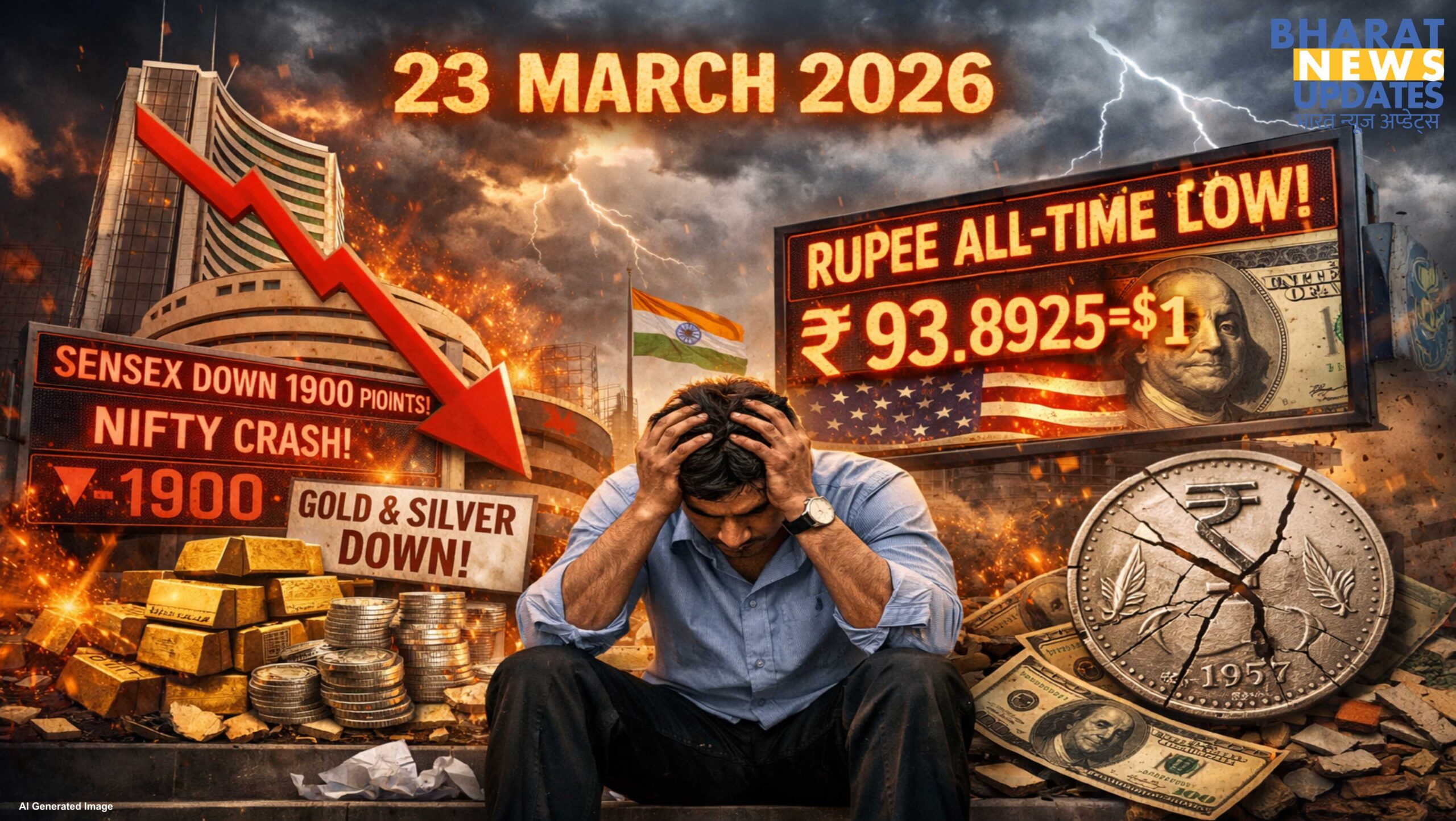
The BSE Sensex dropped as much as 1,900 points, or 2.50%, from its previous close of 74,532.96, while the Nifty 50 fell to an intraday low of 22,504— a decline of 610 points or 2.60%. By end of session, Sensex closed at 72,696, down 2.46%, and Nifty settled at 22,512, down 2.60%. Investors lost nearly ₹8 lakh crore in market value within minutes, as total BSE market capitalization dropped from roughly ₹429 lakh crore to ₹421 lakh crore.
The selling was not limited to one pocket. All sectoral indices traded in the red, with the Nifty PSU Bank index leading losses at over 3%, followed by Metal, Consumer Durables, and Realty. The Nifty Midcap 100 and Smallcap 100 indices each fell nearly 2.5%. Among blue-chip names, HDFC Bank, SBI, ICICI Bank, Bharti Airtel, L&T, Bajaj Finance, M&M, Tata Steel, Axis Bank, Reliance Industries, ITC, and Titan were among the heaviest drags on the headline indices.
Is the Middle East War the Only Reason? No.
The headlines blame the US-Iran conflict, and rightly so— it is the proximate trigger. The fresh trigger came after Trump issued a 48-hour ultimatum to Iran to “fully open” the Strait of Hormuz, while Iran threatened to strike regional energy sites if US and Israeli forces targeted its power plants. This sent Asian markets tumbling: Japan’s Nikkei plummeted 3.9%, China’s Shanghai Composite declined 2.5%, and Hong Kong’s Hang Seng tanked 3.4%.
But the war is a lit match in a room full of dry kindling. The kindling was already there:
1. Crude Oil at Crisis Levels: Brent crude surged past $112 per barrel, with fears of it breaching $130 if the conflict escalates further. For India— which imports over 85% of its crude requirement — every $10 increase in Brent adds roughly ₹1 lakh crore annually to the import bill, pressuring the current account deficit and fueling inflation.
2. Relentless FPI Exodus: Foreign Portfolio Investors have sold close to ₹90,000 crore worth of Indian equities so far in March, putting the month on track for the heaviest monthly foreign outflows since October 2024. The reasons go beyond geopolitics. According to VK Vijayakumar, FPIs regard South Korea, Taiwan, and China as better markets to invest in, since they are relatively cheaper than India even after the recent correction, and corporate earnings prospects in these markets appear better.
3. Rupee at Record Low: The rupee weakened to a record low of 93.8925 against the US dollar, falling roughly 18 paise in early trade. A weaker rupee compounds the oil problem— it makes every imported barrel more expensive in rupee terms, accelerates inflation, and triggers further capital flight.
4. The Fed’s Shadow: Elevated oil prices have fueled inflation fears and lowered the likelihood of a near-term Federal Reserve rate cut, with some traders now pricing in a potential rate hike toward year-end. That prospect strengthens the dollar globally, draws capital away from emerging markets like India, and tightens financial conditions just when the economy can least afford it.
5. India VIX Spikes: The India VIX, often called the market’s fear gauge, surged nearly 10% to cross the 25 mark— a level that signals traders are bracing for sharp intraday swings and uncertain near-term direction.

Gold and Silver: When Safe Havens Stop Being Safe
The most disorienting aspect of Monday’s market action is that gold and silver— assets investors typically rush into during crises — are also falling, and falling hard.
On the Multi-Commodity Exchange (MCX), gold prices fell by 4.92% to ₹1,37,377 per 10 grams, while silver dropped 6% to ₹2,13,166 per kg. In Delhi’s retail market, 24K gold dropped to ₹14,017 per gram, while silver declined ₹15,000 per kilogram to ₹2,30,000.
Why is a war driving gold lower? The answer lies in the interest rate paradox. Analysts at Axis Securities note that COMEX gold witnessed its steepest weekly decline in decades, pressured by rising Treasury yields, a stronger dollar, and profit-taking as investors liquidated positions to offset losses elsewhere. Globally, spot gold fell over 2% to a near four-month low, with April US gold futures declining 4.4%. Silver has more than halved from its peak of ₹4,39,337 per kg recorded in late January 2026.
The message here is stark: when rate-hike fears dominate, even gold yields to the dollar.
Trump’s Five-Day Pause: Relief or False Dawn?
Late Monday brought one piece of cautious optimism. US President Donald Trump postponed threatened strikes against Iranian energy infrastructure and power plants for five days, pending the outcome of what he described as talks with Iran to end the 24-day war. The news sent oil down sharply and stock futures soaring, with Brent crude pulling back from near $113— its highest since 2022— by roughly 8%.
But investors should not mistake a pause for a resolution. Iran’s Foreign Ministry denied that any talks had taken place, calling Trump’s remarks “part of efforts to reduce energy prices and buy time to implement his military plans.” The five-day window is a diplomatic placeholder, not a ceasefire. Markets may see a technical bounce in the coming sessions, but any recovery that is not backed by a genuine de-escalation will be fragile and short-lived.
What This Moment Signals
The simultaneous fall of equities, the rupee, gold, and silver is not noise. It is the market pricing in a scenario where inflation stays elevated, rate cuts get pushed further out, the current account deficit widens, and foreign capital keeps leaving. For India, the vulnerability is structural: a high oil import dependence, a currency sensitive to global risk appetite, and benchmark indices where foreign investors still hold significant sway.
The five-day Trump pause buys time. But until the Strait of Hormuz reopens, crude stabilizes below $90, and the Fed signals dovishness — none of which is visible on the horizon— Indian markets will remain in a state of managed anxiety. Long-term investors with a 3–5 year view may find select beaten-down quality stocks offering entry points. Short-term traders should respect the volatility and wait for confirmed support levels, particularly Nifty‘s critical zone of 22,500–22,700.
The market is not broken. But it is being tested in ways it has not been in years.