

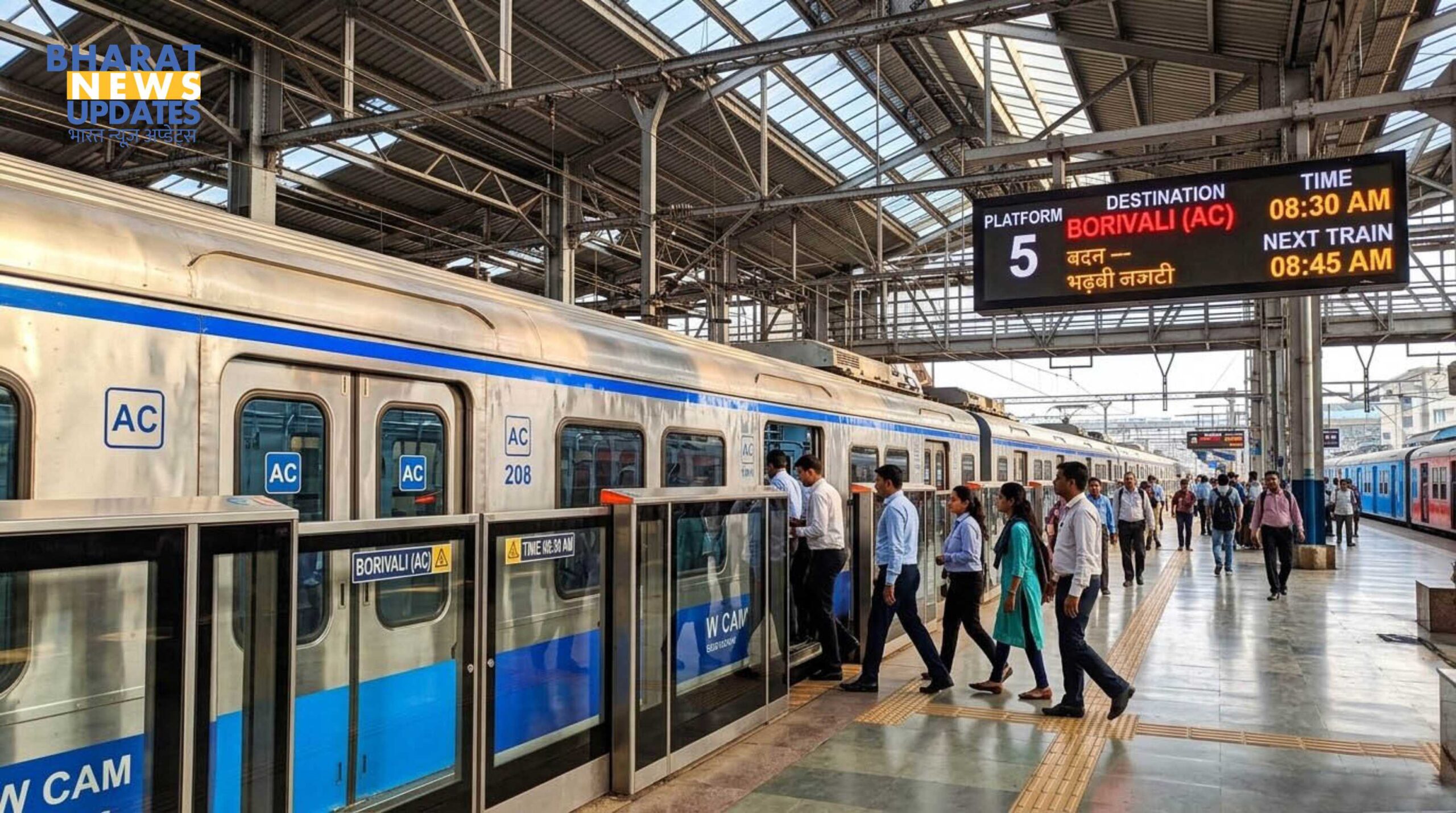
Mumbai’s Lifeline Gets a Long-Overdue Upgrade: 238 New AC Locals Are Coming and They’re Built for the Impossible
For millions of Mumbaikars, the local train isn’t a convenience. It’s a lifeline. And it’s about to change in ways the city hasn’t seen in decades.
Ask any Mumbaikar what defines the city and somewhere between the sea and the street food, they’ll mention the local train. It is the circulatory system of a metropolis of over 21 million people. Every single day, close to 8 million commuters more than the entire population of Switzerland board Mumbai’s suburban rail network. They squeeze into compartments. They hang off doors. They run alongside moving coaches because missing a train doesn’t mean being late; it means losing an hour of your life.
The network runs across three corridors— Western, Central, and Harbour lines threading through the length and breadth of the city from Churchgate to Dahanu Road, CST to Kasara and Khopoli, and Panvel to Andheri. Together, these lines clock over 3,000 services a day across roughly 465 kilometres of track. It is, by any measure, one of the most intensely used urban rail systems on earth.
And until recently, it was running mostly on trains designed for a different era.
What Mumbai’s current fleet actually looks like
The bulk of Mumbai’s suburban fleet today runs on older EMU (Electric Multiple Unit) rakes non-air-conditioned coaches that have served the city faithfully for decades. They are robust, reliable, and utterly stripped of comfort. Wooden or hard plastic seats, ceiling fans that battle the humidity in the monsoon, and zero insulation from the noise, dust, and heat of a coastal Indian city in May.
AC locals were introduced initially on the Western line but in limited numbers. The uptake was gradual, partly due to higher fares and partly due to limited availability. For most commuters on the Central and Harbour lines, an AC train remains an occasional luxury, not an everyday reality.
The summer months are brutal. Peak-hour trains in April and May turn into rolling pressure cookers. Crush load the number of passengers per metre of train regularly hits figures that most developed-world transit systems would consider an emergency. In Mumbai, it’s Tuesday.
Why 238 new AC trains, and why now?
The Mumbai Railway Vikas Corporation (MRVC) the body responsible for the city’s rail infrastructure upgrades has floated what is arguably one of the most ambitious rolling stock tenders in India’s history. The project: 238 state-of-the-art AC trainsets, worth Rs 19,293 crore, custom-engineered for Mumbai’s specific conditions.
These won’t be off-the-shelf trains. The spec sheet reads like a challenge issued to the global railway industry: achieve 130 kmph operating speed, handle Mumbai’s Super Dense Crush Load (SDCL), survive the salt-laden coastal air that corrodes metal and degrades electronics, and do all of it within a 20.32-tonne axle load limit the maximum the city’s aging tracks and bridges can carry.

Global manufacturers have responded. Queries from international industry players have been so detailed and so numerous that MRVC has fielded over 2,000 technical, commercial, and legal questions across two pre-bid conferences. The tender is expected to be finalised by June.
MRVC Chairman and Managing Director Vilas Wadekar, speaking to media, said “We are procuring 2,856 coaches, equivalent to 238 twelve-car air-conditioned rakes, named Vande Metro Suburban. This is part of the Make in India and Atmanirbhar Bharat initiatives. The tender process is underway, and manufacturing will take place in India…” He wasn’t exaggerating.

What makes these trains different
The 130 kmph top speed is the headline number, but it’s not the most interesting part. What makes these trainsets genuinely remarkable is how much engineering has gone into solving Mumbai-specific problems that no other city in the world faces at this scale.
Take SDCL—Super Dense Crush Load. In global transit terms, a crush load is already an extreme figure. Mumbai’s SDCL is so dense that engineers compare it to heavy-haul freight operations, not standard urban commuting. Most international train designs simply can’t handle the weight and stress this puts on the chassis, bogies, and suspension systems over decades of daily use.
Then there’s the coastal environment. Salt air, humidity, monsoon flooding, and temperature swings are a constant and they destroy electrical systems, corrode undercarriages, and degrade insulation if not accounted for in the original design.
The HVAC systems in these new trains are being designed specifically for Mumbai’s passenger density. That means not just cooling the air but managing it one notable design decision is the complete segregation of luggage compartments to prevent odour from circulating into passenger areas. It’s a small detail, but anyone who has endured a summer commute next to a pile of fish crates will appreciate it.
On seating, MRVC studied everything Metro-style longitudinal benches, Japanese flexible bay configurations, transverse seating. Field trials and commuter feedback eventually pointed to retaining the existing lateral seating arrangement, partly because alternatives resulted in a 20% drop in seating capacity. In a city where seats are a competitive sport, that’s not a trade-off anyone is willing to make.
Flexibility built in for the future
While the standard formation is 12 cars, the new rakes are designed to be reconfigured as 15-car or 18-car trains future-proofing them as platform extensions and power supply upgrades are completed across the network. A Train Control and Monitoring System (TCMS) will serve as the digital brain of each rake, coordinating propulsion, braking, doors, and more, allowing seamless reconfiguration as infrastructure evolves.
Work on platform extensions and power upgrades is already underway, and MRVC‘s immediate priority is scaling up 15-car AC services to boost capacity before the longer-term 18-car buildout matures.
What this means for the daily commuter
Eight million daily passengers. Forty-degree summers. Three lines, thousands of services, and decades of deferred comfort.
The arrival of 238 new AC trains won’t fix everything overnight, phased induction will take time but the scale of this procurement is unprecedented in Mumbai’s suburban rail history. For commuters on the Central line who’ve waited years for AC expansion, and for Harbour line passengers who’ve largely been an afterthought in capacity planning, this is significant.
More AC trains means more services, more cooling, and eventually, a meaningfully less crushing daily commute. For a city whose trains have carried its people loyally and relentlessly for over a century, that feels like the least it deserves.