

The Jhalmuri Moment: When Bengal’s Spicy Street Snack Became the Taste of History
How a bowl of puffed rice at Bharat Mandapam marked India’s most remarkable democratic milestone
There’s something quietly extraordinary about June 10, 2026. On this day, Prime Minister Narendra Modi completed 4,399 consecutive days in office surpassing the record of Pandit Jawaharlal Nehru as an elected Prime Minister after India’s first general elections. And how did the man who just rewrote Indian political history choose to mark the moment? Not with champagne. Not with a gold-plated gavel. With jhalmuri, a Rs 20/- street snack from the lanes of Bengal.
The detail is almost too perfect to be scripted.
The Snack That Stole the Show
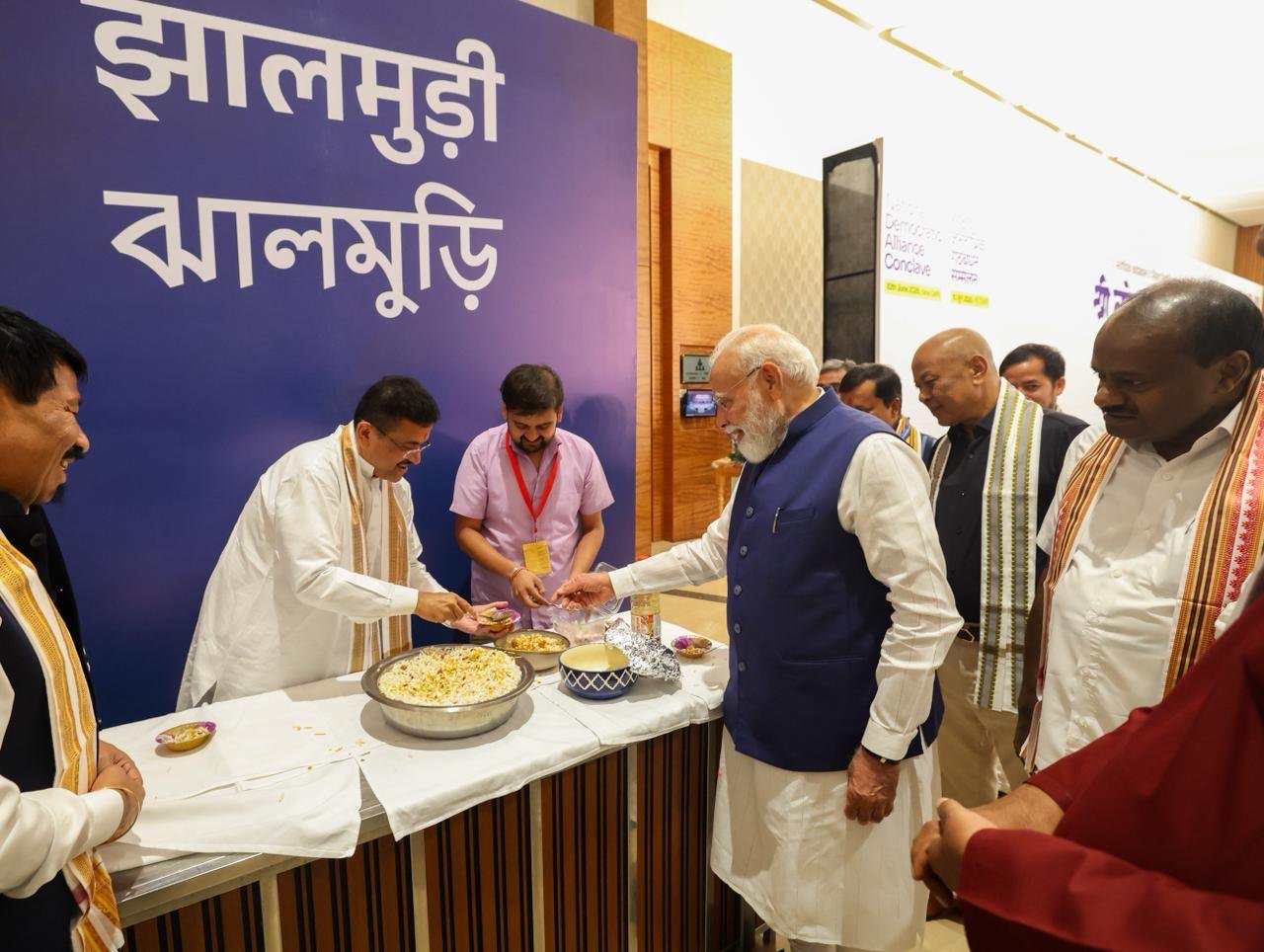
West Bengal Chief Minister Suvendu Adhikari personally served the popular Bengali snack to Prime Minister Modi during the NDA meeting at Bharat Mandapam, held to celebrate both the 12-year milestone and Modi becoming India’s longest continuously serving elected Prime Minister. There were no grand garlands, no ornate mementos being handed over, just a man who had just wrested Bengal from decades of Trinamool Congress rule, standing behind a jhalmuri counter, spooning puffed rice into a bowl.


Modi took a bite. Then typically PM Modi, he turned to the vendor and asked him to serve the snack to every NDA leader gathered around the counter. BJP President Nitin Nabin, Andhra Pradesh CM Chandrababu Naidu, Pawan Kalyan, all of them, presidents and deputy CMs and cabinet ministers, waiting their turn for street food in the corridors of India’s grandest convention centre.
The Prime Minister then did what this generation’s leaders do: he pulled out his phone. Modi posted the video on Instagram, captioning it: “A Jhalmuri break during the NDA meeting at Bharat Mandapam. All our leaders greatly enjoyed this snack!” The video went viral before the meeting had even ended.
Why Jhalmuri, and Why Now?
Here’s what most coverage missed: this wasn’t the first time jhalmuri had appeared in Modi’s political story. The snack had already emerged as a symbol of BJP’s electoral campaign in the West Bengal Assembly polls, after Modi made an unexpected stop in Jhargram during rallies for a quick bite. Jhalmuri, in that context, wasn’t just street food. It was a statement that a Prime Minister could eat from a Bengal roadside stall, that the distance between Delhi and Kolkata was shorter than people thought.
And now, with Suvendu Adhikari as Chief Minister of a state that the BJP had contested for thirty years, the snack had come full circle. The jhalmuri had, in a sense, won.
The jhalmuri recipe itself is deceptively simple-puffed rice, raw onions, green chillies, mustard oil, roasted peanuts, a squeeze of lemon, and a lashing of tamarind chutney mixed at breathtaking speed in a cone made of newspaper. What makes it special is the mustard oil. That sharp, almost aggressive bite is uniquely Bengali, and it doesn’t apologize for itself. Much like the political journey it now symbolizes.

The Conclave That Made History
Leaders from all 22 NDA-ruled states and union territories gathered at Bharat Mandapam: 72 leaders in total including Chief Ministers, Deputy Chief Ministers, and senior Union Ministers. It was, by scale and symbolism, the most significant gathering of the ruling alliance since the 2024 election victory.
The highlight was a formal resolution honouring the Prime Minister’s record tenure moved by Andhra Pradesh Chief Minister Chandrababu Naidu and supported by Nagaland CM Neiphiu Rio. That Naidu, a partner whose TDP holds significant coalition weight, proposed the resolution was itself a signal — this was not a BJP party function, but an alliance celebration.
Pawan Kalyan, Deputy CM of Andhra Pradesh and founder of Jana Sena, sat alongside Naidu. The optics were deliberate: the man who beat Nehru’s record was being congratulated by allies who came from outside the BJP, in a hall that had no opposition.

What Modi Said and What He Meant
Modi dedicated the feat to the people and NDA constituents, calling “liberation from Congress misrule” the top achievement of 12 years in power. He didn’t stop there. He corrected the historical record in real-time, arguing that the so-called “Hindu growth rate” India’s notorious 3-4% GDP crawl of earlier decades should rightfully be called the “Congress growth rate,” blaming policy indecision and governance failure rather than any cultural tendency.
He cited airports growing from 74 in 2014 to over 160 in 2026, expressways expanding from 1,000 km to 6,700 km, metro networks spreading from 5 cities to over 20, and defense exports jumping from Rs 700 crore to Rs 23,000 crore in the same period. These aren’t just numbers, they’re the scaffolding of an argument that governance, not just intention, changed.
The Cabinet, separately, passed a resolution expressing confidence that under his leadership India would “scale new heights as a self-reliant, secure and prosperous nation,” and gave Modi a standing ovation as he completed his 4,399th day in office.
The World Watches
The congratulations arrived from across the globe, some expected, some quietly significant.
Italian PM Giorgia Meloni posted on X with a photograph of herself and Modi: “Congratulations to @narendramodi who today becomes the longest-serving elected Prime Minister in the history of India. It has been a pleasure to meet again in Rome and to launch together a Special Strategic Partnership.”
Former Australian Prime Ministers Tony Abbott, Malcolm Turnbull, and Scott Morrison jointly noted that under Modi, India had become the world’s third superpower while “maintaining free elections, a riotously free media and a robustly independent judiciary.”
Russia’s Vladimir Putin, whose own lengthy hold on power carries a very different democratic texture, sent congratulations, a leader who has governed for over two decades recognizing another who did it three elections in a row, without a single interruption, without emergency rule, without amendment of term limits.
The Hidden Contradiction at the Heart of It All
Here is what nobody quite says out loud: Nehru’s record, the one Modi just surpassed, counts only from after the 1951-52 general election. Nehru remained PM from 1947 until his death in 1964, a stretch that included years before India held its first general election. The record Modi beat is the elected, post-democratic record. Nehru’s total tenure is longer. Indira Gandhi served nearly 16 years, though across two separate terms.
So the milestone is real and significant but it is also carefully defined. Modi is the longest-serving elected PM in consecutive terms. It is a record built on three successive mandates from voters, which is genuinely remarkable. But it is not the longest tenure in total years. That distinction still belongs to Nehru.
This is not pedantry. It is the kind of honest context that makes the achievement more interesting, not less. Winning three elections in a row, especially the 2024 one, which was tighter than expected, is a different kind of staying power than governing by historical default.
The Snack as Metaphor
There is one more thing about jhalmuri worth noting. It is not a refined food. It is sold on platforms and in markets and near bus stands. It costs almost nothing. The mustard oil that gives it its character is the same oil used by farmers and labourers across Bengal, Jharkhand, Bihar, UP, Haryana, Punjab and MP. When a Prime Minister eats it on the day he becomes the longest-serving elected leader in Indian history and when he shares it with a room full of Chief Ministers and Union Ministers, it either means something, or it is very good optics.
Probably both. That tension is exactly what makes Indian democracy so endlessly watchable.
Bharatnewsupdates Political Insight Team ⊥ June 2026, 10