

When the Sun Stood Still Over Red Road: Inside Yoga Day’s Quiet Revolution
There is a strange coincidence buried in the date June 21. It is the longest day of sunlight in the Northern Hemisphere and the shortest in the Southern. For one day, the planet is physically tilted into two opposite truths at once. Maybe that is fitting, because yoga itself has always been about holding two things together stillness and effort, breath in and breath out, body and something beyond it.
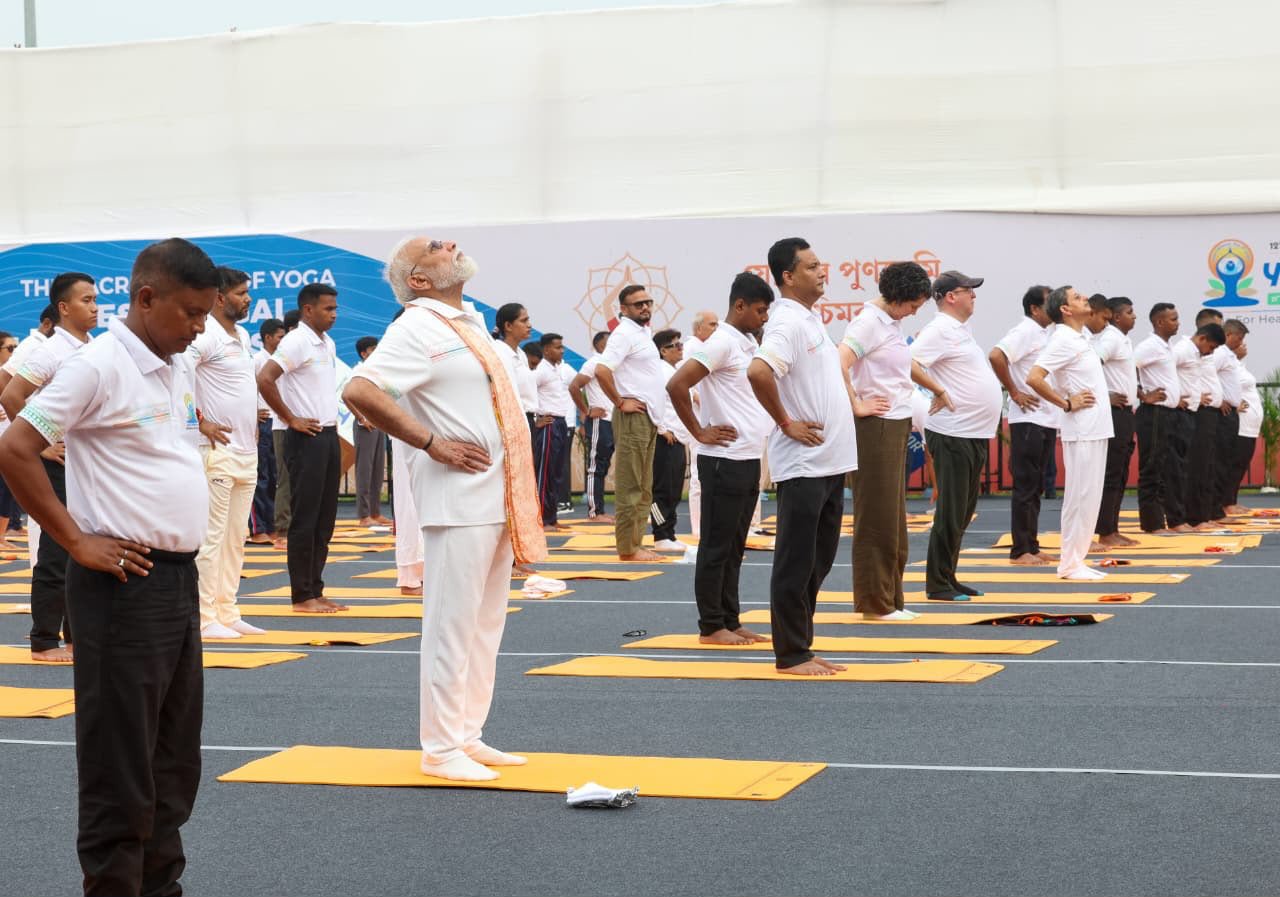
This year, that tilt of the Earth pointed straight at Kolkata’s Red Road, where Prime Minister Narendra Modi rolled out a mat among thousands of people for the 12th International Day of Yoga, a city better known for its trams, its Durga Puja roar, and its argumentative addas than for downward dogs. And that, in itself, is the first uncommon thing worth noticing.
The Bengal Nobody Talks About
Most retellings of yoga’s history loop back to the Himalayas or to Rishikesh. Bengal rarely gets a mention and yet it quietly produced some of the people who made yoga a world idea rather than a regional one. Ramakrishna Paramhansa practiced it as devotion. Swami Vivekananda carried it out of India entirely, introducing the very word “yoga” to Western audiences at the 1893 Parliament of Religions in Chicago, decades before anyone in the West owned a yoga mat. Sri Aurobindo turned it into a philosophy of evolution, arguing that yoga wasn’t an escape from the world but a method for transforming it. And Lahiri Mahasaya, working quietly out of Varanasi but rooted in Bengal’s spiritual lineage, revived Kriya Yoga the breath-control tradition that later inspired Paramahansa Yogananda‘s Autobiography of a Yogi, a book that pulled an entire generation of Americans toward the practice in the 1950s and 60s.
So when the national Yoga Day event landed in Kolkata this year, it wasn’t a random logistical choice. It was a homecoming to the soil that exported yoga to the planet, even if history books rarely credit it.

Not a Stretch, A Survival Manual
Strip away the marketing language, and yoga’s oldest texts were never really about flexibility. The Yoga Sutras of Patanjali, compiled roughly 2,000 years ago, open with a definition that has nothing to do with poses: “yogas chitta vritti nirodhah” (yoga is the stilling of the fluctuations of the mind). The postures, the asanas, came later, largely as tools to make long periods of seated stillness physically bearable. In other words: the body work was invented to serve the mind work, not the other way round, a sequencing modern fitness culture has almost completely reversed.
That inversion is part of why so many people quit yoga within weeks. They show up for the stretch and never reach the part it was actually built for.
The Poses Nobody Photographs
Instagram has flattened yoga into a handful of poster-friendly shapes the warrior, the tree, the lotus. But some of the most physiologically interesting asanas rarely make it onto a feed because they look almost comically undramatic.
- Viparita Karani (legs-up-the-wall): looks like someone lying down doing nothing. It’s actually one of the few yoga postures with decent clinical evidence for lowering heart rate and easing mild anxiety, simply by using gravity to assist venous blood flow back to the heart.
- Marjaryasana-Bitilasana (cat-cow): unglamorous, almost childlike, yet it’s the pose physiotherapists most often prescribe for desk-bound spines because it cycles the vertebrae through flexion and extension without load.
- Yoga Nidra: not a posture at all, but a guided lying-down practice sometimes called “yogic sleep.” Some sleep researchers have studied it as a tool for reducing fatigue in shift workers, since 30-40 minutes of it appears to mimic some of the restorative effects of deeper sleep stages.
The uncomfortable truth: the poses that build Instagram followings (deep backbends, advanced arm balances) often carry the highest injury risk for untrained joints, while the unglamorous ones quietly do most of the medical heavy lifting.
A Day That Began With a Single Sentence at the UN
International Yoga Day didn’t evolve organically out of global demand: it was proposed, almost as an aside, in PM Modi’s first address to the United Nations General Assembly in September 2014. He suggested 21 June, the summer solstice, precisely because of its dual meaning across hemispheres. What happened next is the part that still surprises diplomats: 177 countries co-sponsored the resolution, the highest number of co-sponsors any UN resolution of its kind has ever received, passed without a single vote against it. Within nine months, on 21 June 2015, nearly 36,000 people assembled at Rajpath in New Delhi and performed 21 asanas in 35 minutes, setting a Guinness World Record with dignitaries from 84 nations present on the lawn.

What’s rarely highlighted is how fast that scaled. By this year, the 12th edition, Indian missions and partner organizations coordinated events across nearly 2,500 locations in more than 190 countries from a UN headquarters ceremony in New York led by Modi’s own yoga teacher, H. R. Nagendra, to sessions reportedly staged in Times Square. Yoga, once dismissed by some Western wellness circles as a fad import, is now estimated to be practiced by roughly 300 million people worldwide, and UNESCO inscribed it on its list of humanity’s Intangible Cultural Heritage back in 2016.
The Theme That Quietly Rewrites the Ageing Conversation
This year’s theme, “Yoga for Healthy Ageing,” is easy to skim past as a soft slogan. But its real ambition is sharper than it sounds. In his Kolkata address, Modi framed it as a direct reversal of expectation: the goal isn’t merely to live longer, but to be more flexible at 40 than at 20, more energetic at 50 than at 30, more resistant to lifestyle disease at 70 than at 50. That’s not nostalgia for youth, it’s an argument that decline is negotiable, not guaranteed.
It echoes something the World Health Organization has been pushing in public health circles for a few years now: the shift from focusing purely on lifespan to focusing on “healthspan” the years actually lived in good function, not just years lived. Yoga, requiring no equipment, no gym membership and almost no space, fits that brief uncomfortably well for ageing populations and tight health budgets alike which may be part of why governments, not just wellness influencers, keep investing in it.
The Contradiction Nobody Resolves
Here is the honest, slightly uncomfortable part. A practice built on Patanjali’s call to still the mind is now broadcast through livestreams, hashtags, drone shots of stadium-sized human formations, and competitive city-by-city participation counts this year Kolkata’s organizers were reportedly chasing a Guinness World Record themselves. Yoga’s founding texts treat solitude and withdrawal from spectacle as virtues. Yoga Day treats scale and spectacle as the entire point. Both things are true at once, and neither cancels the other out which is, perhaps unintentionally, the most “yogic” outcome of all: holding two opposites without needing to resolve them.
What’s Easy to Miss in Kolkata
The genuinely under-reported detail from this year’s Kolkata event isn’t the size of the crowd on Red Road, it’s the city’s own civic build-up around it. Local authorities tied the occasion to a “Swachhata Se Swagat” cleanliness drive, treating tidy streets as a form of preparation, almost a warm-up posture, for the bigger gathering. It’s a small reminder that for all the global scale, Yoga Day still depends entirely on hyper-local effort one street, one civic body, one early-morning sweep at a time before a single mat ever gets unrolled.