

Just after 4:27 PM local time on Tuesday, July 28, 2026, the ground under Kyushu Island stopped behaving. A 7.1-magnitude earthquake, later revised by the US Geological Survey to 6.8, though Japan’s own agency held its number at 7.1, tore through Kumamoto Prefecture at a shallow depth of roughly 10 kilometres. Shallow quakes hit harder than deep ones, and this one hit shindo 7, the top of Japan’s own intensity scale, a level reserved for shaking that throws furniture across rooms and buckles highways.
Within minutes, the Japan Meteorological Agency issued a tsunami advisory for the Ariake and Yatsushiro seas, warning of waves up to a metre high. It was lifted a few hours later, but for a country that still remembers 2011, even a “small” advisory reopens an old wound.
Ground Zero: Uki, Kashima, and a Castle That Just Won’t Catch a Break
The epicentre sat near the city of Uki, just south of Kumamoto city, with the towns of Kashima, Yatsushiro, and Mashiki absorbing the worst of it. Strong shaking rolled through six prefectures namely Kumamoto, Nagasaki, Kagoshima, Fukuoka, Saga, and Miyazaki rattling windows as far as Fukuoka’s bullet train hub, where JR Kyushu suspended services outright.

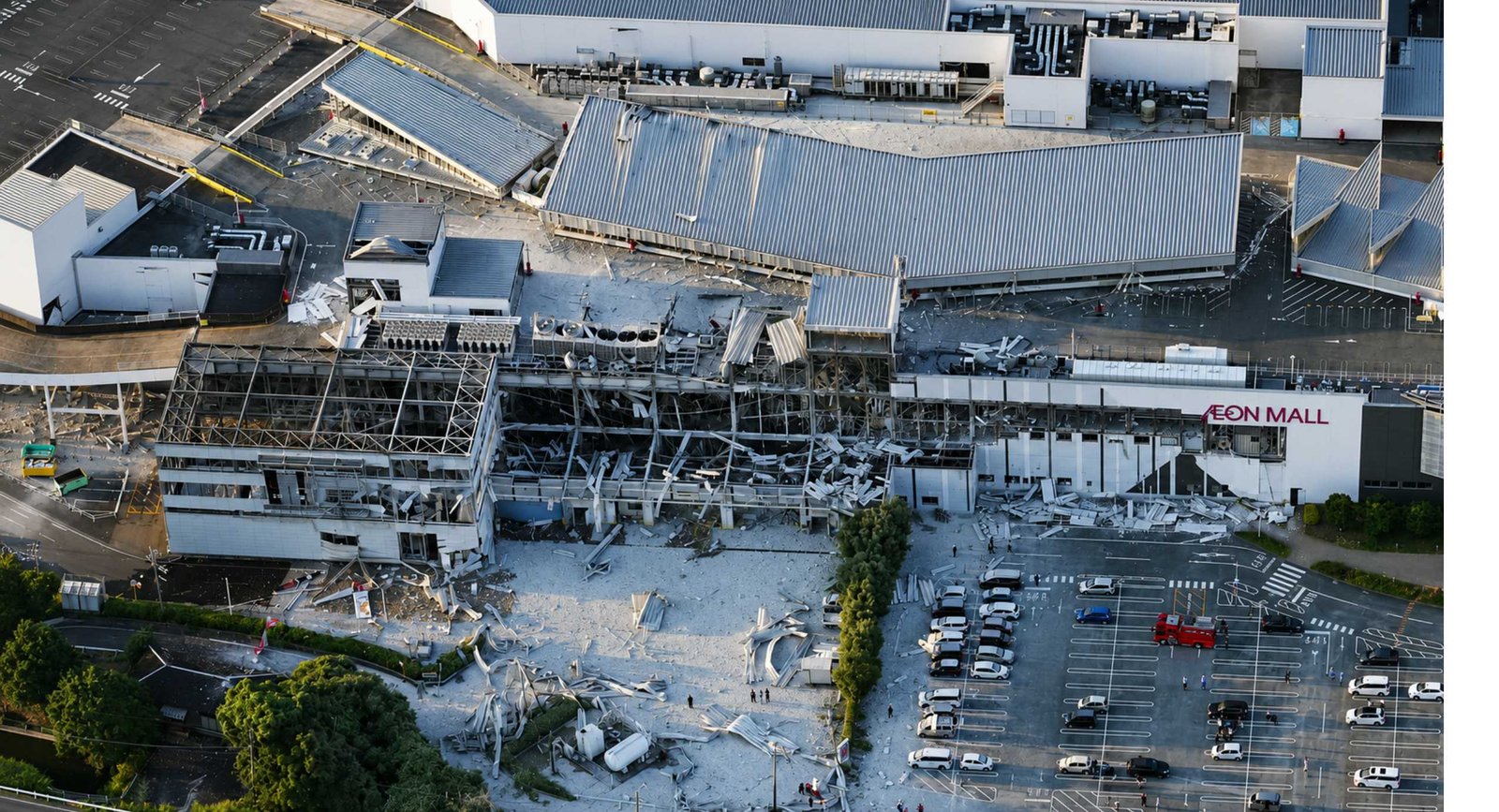
The most dramatic scene played out at an AEON shopping mall in Kashima. Witnesses described an explosion after the quake, and the mall’s second floor gave way, trapping shoppers and staff. Around 20 to 30 employees were unreachable in the chaos that followed, and firefighters worked through smoke to reach them. Not far away, a Nippon paper factory in Yatsushiro lost a chimney entirely, and several workers there went missing from contact, a detail that unsettled locals more than the quake itself, because factories are supposed to be the safe, solid buildings.

Roughly a dozen homes collapsed, four people were pulled from the wreckage of their own houses, and a section of the Kyushu Expressway near Yatsushiro buckled so badly that two segments no longer lined up, stranding vehicles mid-span. Kumamoto Castle, a 1607 fortress that survived a 19th-century siege and was still being stitched back together after the 2016 quake has lost part of its stone wall again. Engineers say the repairs already underway may now take decades longer.


An Old Fault, a Familiar Fear
Here’s the part locals will tell you before any seismologist does: this is not new ground. Kumamoto sits on the Futagawa-Hinagu fault zone, part of the median tectonic line that scars central Kyushu, and exactly ten years ago, in April 2016, this same region was hit by a foreshock-mainshock sequence with a 6.5 quake followed a day later by a 7.3, that killed at least 41 people, injured over a thousand, and forced 90,000 to evacuate. Locals still call it “the two-day earthquake.” Older Kumamoto residents describe a strange déjà vu: the same castle wall crumbling twice in one lifetime.
That history matters, because Japan’s meteorological agency flagged something uncommon this time: the area is shallow enough that clusters of quakes tend to follow one another, sometimes for days. Officials didn’t just ask people to be careful, they explicitly warned that another quake of similar size could strike the same ground before the dust settles.

The Human Toll Still Being Counted
By evening, NHK reported at least 50 people hospitalised, alongside “scores” of lesser injuries across the region. No confirmed deaths had been officially announced as this article went to press, though rescue teams were still combing through the mall and the collapsed homes, and several people remained unaccounted for. About 40,000 households lost power. Kyushu Electric checked both the Genkai and Sendai nuclear plants and found no abnormalities and no radiation change, a detail Japan now checks reflexively, a habit born entirely out of Fukushima.
Takaichi’s Appeal, and Boots on the Ground
Prime Minister Sanae Takaichi set up an emergency disaster task force within the hour, placing herself at its head, and ordered 3,600 Self-Defense Force personnel into Kumamoto at the governor’s request. Her public message was unusually blunt for a Japanese leader: she asked residents not to relax, warning them to stay alert for another quake of the same scale, even as damage assessments were still incomplete. It’s a subtle but telling shift as Japanese officials have historically been cautious about amplifying fear, yet here the warning came first, ahead of the condolences.
The World Watches, India Sends Word
Taiwan’s president offered condolences and readied assistance. Neighbouring countries put coastal monitoring on alert as a precaution, even where no tsunami threat existed for them. In India, the earthquake trended through the evening, from earnest explainer threads on why Japan shakes so often, to the reflexive diplomatic warmth that has marked Tokyo-Delhi ties for years, with Indian voices online expressing solidarity for a country many see as a genuine partner rather than a distant headline.
The Uncomfortable Truth Nobody Likes Saying Out Loud
Japan absorbs nearly a fifth of the world’s magnitude-6-plus earthquakes, sitting where it does on the Pacific Ring of Fire. Its buildings are engineered brilliantly, its drills are relentless, and its warning systems buy people seconds that save lives. And yet a shopping mall with a modern, code-compliant building has still lost a floor. That’s the part worth sitting with: preparation lowers the odds, it doesn’t erase them. Kumamoto rebuilt after 2016 believing it had paid its dues. Tuesday said otherwise.
Bharatnewsupdates International Insight Team ⊥ July 2026, 28