

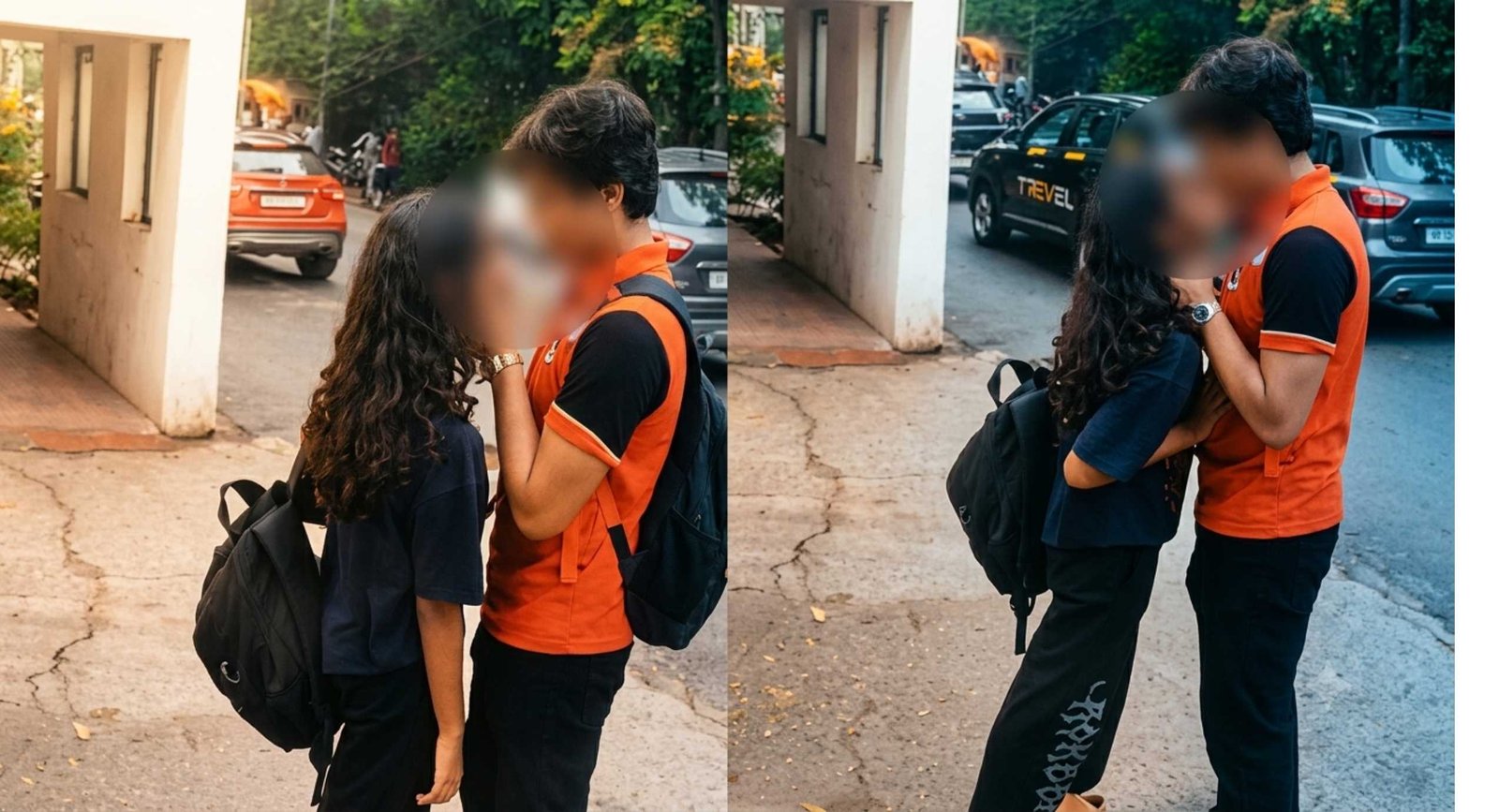
It started the way most Delhi society dramas do, not with a fight in the lift lobby, but with a phone camera pointed out of a balcony window.
A woman living in a gated society in Delhi filmed a young couple kissing in the parking lot below her flat. She didn’t confront them. She didn’t call the guard. She uploaded the clip with a caption that has since been screenshotted more times than the video itself: “सुबह-सुबह बेटी को जब स्कूल बस तक छोड़ने गई थी तो यह वाक्या देखकर मैं हैरान रह गई आखिर युवा किस ओर जा रहा है देखते ही देखते दिल्ली भी इतनी बदल गई कि आजकल इस तरह की हरकतें आपको हर गली, नुक्कड़ और चौराहे पर नज़र आ जाएंगी वीडियो मेरी ही सोसाइटी का है और 2 दिन पुराना है मैंने बहुत सोचा कि इस तरह का वीडियो मैं शेयर करूं या नहीं करूं और आखिरकार मैंने कर ही दिया” meaning “I was stunned when I witnessed this incident while dropping my daughter off at the school bus this morning; it makes one wonder where the youth are headed. Delhi has changed so drastically that such behavior can now be seen on every street, corner, and intersection. This video is from my own society and is two days old. I deliberated a lot on whether or not to share it, but ultimately, I decided to go ahead.”
Within hours, it was everywhere with repost pages on X account, meme accounts, WhatsApp family groups where uncles forwarded it with three “😡” emojis and zero context.
The Emotion Behind the Post
Strip away the outrage-bait caption and what you’re left with is something more human and a little sadder: a woman who felt like the world she recognised was slipping away from her, and instead of sitting with that discomfort, she reached for her phone. That’s not unusual. It’s almost the default reflex now with feeling something and immediately needing an audience to validate the feeling.
Was she genuinely alarmed? Possibly. Was she also, somewhere underneath, seeking the dopamine hit of viral agreement? Almost certainly. Both things can be true at once, and pretending otherwise is where most hot takes on this topic go wrong.
The Internet’s Split Verdict
The comment section split almost instantly into two furious camps.
Camp one called her a moral cop with nothing better to do and pointing out that filming strangers without consent and broadcasting their faces is a far bigger violation than two adults kissing in a parking lot ever could be. Several users flagged that this could technically fall under privacy violation and harassment, not “concern.”
Camp two agreed with her entirely, arguing that a residential parking lot is not a nightclub, and that public intimacy in shared family spaces is a fair thing to object to, even if filming was the wrong method.
Here’s the uncomfortable truth neither camp says out loud: both are partly right, and the internet doesn’t reward “partly right.” It rewards a clean villain.
The Hidden Reality Nobody’s Talking About
The real story isn’t the kiss. It’s that surveillance has become the new neighbourhood gossip. A decade ago, this woman would’ve mentioned it to another aunty over tea, and it would’ve died there. Today, her balcony has effectively become a broadcast tower, and two 20-year-olds are now permanently searchable by name-adjacent hashtags for something that lasted eleven seconds.
Nobody asked the couple how they felt. Nobody asked if they’ve faced consequences at home, at college, or from family who may have seen the clip. That silence is the real story and it’s the part Discover feeds never surface.
An Uncommon Contradiction
The same India that produces some of the world’s most-watched romantic cinema, where audiences whistle at on-screen kisses, still can’t process the same act happening three floors below a balcony. Distance seems to be the moral compass yet acceptable on a 70mm screen, unforgivable at 70 metres.
What This Really Reveals
This isn’t a story about “youth going astray.” It’s a story about how consent, privacy, and morality collide the moment a phone camera enters the picture and how easily we forget that the loudest caption isn’t always the most honest one.
The couple broke no law. The person who filmed and published their faces without consent walked closer to one. Yet only one of them is being called out today.