

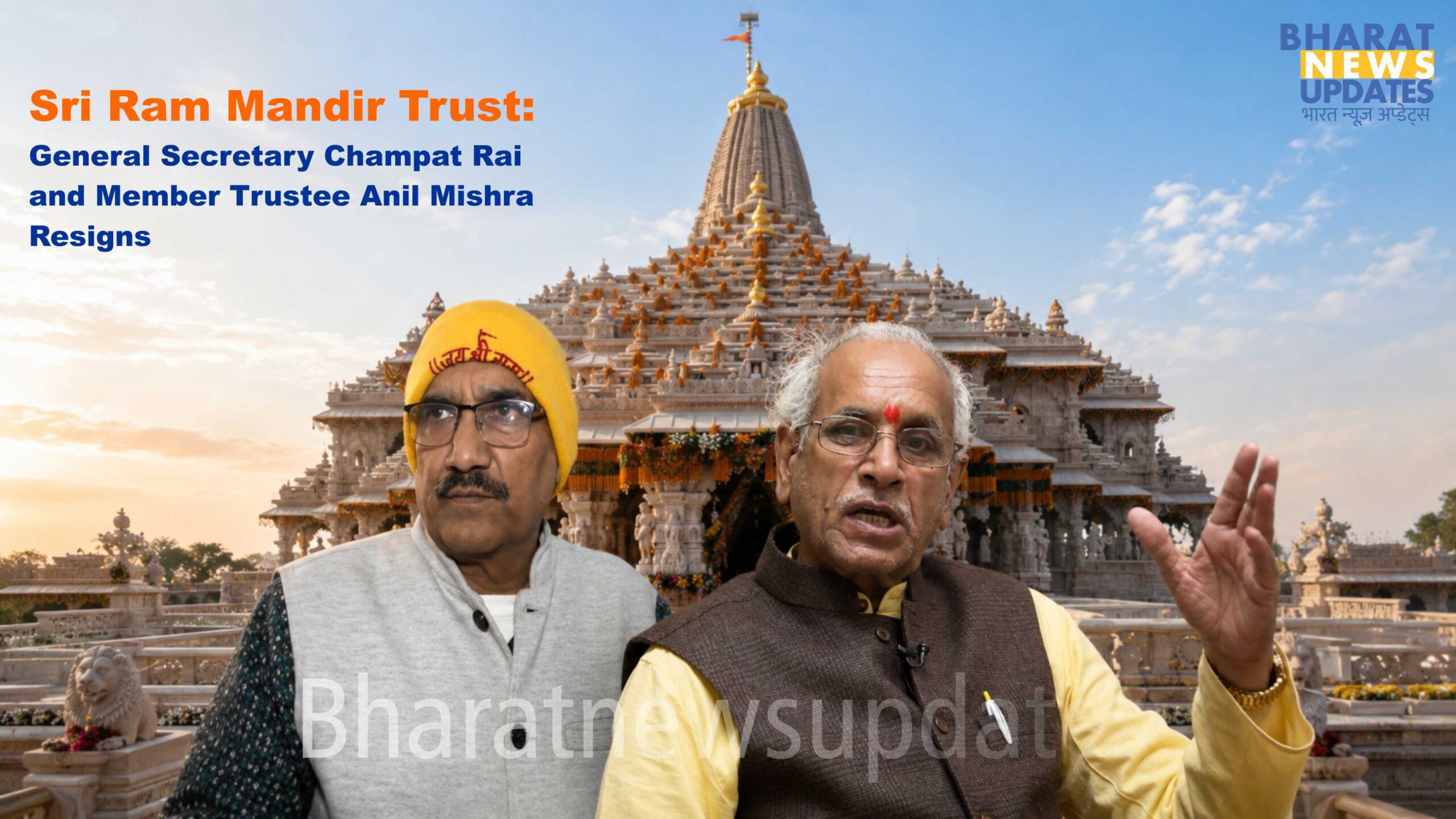
Champat Rai and Anil Mishra Resigns as Ram Mandir Donation Scandal Reaches the Inner Sanctum
For nearly two years after the Ram Mandir’s consecration, Champat Rai was the most powerful man in Ayodhya who wasn’t a politician or a priest. As General Secretary of the Shri Ram Janmabhoomi Teerth Kshetra Trust, he was the institution’s face, voice, and operational spine, a VHP stalwart who had devoted decades to the Ram Janmabhoomi cause.
By the morning of June 26, 2026, General Secretary Champat Rai and Trust member Dr. Anil Mishra has resigned as the donation scam that started as a political allegation has now become a criminal investigation with their own names on the mandir SIT investigative accused list.
This is no longer a story about eight lower-rung employees skimming from donation boxes. This is a story about how an institution built on the faith of crores of Indians may have been rotting quietly at the top while celebrating loudly at the front.
How It All Started: One MLA’s Allegation That Refused to Die
The issue first gained public attention on June 7, 2026, when former Samajwadi Party MLA Pawan Pandey alleged that between ₹7 crore and ₹7.5 crore in donations made to the Ram Temple had either been stolen or embezzled.
The UP government’s immediate reaction was to dismiss it. Deputy CM Brajesh Pathak called it a “false narrative.” Champat Rai said audits were ongoing and nothing was amiss. But two things happened simultaneously that made silence untenable.
First, BJP leader Dr. Rajneesh Singh reportedly wrote to Prime Minister Narendra Modi on June 9, seeking a CBI inquiry, a BJP man demanding investigation into a BJP-adjacent trust. Second, former BJP MP Brij Bhushan Sharan Singh publicly hinted that he had known about misuse of donations for some time but declined to name names, a hint-without-substance that in Indian politics is often more damaging than a direct accusation.
On June 13, Chief Minister Yogi Adityanath approved a three-member SIT after a formal request from the Trust itself, a move that looked like transparency but was, in part, a bid to control the anti government narrative before it spun completely out of reach.
It didn’t work.
The SIT’s Bombshell: Champat Rai Named Among 14 Accused
The most consequential development in this story isn’t the eight arrests. It’s what the SIT’s own preliminary report found after questioning over 150 people.
The SIT named a total of 14 people as accused, including Trust General Secretary Champat Rai, member Dr. Anil Mishra, administrator Gopal Rao, and management manager Ramshankar Yadav alias Tinnu. Several statements recorded during the investigation do not match the available records of the Trust.

The 20-page preliminary report, submitted to Home Department Additional Chief Secretary Sanjay Prasad, recommended filing an FIR, restructuring the trust entirely, and appointing a CEO along with an audit of the past five years’ donations.
The five-year audit recommendation is extraordinary. It implies the SIT believes this is not a recent problem. That aligns with claims made by the temple’s former accounts-in-charge, Mahipal Singh, who alleged the theft had been ongoing “for quite some time” and with Dharamsena founder Santosh Dubey’s police complaint naming Champat Rai and alleging that irregularities in handling gold and silver donated to Ram Mandir go back as far as 1989. These claims remain unverified and contested, but the SIT’s own recommendation for a five-year lookback gives them a new and uncomfortable relevance.
The report also raised questions about missing jewellery donated by devotees, recruitment of employees involved in donation counting, and flaws in the monitoring system, flagging the role of trust officials, bank employees, and administrators.
The Resignation: What It Means
Sources told Bharatnewsupdates that Champat Rai has been asked to resign and take moral responsibility in connection with the alleged Ram Temple donation theft case. And we broke the news that both Champat Rai and Anil Mishra has step down.
The critical nuance: no criminal case has been registered against Rai till now, even though the SIT’s preliminary report names him among 14 accused. The gap between being named by an SIT and being charged in an FIR is legally significant but politically, it means very little. When your own name appears in an investigation report of a probe you yourself requested, resignation is not a concession. It is damage control.
Meanwhile, speculation has already begun that Nripendra Mishra, Chairman of the Ram Temple Construction Committee and former IAS officer and PM Modi’s former Principal Secretary could be appointed CEO of the Trust. The SIT specifically recommended appointing an administrative officer as CEO, a recommendation tailor-made for a bureaucrat of Mishra’s standing.
What this tells you about the power behind the scenes: the Trust’s post-scandal restructuring is not going to be driven by the Trust. It is going to be driven by the state and by extension, by Delhi.
The Eight Arrested: A Family Business Inside a Public Institution
Before the resignations at the top, there are eight people already in custody whose roles reveal exactly how the alleged theft was structured.
Ram Shankar Yadav alias Tinnu: Champat Rai’s former driver. He held the keys to the donation boxes and ran the counting operation. His proximity to the Trust’s General Secretary gave him authority far beyond his designation. He has denied involvement.
Ramashankar Mishra alias Ravi Mishra: A counting veteran who allegedly placed both his son and son-in-law inside the same operation, creating a family unit within a cash-handling function that was supposed to be independently overseen.
Anukalp Mishra: Son of Ramashankar Mishra, and notably, a relative of Trust member Anil Mishra. That blood connection between a counting-room employee and a senior trustee is precisely the kind of structural conflict that a proper compliance system would have caught — and evidently didn’t.
Lavkush Mishra: Son-in-law of Ramashankar Mishra. Investigators allege he was responsible for disposing of embezzled cash. When the SIT searched his home in Phagauli village, they found ₹10 lakh some hidden in a cupboard, some buried beneath a pile of cow dung. An employee reportedly earning ₹18,000 a month who had allegedly purchased property worth ₹1.5 crore and ₹40 lakh.
Avinash Shukla: A temple attendant described as a core syndicate member. ₹5 lakh was recovered from his account.
Manish Kumar Yadav: Nephew of Tinnu Yadav. Stolen money was reportedly recovered from his home.
Subhash Shrivastava: A former bank employee who served as head of the cash-counting staff — the supervisor of the very operation where the manipulation allegedly took place.
Karunesh Pandey: Accused of manipulating donation receipts, the paper record that was supposed to guarantee the integrity of each transaction.
Together, they represent two family networks, a former banker, and a former driver, all operating inside a cash-counting process that involved three institutional layers (Trust, SBI, private agency) and somehow produced fraudulent output from all of them.

The Detail Nobody’s Fully Reporting: The Deleted CCTV Footage
Among the most damning elements of this case one that has received far less attention than it deserves is the alleged deletion of CCTV footage from the cash-counting areas, reportedly covering several months. If accurate, this is not a systems failure. This is deliberate evidence destruction. The SIT’s reference to the CCTV record as a basis for the FIR suggests some footage remains, but what’s missing may be as significant as what survives.
Additionally, when a complaint from BJP leader Rajneesh Singh forwarded by the PMO asked Champat Rai to provide details of the trust’s income, expenditure, donations, bank accounts, and land transactions, Rai declined, citing the ongoing SIT probe. That refusal, however legally defensible, is not how an innocent man runs a transparency exercise.
The Opposition’s Demands And the Political Trap Beneath
The opposition has not missed its moment. The Samajwadi Party has demanded CM Yogi Adityanath’s resignation, calling the FIR an “eyewash” for targeting counting staff while sparing senior figures. Faizabad SP MP Awadhesh Prasad has demanded removal of all trust members until the probe concludes. Congress President Ajay Rai has demanded FIRs against Champat Rai, Gopal Rao, and Anil Mishra.
AAP’s Arvind Kejriwal has demanded stern action, while AAP MP Sanjay Singh claims to have evidence related to a land scam linked to the Ram Temple and has offered to present it before the SIT.
The Supreme Court has received a petition seeking a CBI-monitored probe, arguing that treating this as an “administrative irregularity” rather than criminal breach of trust insults the crores of devotees who donated in good faith.
Even within the BJP’s own orbit, the knives are out. BJP veteran Vinay Katiyar who went to jail during the Ram Janmabhoomi movement described the alleged theft as a “betrayal of decades of devotion.” That is not a quote from the opposition. That is a man who sacrificed his freedom for this temple, saying the people who ran it may have stolen from it.
VHP International President Alok Kumar acknowledged that “Ram Mandir cannot run only on trust” and called for professional management with Standard Operating Procedures (SOPs) a remarkable concession from within the Hindu nationalist ecosystem that built the institution.
The Contradiction at the Heart of This Scandal
The Ram Mandir Trust earned ₹327 crore in FY 2024-25. Donations accounted for ₹153 crore; interest income for ₹173 crore. The temple received ₹3.17 crore in a single afternoon on its opening day. Between 70,000 and 80,000 devotees visited daily, doubling on weekends and festivals.
And somehow, the institution responsible for all of that ran its cash-counting operation like an informal village arrangement with keys held by one man, families placed in adjacent roles, receipts manipulated by a former banker, and CCTV footage allegedly deleted across multiple months.
The ₹7-7.5 crore allegedly stolen is not the real number to focus on. The real number is whatever a five-year audit finds. The SIT recommended that audit. The question is whether anyone in power will let it actually happen.
What Comes Next
The SIT’s final report is expected within days. The resignations of Champat Rai and Anil Mishra resignation has been framed as moral accountability but they are, in reality, the minimum political price of survival. The bigger questions are whether criminal charges follow their names, whether the five-year audit is ordered and independently conducted, and whether the Trust’s restructuring produces actual accountability or simply new faces on the same broken system.
Nripendra Mishra, as a former IAS officer and Modi’s former Principal Secretary, represents the state’s preferred answer, a technocrat who can professionalize the Trust and insulate it from further scandal ahead of the 2027 UP elections.
Whether that satisfies the millions of ordinary Indians who gave ₹10, ₹100, and ₹1,000 notes at those donation boxes believing every rupee was going to Prabhu Sri Ramlala Ji is a different question entirely. And it is the only one that actually matters.
All developments are based on SIT findings, preliminary report recommendations, FIR filings, and credible media reporting as of June 26, 2026. No final judicial finding has been made. The investigation is ongoing.
Bharatnewsupdates News Insight Team ⊥ June 2026, 26