

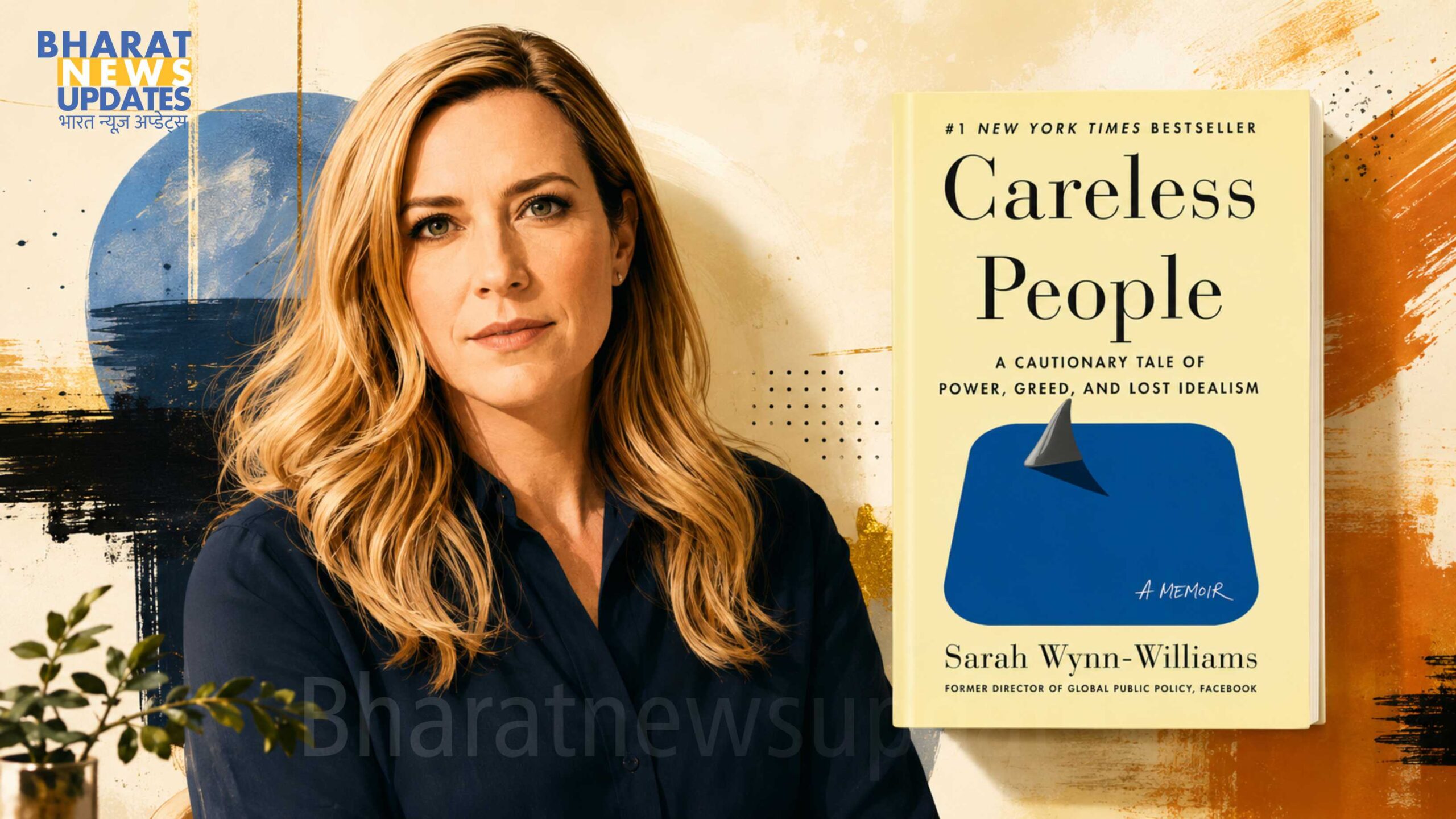
Inside “Careless People” the book that turned a gag order into a megaphone, and revealed what really happens when you tell the truth about Facebook
Imagine sitting on a festival stage for a full hour with microphone in hand, audience waiting, panelists on either side and saying absolutely nothing. Not out of protest, not out of stage fright. Because a corporation with a market cap larger than most countries has legally threatened to fine you $50,000 every time you open your mouth about them.
That is exactly what happened to Sarah Wynn-Williams at the Hay Festival in late May 2025. The image a woman in complete, court-ordered silence while seated beside journalists and law professors became one of the defining pictures of the year in publishing. And somehow, the silence spoke louder than anything she could have said.
This is the story of Careless People, the memoir Meta did not want you to read. It is also a story about what it actually costs a woman to tell the truth in corporate America not in the abstract, but in the very specific, very expensive, very lonely reality of it.

The Woman in the Room Nobody Saw Coming
Sarah Wynn-Williams is not a typical Silicon Valley disruptor. She is a New Zealand lawyer and diplomat who spent years working in embassies and at the United Nations before joining Facebook in 2011 as director of global public policy. She was, in many ways, everything Facebook desperately needed at the time and did not quite deserve: seasoned in geopolitics, fluent in diplomacy, and genuinely idealistic about what a global social platform could do.
She arrived at a company that barely knew what a foreign minister was. She left six years later, fired, pregnant with her second child, and convinced that the company she had helped build its international credibility had betrayed almost every principle she believed it stood for.
Her memoir, published in March 2025, quickly became a bestseller and generated widespread attention for its allegations about the company’s leadership and corporate culture. But by the time most people heard of it, the legal circus surrounding it had already become the story within the story.

The Book That Arrived With a Lawsuit Attached
On the very day Careless People was published, Meta filed an arbitration demand arguing that the book breached a non-disparagement agreement Wynn-Williams signed when she left the company. An emergency arbitrator agreed, temporarily ordering her to stop promoting the book and to make no “disparaging, critical or otherwise detrimental” comments about Meta with fines of up to $50,000 each time she breached it.
The move was legally aggressive. It was also, strategically speaking, a catastrophic miscalculation.
Nothing sells a book like a corporation trying to ban it. Careless People flew up bestseller lists. And the arbitration order conducted in March 2025 without Wynn-Williams even present in the room became proof of exactly the kind of institutional overreach she had been writing about.
The complaint points to two public commitments Wynn-Williams says she relied upon: a 2018 Facebook announcement ending mandatory arbitration for sexual harassment claims, and language in Meta’s 2022 proxy statement declaring that the company does not bind workers to agreements barring them from discussing what happens in the workplace. In other words, she published her book partly because Facebook itself had told employees, publicly, that this kind of silencing was over. It wasn’t.
Meta had also, according to the lawsuit, obtained an emergency gag order and then surveilled her, with company representatives attending her public appearances and photographing her. It reportedly even objected to her attending a literary festival where she said nothing at all because other panelists on the stage were critics of the company.
There is something almost novelistic about that detail. A woman who has already been silenced, sitting silently, being photographed by the company that silenced her, for the crime of sitting near people who haven’t been silenced yet.
The “Bleeding” Question, the “Sultry” Comment, and What Gets Called an Investigation
Sexual harassment in tech has been documented, litigated, and lamented for years. But what Wynn-Williams describes goes beyond the usual boardroom-bro dynamics, and the specific details matter.
Joel Kaplan who was her direct supervisor, who has since been promoted by Mark Zuckerberg to become Meta’s chief global affairs officer allegedly asked her, after she had given birth, “where are you bleeding from?” At a company event, he told her she looked “sultry.” In 2016, during an email chain about her U.S. citizenship test, he asked whether the test included the phrase “dirty sanchez” a sexual slang term and a racial slur.

These are not ambiguous edge cases. These are specific, documented, named incidents, one of which exists in an email that NBC News reviewed. And yet when Wynn-Williams reported Kaplan’s behaviour in 2017, the investigation which Meta says involved 17 witness interviews over 42 days cleared him. She was fired that year.
Meta says she was dismissed for “poor performance and toxic behaviour.” She says she was fired in retaliation for the complaint. Her former supervisor Elliot Schrage said he fired her “based on her repeated failures.” The company says the investigation “determined she made misleading and unfounded allegations.”
Here is what we do know: the man she accused is now the most powerful corporate-political liaison at one of the most powerful companies in the world. The woman who accused him wrote a book and is being fined $50,000 per utterance. That is not an investigation’s finding. That is an outcome. And outcomes tell their own story.
The Private Jet, the Bed, and the Woman Who Wrote Lean In
Sheryl Sandberg was, for a generation of women, a symbol. Her 2013 book Lean In sold millions of copies and became the unofficial scripture of corporate feminism. The advice was simple: push harder, ask for more, don’t leave the table. It was aspirational and frustrating in equal measure, but it came with a certain moral authority, here was a woman at the top, telling other women how to get there.
What Wynn-Williams describes on a private jet from Davos to California in January 2016 does not fit that image.
Wynn-Williams, visibly pregnant at the time, writes that her former COO Sheryl Sandberg repeatedly insisted she join her in sharing a bed on the plane. She considered it inappropriate and refused. At the end of the flight, she writes, Sandberg told her: “You should have got into bed.”

Meta’s version, offered by a person on the plane who spoke anonymously, says everyone encouraged Wynn-Williams to rest because she was pregnant, and that the plane had multiple beds. But Wynn-Williams also says that after she refused, she felt increasingly sidelined by Sandberg at work.
There is a separate allegation about Sandberg instructing a different employee to purchase $13,000 worth of lingerie for both of them, an instruction that came with emails, copies of which NBC News reviewed.
Sandberg declined to comment, through her family foundation. She stepped down as Meta’s COO in 2022 and left its board in 2024.
The discomfort here is not simply about what happened on a plane. It is about what it means when the woman held up as the model of professional female empowerment creates a workplace environment that another woman describes as mortifying. The contradiction is not incidental. It is the point.
Zuckerberg and China: The Deal That Was Never Quite Admitted
The most geopolitically significant section of the memoir concerns Facebook’s years-long pursuit of the Chinese market and what the company was apparently willing to trade for access.
Careless People alleges that Zuckerberg, beginning around 2014, committed seriously to re-entering China, an effort Facebook internally named “Project Aldrin,” after astronaut Buzz Aldrin. Getting there meant dealing with the Cyberspace Administration of China, the government body that controls the country’s internet. And dealing with them meant building the tools they wanted.
Among the memoir’s other disclosures, it contends that Zuckerberg pursued a deal that would have handed Chinese government authorities access to the personal data of millions of users as the price of admission to the Chinese market.
What makes this allegation particularly sharp is what Facebook told U.S. lawmakers at the same time. The company submitted written testimony to three Senate committees in 2018 saying it was “not in a position to know” how China would apply its laws to a theoretical Facebook China service. It did not mention the years of negotiations, tool-building, and discussions with Chinese regulators that Wynn-Williams documents.
Zuckerberg himself said in 2019 that Facebook had tried and failed to reach agreement with China. He framed it as a principled stand on free expression. The internal documents tell a more complicated story: not a principled stand, but a deal that fell through.
And here is the detail that tends to get lost: Facebook never stopped making money from China. Even without operating its apps there, Meta reportedly generates around $1 billion a month from Chinese advertisers using its platform to reach audiences elsewhere in the world. The principle, it seems, had a flexible floor.
What Systemic Looks Like From the Inside
The real power of Careless People is not any single allegation. It is the accumulation.
Wynn-Williams describes a company where warnings about Facebook’s role in ethnic violence in Myanmar, in Sri Lanka were deprioritized for years. Where Zuckerberg couldn’t be briefed in more than a text message at first but eventually became obsessed with political leverage. Where internal alarms about election interference were noted and largely unaddressed. Where the culture that protected powerful men from accountability was the same culture that built tools for authoritarian governments and told Congress it didn’t know things it clearly knew.
She calls it “lethal carelessness.” The phrase is precise. It’s not malice exactly though malice appears. It’s carelessness elevated to institutional practice. A culture so convinced of its own good intentions that it couldn’t process evidence that those intentions had consequences.
The women who reported harassment faced investigations that cleared their harassers. The whistleblower who submitted an SEC complaint was accused of being an “anti-Facebook activist.” The memoir that documented six years of firsthand experience was met, on its first day of publication, with an emergency legal filing.
This is what systemic looks like. Not a villain twirling a mustache. A process. A series of procedures — HR investigations, non-disparagement agreements, arbitration orders that reliably produce the same result: the institution protected, the individual silenced.
The Silence That Became Testimony
On June 26, 2025, Wynn-Williams filed suit in federal court in Northern California, asking a judge to vacate the arbitration order and declare her severance agreement unenforceable, arguing it was signed under financial duress. She also alleges that roughly $310,000 in pre-approved expenses travel costs incurred on behalf of Zuckerberg and other senior leaders were withheld as leverage when she left.
The dispute has drawn political attention on both sides of the Atlantic. Senator Chuck Grassley, the Republican chair of the Senate Judiciary Committee, wrote to Mark Zuckerberg over the allegations that the company had worked to silence her, and a UK politician argued she was being pushed toward financial ruin by the accumulating arbitration exposure.
The book is now in its second act. The first act was the memoir. The second is a federal lawsuit. The third, presumably, is whatever Meta does next.
But the image that stays with you is the Hay Festival. A woman on stage, in silence, for an hour. Journalists beside her. An audience watching. A company somewhere documenting the event, looking for violations.
She said nothing. And somehow, that is the sentence that lands hardest in the whole story.
Because what she was really demonstrating involuntarily, at great personal cost is exactly what she had been trying to say in 300 pages: that when a woman tells the truth about powerful men, powerful institutions don’t argue with her. They price her out of speaking at all.
That is not a Facebook problem. It is a power problem. And the only reason we’re talking about it is because she kept writing anyway.
Sarah Wynn-Williams’ lawsuit against Meta was filed June 26, 2025, in the U.S. District Court for the Northern District of California. “Careless People” (Flatiron Books) is currently available in print and digital editions.