

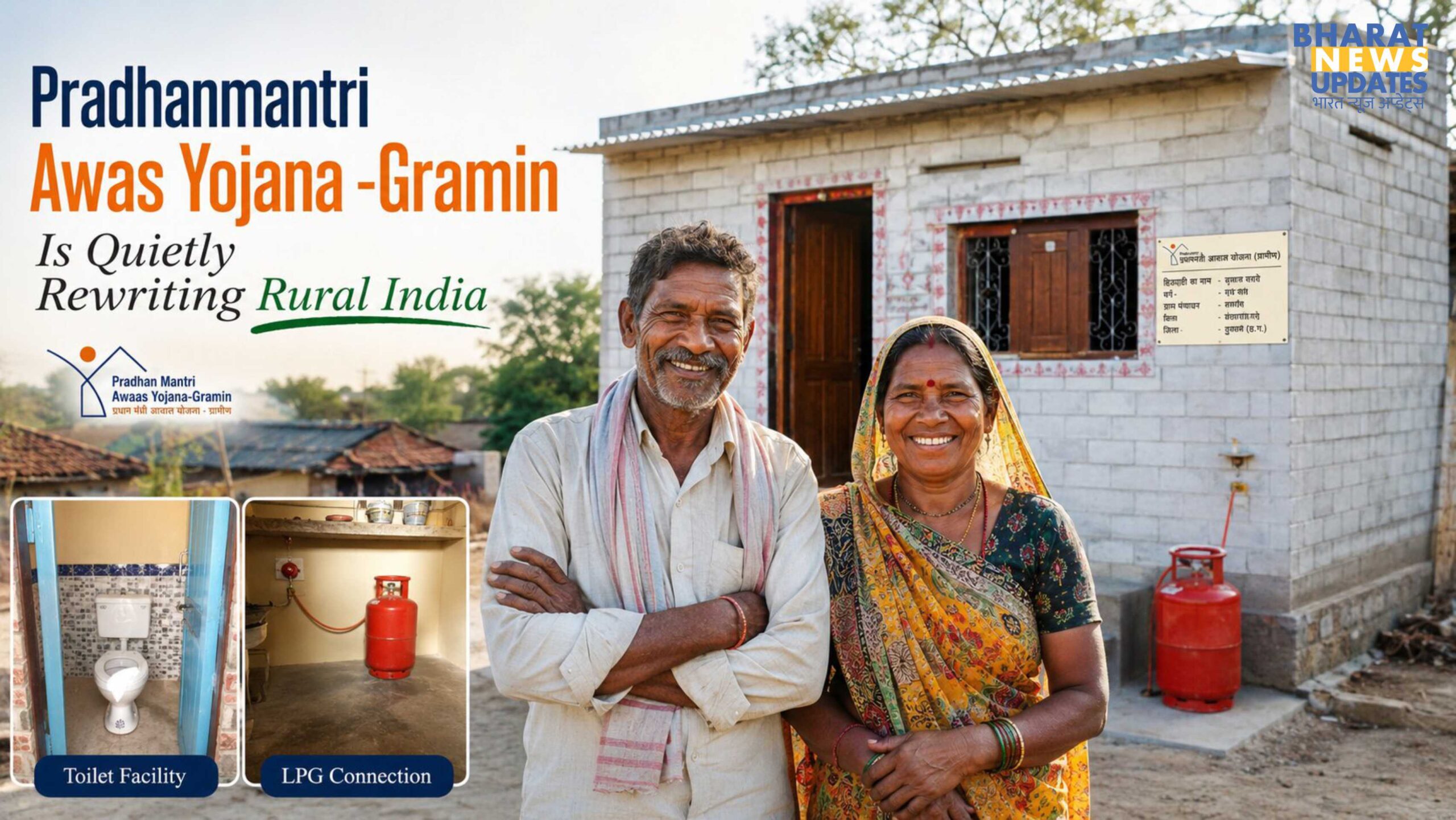
A Roof, A Right: How PMAY-G Is Quietly Rewriting Rural India And Where It’s Still Falling Short
Every monsoon, Savitri Devi of a village in Jharkhand used to spread plastic sheets over her family’s mud-and-thatch ceiling and pray. Last year, she moved into a two-room pucca house with a toilet, an LPG connection, and her name on the ownership document. She is one of over three crore rural Indians for whom a government scheme has done what decades of poverty could not undo: given them walls that don’t dissolve in the rain.
The scheme is Pradhan Mantri Awaas Yojana-Gramin (PMAY-G), and it just got a major shot in the arm.

₹10,021 Crore Released, A Double Infusion in One Year
On May 28, Union Minister Shivraj Singh Chouhan released what the government called a “mother sanction” of ₹10,021.42 crore to 12 states under PMAY-G, via video conferencing a significant push toward realizing the ‘Housing for All’ vision by March 2029. The 12 states receiving this tranche: Assam, Chhattisgarh, Gujarat, Haryana, Himachal Pradesh, Jharkhand, Karnataka, Kerala, Punjab, Rajasthan, Tamil Nadu, and Uttar Pradesh represent a cross-section of India’s rural geography, from the flood plains of Assam to the arid belt of Rajasthan.
What makes this notable is the compounding scale: this comes on top of an ₹11,121 crore approval already issued for financial year 2026-27. Against a total target of 4.95 crore houses under the scheme, approvals for 3.91 crore have already been accorded, and construction of more than 3.05 crore has been completed. The housing target for the current year, officials confirmed, is three times higher than the previous year, an acceleration that is either visionary or vertiginous, depending on who you ask.

Not Just Bricks: A Convergence of Dignity
What separates PMAY-G from a simple construction subsidy is its convergence logic. The government has framed it not merely as house construction but as creating homes supported by roads, electricity, drinking water, LPG connections, and toilets linking it with schemes like Swachh Bharat Mission and the Ujjwala Yojana. Financial assistance under the scheme is ₹1.20 lakh per unit in plain areas and ₹1.30 lakh for hilly and north-eastern states.
The scheme has also created roughly 568 crore person-days of rural employment over the past nine years a figure that rarely gets cited alongside the house count. In states like Chhattisgarh, mason training programmes have been launched specifically for PMAY-G construction, giving tribal youth a livelihood alongside the housing push.

75% Owned by Women: Quiet Revolution in Property Rights
Perhaps the most transformative and least discussed aspect of PMAY-G is its gender dimension. Approximately 75 percent of houses sanctioned under the scheme are registered in the names of women or held under joint ownership. For rural women who have historically had no legal stake in family property, a house registered in their name is not a policy metric. It is, in many cases, the first asset they have ever legally owned. It changes their standing in the family, in the panchayat, and in any future legal dispute.
The Contradiction at the Heart of the Scheme: The Landless Poor
Here is where the scheme’s most uncomfortable truth surfaces. PMAY-G is designed for the poorest of the poor yet it quietly excludes the absolute poorest. Owning a plot of land is a prerequisite to qualify as a beneficiary under PMAY-G. The identification of landless beneficiaries and providing them with land is the responsibility of state governments and except for a few, most states have remained largely passive about this.
According to the 2011 Census, India has 144 million landless farmers most in rural areas. Yet PMAY-G’s own records identified only 0.26 million as landless, and sanctioned a mere 0.11 million as beneficiaries. A parliamentary panel flagged recently that over 37 percent of landless beneficiaries identified under PMAY-G could not avail assistance due to delays in land allotment by states with Tamil Nadu having the highest number of landless applicants stuck in limbo.
In Meghalaya, a Congress MLA pointed out that BDOs were simply not approving applications from houseless people who had no land, a bureaucratic deadlock that defeats the very premise of the scheme. The minister in question acknowledged the challenge but offered no concrete solution.
Shivraj Singh Chouhan himself, at the fund-release event, urged states to undertake special initiatives for landless families, an acknowledgment that this gap is real, persistent, and unresolved.

States Still Lagging on Beneficiary Identification
The Centre also flagged that some states have not completed the beneficiary-identification process aligned with targets for 2024-25 and 2025-26, and pushed for it to be completed by June 30, 2026. Other documented challenges include permanent migration of identified beneficiaries, disputed succession of deceased beneficiaries, and unavailability of building materials in remote areas.
There is also the quality question. A CAG audit found compromised construction quality in earlier iterations, and the pressure of tripling annual targets raises the same concern again.
The Larger Picture
PMAY-G has received ₹54,917 crore in the 2026-27 budget, a significant rise and together with MGNREGS-aligned rural programmes, accounts for over 63 percent of the Rural Development Ministry’s expenditure. This is a scheme that has genuinely moved the needle on rural shelter. Three crore families living in pucca homes is not a press release, it is a material change in millions of lives.
But the scheme’s ambition outruns its ground-level execution in the places that matter most: where families are landless, where states are slow, and where the poorest applicant cannot navigate the paperwork. Getting to 4.95 crore houses by March 2029 is achievable but only if the next phase is built on fixing what the first phase exposed.
Savitri Devi has her house. Millions more are waiting, not for a vision, but for a plot of land on which to build one.