

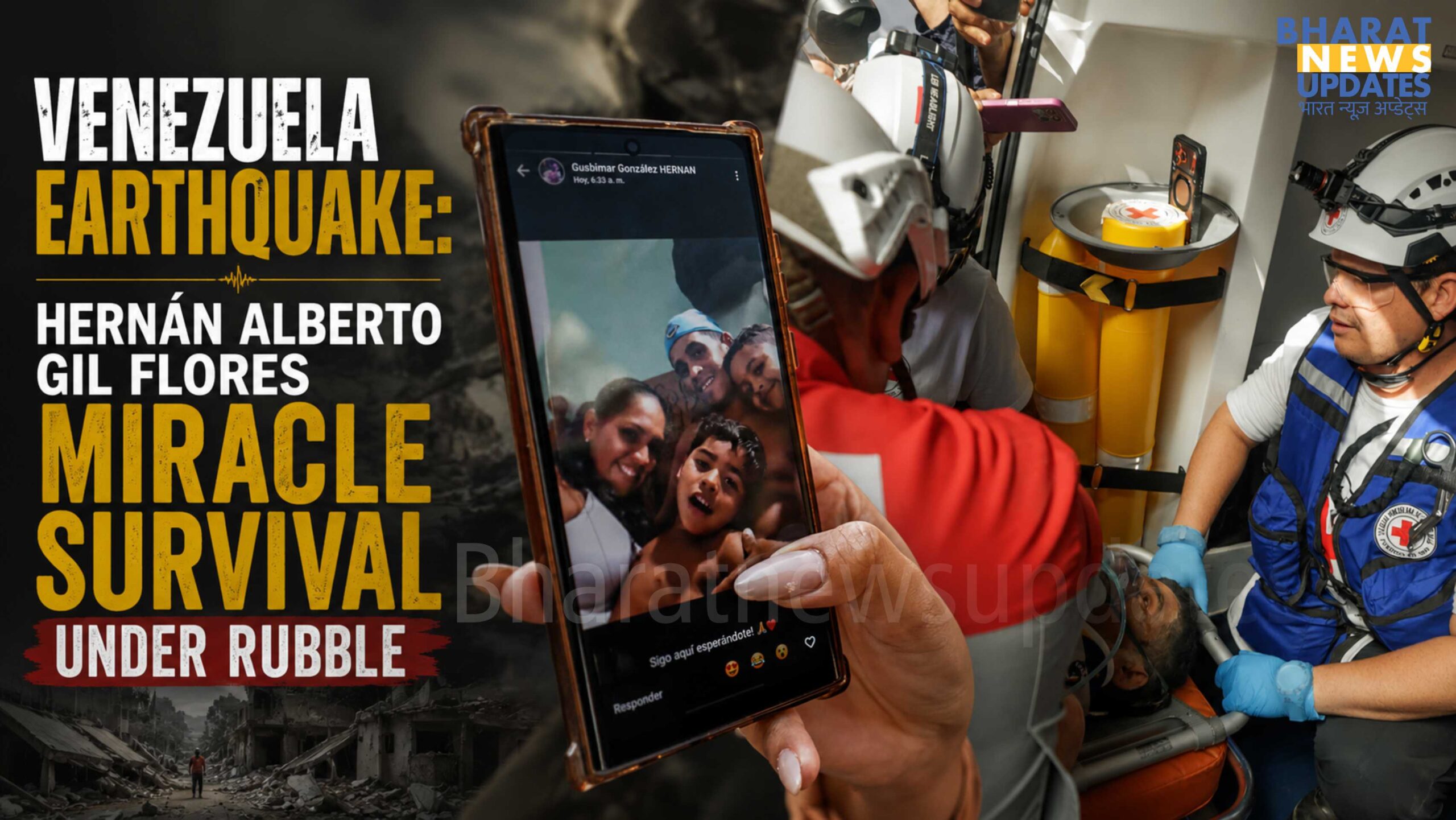
La Guaira, Venezuela: On June 24, two earthquakes tore through northern Venezuela within hours of each other, magnitude 7.2 followed by 7.5. The confirmed death toll from the twin earthquakes reached nearly 2,600, with an estimated 50,000 people still missing. Whole neighbourhoods in the port city of La Guaira folded in on themselves. Nine days later, most of the country was no longer searching for survivors. It was counting bodies.
Then, on July 2, a stretcher came up through a hole in the wreckage of a shopping mall, and the man on it was breathing.
His name is Hernán Alberto Gil Flores. He is 43, a security guard who worked nights, and until eight days earlier, most people outside his circle of family and co-workers had never heard of him. Now his face gaunt, one eye bruised almost shut, dust still in his hair is the closest thing this disaster has to a happy ending.


A booth, not a coffin
Gil Flores was on duty in the basement parking area of Galerías Playa Grande when the ground first moved. He didn’t run. There wasn’t time. He was buried under roughly 29 feet of wreckage after the nine-story shopping mall’s parking structure came down around him.

Here’s the detail almost nobody expects: the thing that should have killed him is the same thing that saved him. Concrete security booths are built small and reinforced, meant to survive a car crash, not an earthquake but that same stubborn geometry is exactly what held its shape when nine floors of mall collapsed on top of it. Disaster engineers have a clinical name for it, a “void space.” Gil Flores would probably just call it luck with very specific edges.
He wasn’t untouched. He wasn’t comfortable. But he had air, and air is the only ingredient that matters in the first hour of a collapse.
The part rescuers don’t usually talk about
Search teams didn’t hear from him immediately. Rescuers were first alerted that someone may still be alive under the rubble on Sunday, a full five days after the quakes hit, well past the point most emergency doctrine treats as the outer edge of hope. The textbook window for finding survivors without a water source is about 72 hours. Gil Flores blew past it by more than double.


What changed the odds wasn’t just his booth. It was the radar. Teams confirmed a survivor was underneath using radar, sonar and sound-detection equipment before they’d even cut a path to him. Then came the part that rarely makes headlines: keeping a buried man alive is a logistics problem as much as a medical one. Crews used a telescopic camera to talk to him and lowered water and liquid nutrients down a narrow shaft to sustain him through the final days of digging. Somewhere under nine stories of collapsed concrete, a man was being fed through a straw the width of a garden hose, one careful squeeze at a time.
“How nice that you came back”
This is the part that separates Gil Flores’ story from a simple survival statistic: he stayed present. He recognized voices. He made small talk with strangers digging toward him in the dark. Rescue crews who’ve pulled people from far shallower wreckage say that alertness, that stubborn thread of personality, is unusual this many days in and it may have mattered as much as the water did. A body under stress can shut down through despair long before it shuts down through thirst. His didn’t.
The digging itself was brutal in its slowness. Crews worked through aftershocks, torrential rain, and unstable rubble, moving debris piece by piece because pulling the wrong chunk could bring the rest down. The operation, led by Chile’s fire brigade with specialists from roughly half a dozen countries, took 70 hours from confirmed contact to extraction. Nearly three full days of work to close a gap that, on a map, would barely register as a few metres.
“Don’t tell my wife”
The single most human moment of the whole operation happened before he’d even seen daylight. “When we found him, he asked us not to tell his wife that he was alive, just in case he wouldn’t make it,” a Costa Rican Red Cross rescuer later said. Not relief. Not a request for water. A man managing his family’s grief in advance, from underneath a collapsed mall, on the off chance his rescue failed.
His wife, Gusbimar González, had already made her own peace with the worst. “When I learned he was alive, I saw a ray of light in the darkness,” she told reporters. She described him as holding up “like a hero.” The couple has two children, ages 8 and 10, who spent eight days not knowing whether their father was one of the thousands still under the rubble across the city.
When he finally came up, crowds outside the site cheered as he was carried through on a stretcher and loaded into a Red Cross ambulance. Venezuela’s acting president called it a celebration of life itself, a rare unifying sentence in a country that has agreed on very little since the quakes hit.


What happens to a mind after eight days in the dark
Doctors treating Gil Flores describe his physical condition as stable, helped enormously by the steady hydration and nutrition rescuers managed to get to him underground. But physical stability is the easier prognosis. What trauma specialists watch for after an ordeal like this isn’t just physical scarring, it’s the after-effects that surface weeks or months later: sleep disturbance, claustrophobia, flashes of panic triggered by enclosed spaces or loud noise, a kind of hypervigilance that doesn’t switch off just because the danger has passed. Recovery teams in similar rescues elsewhere have found that survivors who stayed communicative and mentally active underground, as Gil Flores reportedly did, tend to process the experience differently than those who went silent with engagement, oddly, seems to function as a kind of psychological anchor even while it’s happening.
For now, Gil Flores is one of the only pieces of good news to come out of a disaster that is still, quietly, getting worse. Rescue crews are still working the wreckage of La Guaira. Most of what they’re finding isn’t a story like his.
Bharatnewsupdates International Insight Team ⊥ July 2026, 4