

The Abraham Accords: America’s Grand Bargain or a Paper Peace?
When silence on a phone call tells you everything about a diplomatic initiative
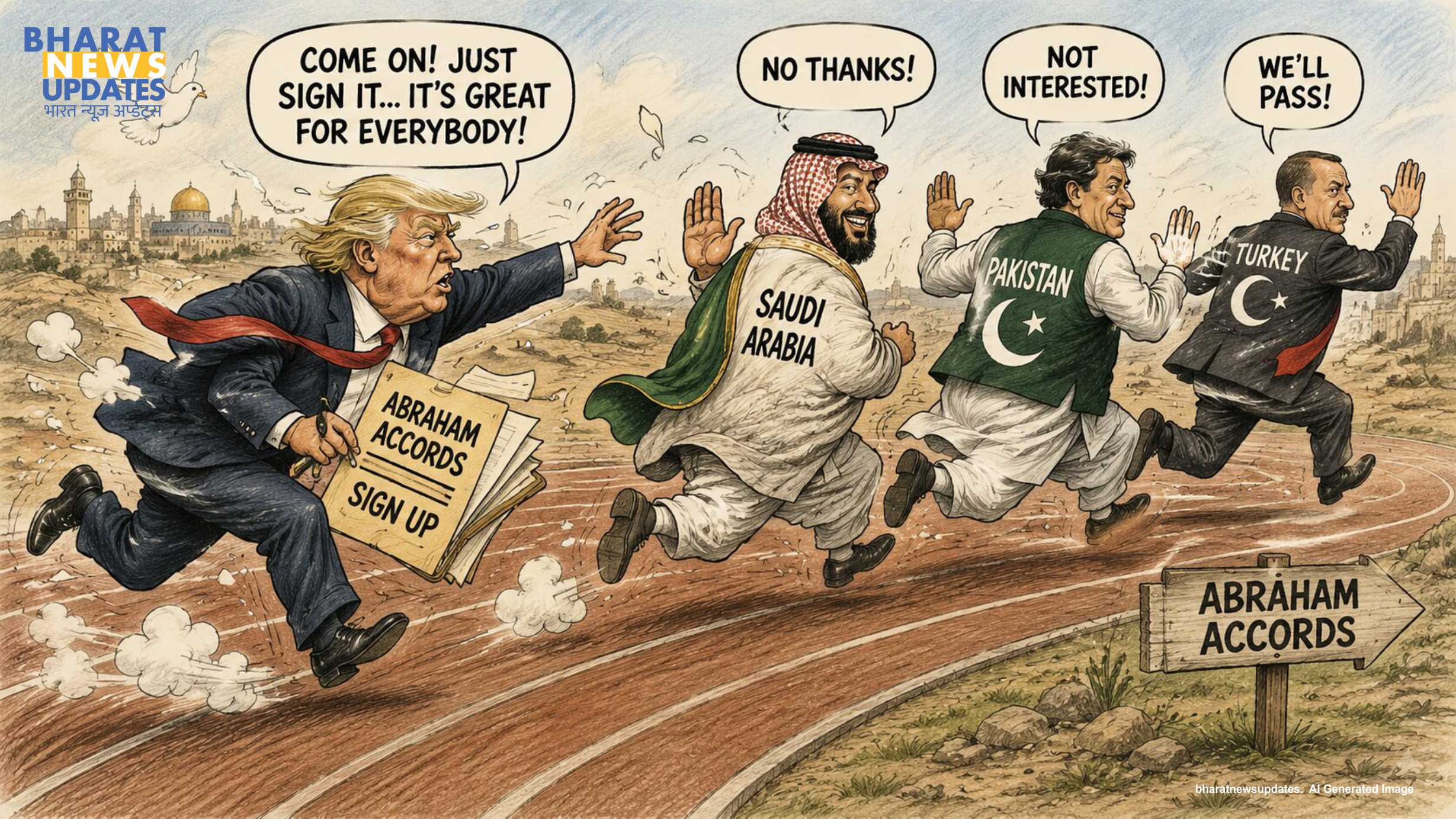
There is a moment that cuts through all the diplomatic language and White House press releases. Donald Trump calls leaders of eight Muslim-majority nations on a Saturday — Saudi Arabia, UAE, Qatar, Pakistan, Turkey, Egypt, Jordan, Bahrain and after his speech urging them all to “immediately sign” the Abraham Accords, there is, according to a US official cited by Axios, complete silence on the line. Trump reportedly joked, “Are you still there?”
They were still there. They just had nothing to say.
That silence is the real story of the Abraham Accords expansion push in 2026.
What the Abraham Accords Actually Are
The Abraham Accords, first signed in September 2020 during Trump’s first term, were a genuine diplomatic breakthrough but a narrower one than the fanfare suggested. The UAE and Bahrain formalized relations with Israel, followed by Morocco and Sudan (though Sudan’s parliament never ratified the deal). These were not peace agreements between warring parties. They were normalization deals between states that had no active conflict with Israel. The UAE, in particular, had long maintained quiet economic and intelligence ties with Tel Aviv. The accords made visible what already existed beneath the surface.
The real masterstroke was the framing. By naming the accords after Abraham the patriarch shared by Judaism, Christianity, and Islam, Washington gave a transactional diplomatic arrangement a quasi-sacred identity. It was smart branding. Whether it was honest is another question.
Kazakhstan joined in late 2025, expanding the accords into Central Asia, a country that already recognized Israel independently. The Central Asian state completed the required steps to formalize its entry, marking a notable geographic expansion of the normalization framework into Eurasia. Symbolically rich; substantively thin.
Why Trump Is Pushing Again And Why Now
Trump is pushing to expand the Abraham Accords as part of a broader effort to reshape the Middle East around closer cooperation between Israel, Arab states and the United States, while also countering Iran’s regional influence.
The timing, however, reveals more than the stated reasoning. The push comes simultaneous with US-Iran nuclear negotiations. The linkage is deliberate. Trump recently said he had spoken to leaders from these countries and insisted they should “simultaneously sign onto the Abraham Accords” once a wider agreement involving Iran is reached. The message to the region: if Iran comes in from the cold, the rest of you have no excuse not to stand with Israel.

The hidden logic here is leverage. By bundling the Iran deal with normalization demands, Trump creates a situation where Arab leaders who quietly support a nuclear agreement with Iran must publicly defend their refusal to sign the accords. It’s a diplomatic trap: elegant in design, likely to fail in practice.
There is also a domestic narrative function. Saudi Arabia remains the major prize for Trump and Israel. If Riyadh signs, Trump can present it as the most consequential Middle East achievement since the Camp David Accords. It would be a legacy-defining moment. This explains the urgency and the hyperbolic language describing the accords as a document that would be “respected like no other that has ever been signed.”
The Countries That Won’t Sign, and Why That Matters More Than Those Who Might
Saudi Arabia is the pivot point for everything. Saudi Arabia’s Crown Prince Mohammed bin Salman told Trump in November 2025 that Riyadh could join the Abraham Accords if there was “a clear path” toward a two-state solution. Subsequent conflict with Iran complicated that stance. MBS is not ideologically opposed to normalization, he is strategically cautious. He wants a Palestinian state pathway, US security guarantees, and civilian nuclear rights in return. What he is being offered instead is a ceremonial signing with no defined Palestinian state timeline. That is not a deal; it’s a photo opportunity.
Pakistan rejected the proposal immediately and categorically. Pakistan’s Defence Minister Khawaja Muhammad Asif said Islamabad would not support any arrangement that contradicts the country’s longstanding position on Palestine. Pakistan has never recognized Israel, and doing so would ignite domestic political firestorms that no government in Islamabad can afford. The fact that Pakistan is simultaneously playing a mediating role in US-Iran talks makes the demand even more tone-deaf asking your mediator to take sides is bad diplomacy.
Turkey is the most confusing inclusion on Trump’s list. Turkey recognized Israel decades ago. But the issue today is not recognition itself, it is the deep political crisis with President Recep Tayyip Erdogan. Ankara has hardened its line against Israel in recent years, halted direct trade following the war in Gaza, and adopted rhetoric against Jerusalem that has become among the harshest in the Muslim world. Asking Erdogan to sign the Abraham Accords is not a diplomatic request. It is a political humiliation demand. It will not happen under his government.
Qatar is perhaps the most paradoxical case. Qatar has no formal ties with Israel, although Doha is a key US ally and was a central mediator in negotiations between Israel and Hamas throughout the two-year Gaza war. Qatar has served American and Israeli strategic interests without formal recognition. Demanding they now formalize that relationship publicly amid ongoing Palestinian suffering would likely end Qatar’s credibility as a neutral mediator, which is worth far more regionally than a signed accord.
Egypt and Jordan are a different story entirely. Two countries on Trump’s latest list, Egypt and Jordan, already maintain full diplomatic ties with Israel but did not originally join the Abraham Accords. Including them in the demand reflects either deliberate obfuscation about what the accords mean, or a desire to use their names to swell the optics of the list. Either way, it suggests the push is more about appearances than architecture.
The Contradiction at the Heart of It All
Here is the uncomfortable truth that analysts in Washington rarely say plainly: the Abraham Accords, in their current form, benefit Israel far more than they benefit the Arab states that signed them.
The UAE gains defense technology access, US approvals for advanced weapons, and investment corridors into Israeli tech. Bahrain, a small island kingdom with a Shia majority governed by a Sunni monarchy, gains American security assurances. Morocco gets US recognition of its sovereignty over Western Sahara a side deal that had nothing to do with Israel and everything to do with transactional diplomacy.
What the Palestinian people got: nothing. Not a state, not a defined timeline, not even a credible negotiating framework. This is not a detail. It is the central moral and political flaw that makes every subsequent expansion attempt harder.
When Saudi Arabia, Pakistan, or Turkey cite Palestinian statehood as their condition, they are not being obstructionist. They are reflecting the overwhelming sentiment of their populations. For many Islamic nations, recognizing Israel without a concrete framework for Palestinian statehood remains politically and diplomatically sensitive, especially at a time when the Gaza conflict continues to dominate political discourse across West Asia and the wider Muslim world.
What US Strategy Looks Like if the Accords Stall
Washington’s fallback, when the grand signing ceremony fails to materialize, will be incremental quiet engagement. The pattern is already visible: economic corridors, defense cooperation MoUs, intelligence sharing all without the political liability of public normalization. This is, in effect, what the UAE and Bahrain were already doing before 2020.
The second lever is economic inducement. Saudi Arabia wants civilian nuclear technology, an official US security treaty, and investment into Vision 2030. The US can offer pieces of this without a Palestinian state commitment. Whether MBS accepts that trade remains the single most important variable in Middle East diplomacy today.
The third, darker strategy is patience through attrition. The calculation never stated publicly is that a generation of Arabs growing up with trade links, tourism, and cultural exchange with Israel will gradually depoliticize the Palestinian question. This is not peace. It is the slow administrative dissolution of a people’s political claim, made palatable by prosperity.
The Hidden Reality: Silence as a Strategy
The silence on Trump’s conference call was not embarrassment. It was a coordinated non-response. These governments have no interest in publicly humiliating Trump, who remains their most useful American interlocutor. But they also cannot afford the domestic cost of association with an initiative that their populations view, rightly or wrongly, as abandoning Gaza.
The Abraham Accords, as they stand in 2026, are a genuine but incomplete diplomatic architecture. They normalized some relationships that needed normalizing. They did not build peace. Peace requires addressing the question that every Arab leader, every Pakistani official, and every silent conference call participant already knows: what happens to the Palestinians?
Until Washington has an honest answer to that question, the Abraham Accords will remain what they currently are a framework impressive enough to celebrate, too fragile to expand, and too convenient to abandon.
The phones will keep ringing. The silence will keep speaking