

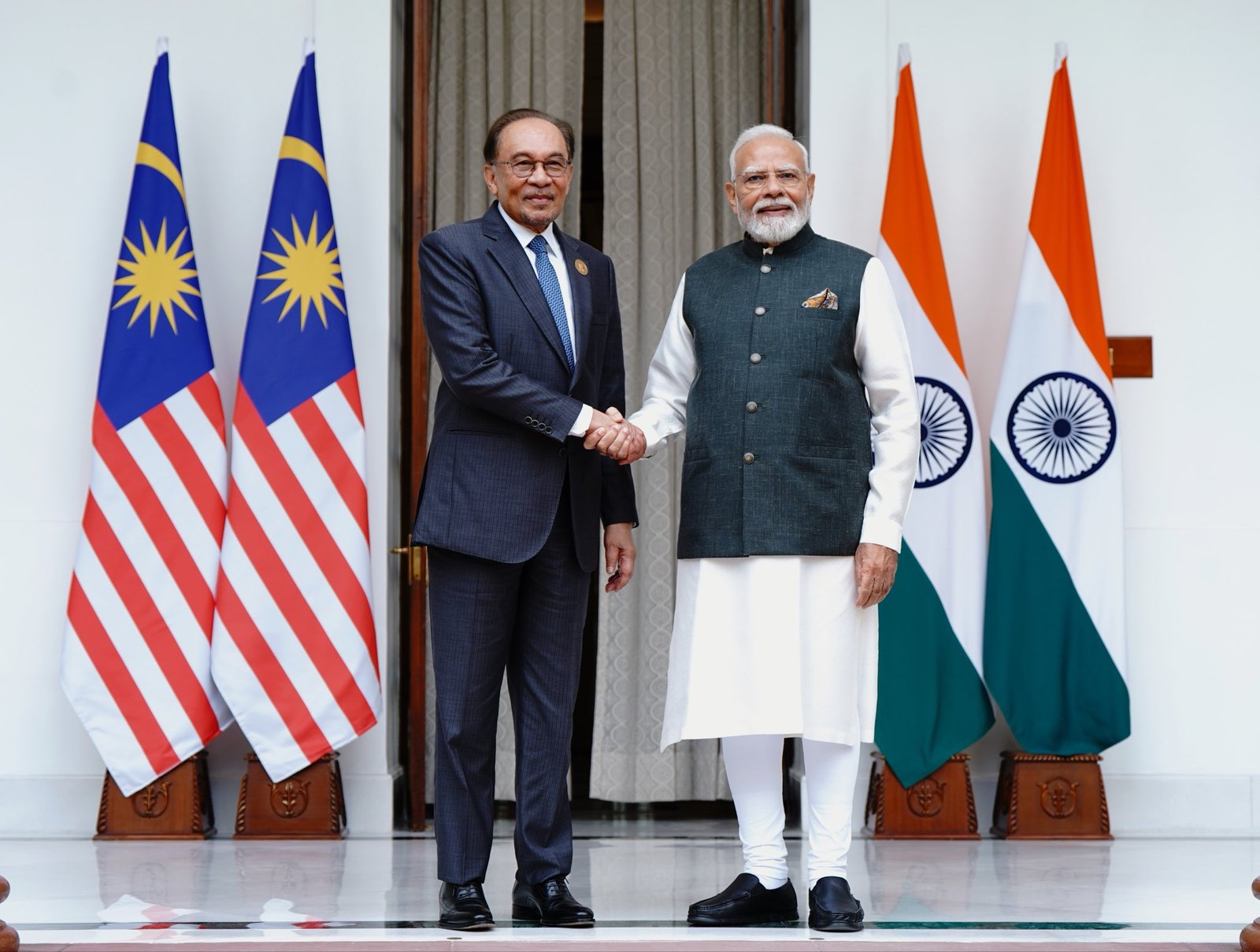
New Delhi was doing what host cities do during a summit is shuttling motorcades, guarding every sentence for its geopolitical weight, counting who showed up and who didn’t. Then, somewhere between the starter and the symphony, PM Anwar Ibrahim walked up to a pianist and asked, in Malay, if he could sing.
That’s the detail almost nobody is talking about, and it’s the one that makes this story more than a cute clip. Malaysian Prime Minister Anwar Ibrahim didn’t announce a performance. He didn’t wait for an invitation from the stage. He simply leaned toward the pianist working the room at Narendra Modi’s gala dinner for the 18th BRICS Summit at Bharat Mandapam and asked, “Guru, mintak izin nyanyi kejap ok?” roughly, “Teacher, may I sing for a bit?” It’s the kind of line you’d use with a music tutor, not a stranger at a state function. That word choice, “Guru,” is the tell. Anwar wasn’t performing for an audience. He was asking permission to join a moment that already felt like his.
What followed was “Khwaab Ho Tum Ya Koi Haqeeqat,” a 1965 S.D. Burman composition written by Majrooh Sultanpuri for the film Teen Devian, sung in the original by legendry singer Kishore Kumar with a voice that, decades after his passing, still carries more emotional real estate in South and Southeast Asia than most sitting politicians. Guests applauded. Phones came out. By morning it was viral everywhere.
Here’s the part most coverage buried: this wasn’t Malasian PM Anwar’s first duet with the Indian songbook, and it wasn’t even his only one that night. Earlier in the same dinner, he’d already sung “Dost Dost Na Raha” from Sangam (1964), a Raj Kapoor classic about love and loss between friends. And in August 2024, during a farewell reception at the Taj Mahal Hotel after an official visit, he sang that very same Sangam number for his hosts. This is a pattern, not a party trick. Anwar has been humming his way through Hindi cinema’s golden age in front of Indian audiences for at least two years, which suggests something more interesting than spontaneity: a leader who has quietly decided that a shared soundtrack does diplomatic work that a communiqué cannot.
That’s worth sitting with, because the room he sang in wasn’t universally full. China’s Xi Jinping and Abu Dhabi’s Crown Prince Sheikh Khaled bin Mohamed had already left Delhi after the day’s talks and skipped the dinner altogether. Absences at summit banquets are their own quiet language read as scheduling, read as signaling, read however you like. Against that backdrop, a partner-country leader choosing to stay, lean into a piano, and sing a 60-year-old nostalgic poetic love song reads less like frivolity and more like an argument: that presence and warmth are themselves a form of diplomatic currency, especially when seats are full with enthusiasm and beautiful Indian hospitality.
The evening itself had been built for exactly this kind of gesture. The gala featured a performance titled “Navarasa, The Universe of Shared Emotions” and a specially commissioned BRICS Symphony, “One Rhythm, Many Cultures” the summit’s own organizers had already framed the night around music as a shared language before PM Anwar rendered a beautiful song. The menu leaned into the same register of considered hospitality: khandvi mille-feuille, khumb galouti, paneer lababdar, gucchi marmik, carrot-bean poriyal, millet pulao, and desserts of Old Delhi fruit cream with jalebi and shahtoot phirni. It’s the big yet grounded evidence of “atithi devo bhava” meaning “the guest is God” showing up not in a slogan but in a menu card and a piano bench.
None of this erases the summit’s real weight: reform of global governance, trade cooperation, the hard arithmetic of a bloc trying to hold together countries with very different interests. That work happened in the daylight sessions and will be judged on outcomes, not applause. But summits are remembered in two registers: the communiqué, and the moment people actually replay. For once, the moment that traveled fastest wasn’t a soundbite about tariffs or a photograph of handshakes. It was a 78-year-old Kishore Kumar melody, sung slightly off the beat, by a 79-year-old head of government who apparently just likes the song.
Diplomacy rarely gets to be unguarded. For about ninety seconds at Bharat Mandapam, it was.
Bharatnewsupdates International Insight Team ⊥ September 2026, 13