

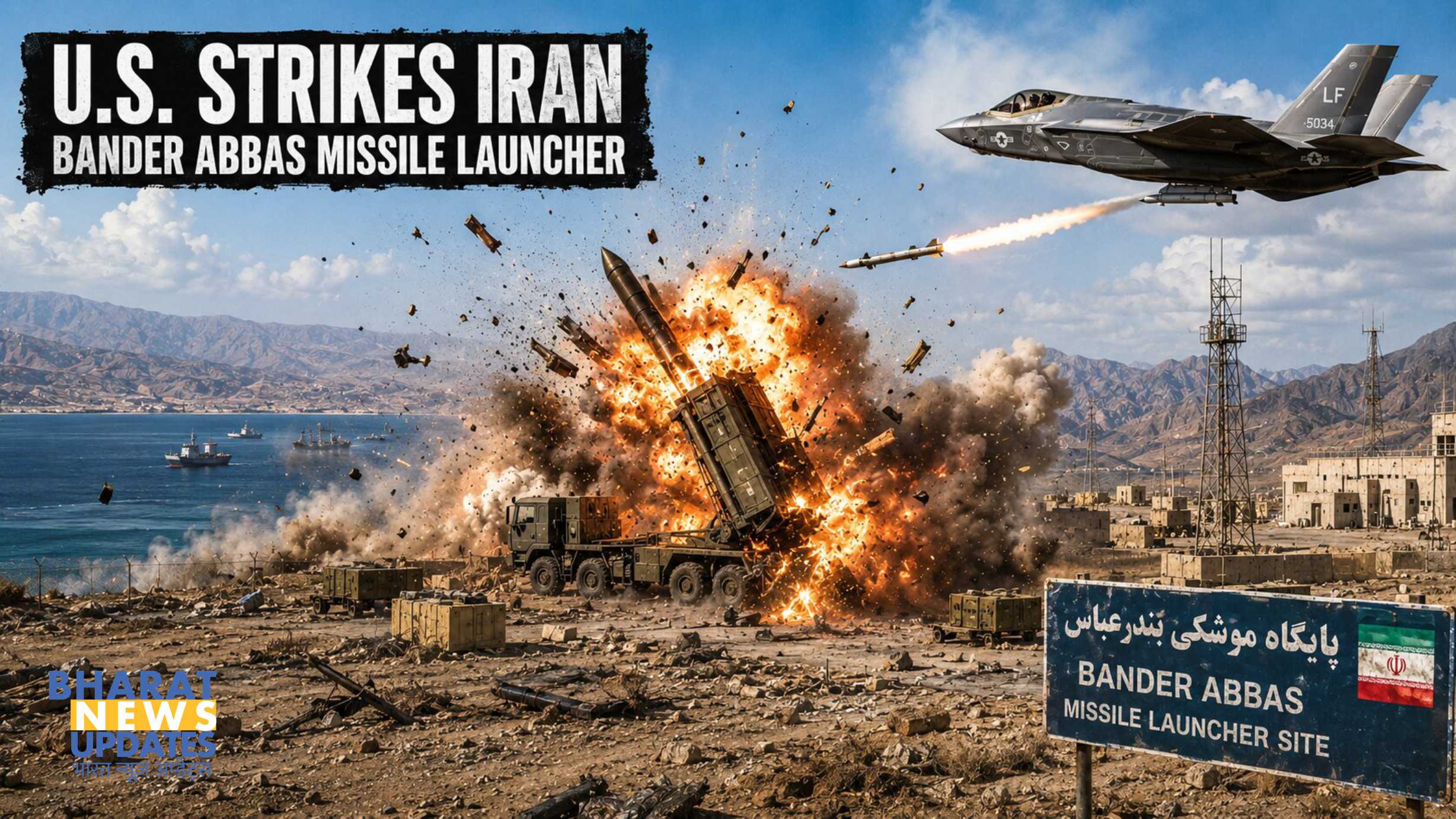
The US destroyed an Iranian drone station before a fifth killer drone launched. Kuwait came under fire overnight. Oil climbed past $97. And behind it all, Iran is now run by a 56-year-old son of the man America killed, someone described by a former Israeli ambassador as almost certainly “vengeful.” This is not a ceasefire. It is a countdown.

Just before dawn on Thursday, US Central Command destroyed a ground control station on the outskirts of Bandar Abbas International Airport, a dual-use civilian and military hub sitting almost literally on the lip of the Strait of Hormuz. It was the second round of American strikes this week. It will likely not be the last.
Four Iranian one-way attack drones had already been shot down. A fifth was seconds from launch when the station went dark. US officials called the action “measured, purely defensive.” Iran’s Revolutionary Guard Corps (IRGC) called it an act of aggression and within hours, claimed to have struck the American air base that launched the attack. Kuwait then activated air defenses against what its military described as “hostile missile and drone attacks.” The fog of war, barely lifted since the April ceasefire, descended again before breakfast.
A ceasefire in name only
Let’s say plainly what most headlines are tiptoeing around: the ceasefire brokered in early April is not a ceasefire in any meaningful military sense. It is a mutually agreed pause a diplomatic placeholder that has been violated, reinterpreted, and exploited by both sides almost since the ink dried. Iran briefly reopened the Strait of Hormuz on paper; in practice, vessel passage required military pre-approval from Tehran, and in the first 24 hours of the truce, a single oil products tanker made it through. One.
This week’s exchanges are the third and fourth military incidents since that agreement. The pattern is unmistakable: Iran tests a boundary, the US responds with what it calls “defensive” action, Iran retaliates and frames itself as the victim, and the diplomatic track convulses. Both capitals then release contradictory statements about whether progress toward a permanent deal is being made. It is not a confidence-building cycle. It is a slow unraveling.
“They’re negotiating on fumes,” said Trump. The harder truth: both sides are — and the global oil market is the collateral.”
The son who inherited a war and a grievance
Background: Ayatollah Ali Khamenei, Iran’s Supreme Leader for 37 years, was killed on February 28, 2026 in joint US-Israeli strikes on Tehran. His son, Mojtaba Khamenei, age 56, was named Iran’s new Supreme Leader by the Assembly of Experts on March 8, a choice that sent oil prices above $120 for the first time since 2022. A former Israeli ambassador called it a signal of “continuity, and the guy will probably be vengeful.”
The most significant and underreported dimension of the current stalemate is not the uranium stockpile dispute, the sanctions freeze, or even the Strait of Hormuz. It is the identity of the man now running Iran. Mojtaba Khamenei is not a career diplomat or a cautious technocrat. He is the son of the man the United States helped kill three months ago, a mid-level cleric with deep ties to the IRGC who has never held public office, never faced a popular vote, and was pushed through the succession process by a Revolutionary Guard command structure that bypassed constitutional formalities because airstrikes were still ongoing when they chose him.
No one in serious analytical circles believes Mojtaba Khamenei is negotiating with Washington in good faith. His political identity was forged in defiance. His legitimacy at home rests on not appearing to capitulate to the power that killed his father. A deal that he signs, in the eyes of Iran’s hardline base, is a betrayal of his father’s legacy. The structural incentive to delay or collapse negotiations is embedded in his very elevation to power.
And yet Washington continues to negotiate as though it is dealing with the same institutional Iran that signed the 2015 nuclear deal. It is not. The Islamic Republic of 2026 is a wartime state led by a grieving son with a vendetta, propped up by a Revolutionary Guard that has already demonstrated it will act outside constitutional procedures when it suits them. That is the negotiating partner the US State Department is trying to reach a permanent agreement with.
Trump’s midterm problem
On the American side, the contradictions are no less stark, just more loudly broadcast. Trump spent weeks projecting confidence that a deal was imminent. This week he said Iran was “negotiating on fumes” and suggested the US might “go back and finish it.” That phrase is not diplomatic language. It is a threat to resume full-scale military operations, made by a president watching approval ratings ahead of November midterms.
The hidden reality is that Trump needs a deal more visibly than he admits. A cosmetic agreement say, formal Hormuz reopening with sanctions relief deferred would play well domestically. But his stated refusal to unfreeze the $24 billion in Iranian oil revenues held in Qatar, or ease sanctions in any form, leaves Tehran with almost nothing concrete to take home. A deal that a government cannot sell to its own people is not a deal. It is a surrender document, and no Iranian politician who wants to survive signs one, least of all a new Supreme Leader whose entire mandate is built on defiance.
Israel, Lebanon, and the expanding frame
Simultaneously, Israel has issued fresh evacuation warnings across southern Lebanon and is again clashing with Hizbollah which Iran has consistently insisted must be covered under any long-term agreement. This is where the geometry of the conflict becomes genuinely complex. Washington has been threading a needle: keeping Israel operationally free while negotiating with Israel’s principal regional adversary. Netanyahu has publicly stated that operations in Lebanon fall outside the scope of the US-Iran truce. Tehran disagrees, loudly and formally.
What this means in practice is that every Israeli strike on Hizbollah gives Iran’s hardliners a legitimate grievance to table in negotiations, slowing or breaking them. It also gives the IRGC political cover to escalate because they can frame any action as retaliation not for US strikes, but for Israeli attacks on Lebanon. The regional conflicts are no longer separable threads. They are a single knot that tightens with each new incident.
Hormuz and the oil price ratchet
The Strait of Hormuz is 33 kilometers wide at its narrowest point. Through it once passed approximately one-fifth of all globally traded oil and liquefied natural gas. Its near-closure has already caused the most severe energy market disruption in decades and every escalation like Thursday’s Bandar Abbas strike extends the timeline for normalization.
Here is the contradiction most energy analysts are not saying clearly enough: even if a permanent deal were signed tomorrow and the strait formally reopened, oil prices would not immediately normalize. Months of disruption have already reoriented supply chains, rerouted tankers via the Cape of Good Hope, and pushed insurance premiums to historic highs. The infrastructure of Hormuz-dependent oil trading has been partially dismantled. Rebuilding it takes time and every new exchange of fire adds months to that clock.
Brent’s rise toward $98 on this week’s strikes is not a panic spike. It is the market updating its probability estimate for a sustainable ceasefire downward, again. The $100 barrier is not far. And if the IRGC’s retaliatory strike on an American air base was launched from, or aimed at, Kuwait, a country that has been repeatedly targeted throughout this conflict and is again under attack, then the regional stabilization story is in serious trouble. When Kuwait comes under fire, every Gulf state recalculates its exposure. Shipping insurance adjusters are already watching.
The uncommon scenario no one is pricing
Most analysis treats a deal as inevitable eventually. There is a credible scenario in which it is not. Mojtaba Khamenei’s political survival depends on not looking like he surrendered to the country that murdered his father. American concessions are structurally limited by midterm domestic politics. Israel has no incentive to pause Lebanon operations. And the IRGC which placed Mojtaba in power and considers itself the true governing authority of Iran has historically preferred a closed strait and permanent confrontation to any compromise that reduces its institutional power.
The ceasefire could simply expire without resolution. The strait could remain de facto closed. Oil could settle above $100 as a new structural floor not as a crisis price, but as the new normal of a permanently fractured Persian Gulf order.
Nobody is pricing that scenario in adequately. The market is still treating this as a crisis with a resolution curve. It may be a crisis with a son at the helm who has every personal reason to ensure it does not resolve cleanly.
The Bandar Abbas strike was, by any tactical reading, precise and proportionate. But precision in tactics does not guarantee wisdom in strategy. And the Strait of Hormuz does not grade on a curve.