

On 14th September 2026 morning, somewhere between a Mumbai chawl and a Pune bungalow, someone is going to wake up at 5 a.m., scrub a brass thali until it shines, and cry a little while placing turmeric on a clay idol that cost them three hundred rupees. Nobody’s filming it. That’s the real Ganesh Chaturthi, not the drone shots of Lalbaugcha Raja‘s queue, which is real too, but the smaller version happening in ten crore homes at the same hour.
Ganesh Chaturthi 2026 begins Monday, September 14, and runs for the traditional ten days to Anant Chaturdashi on September 25, when the grand visarjan happens. Some families do one and a half days, some do five, some do the full stretch and almost nobody outside Maharashtra realizes that’s a choice, not a rule. There’s no scripture mandating ten days. It’s a habit that calcified into tradition, mostly because Lokmanya Bal Gangadhar Tilak revived the public version of this festival in 1893 as a freedom-movement tool bringing Lord Ganesha out of private homes into shared pandals so the British couldn’t ban a “religious gathering” the way they’d banned political ones. The scale you see today in Mumbai with Lalbaugcha Raja’s lakhs of visitors, GSB Seva Mandal‘s gold-and-silver splendour, Dagdusheth Halwai Ganpati Trust in Pune drawing a different, quieter kind of devotion is all of it traces back to that very political, very human decision more than a century ago.
The Puran story, minus the sanitizing
Most retellings stop at “Parvati made a boy from turmeric paste to guard her bath, Shiva didn’t recognize him, cut his head off, felt terrible, replaced it with an elephant’s head.” True, but incomplete and the incomplete version is what makes people ask “why worship a mistake?”
The fuller Shiva Purana version matters here: Parvati created Ganesha specifically because she wanted one son being loyal only to her, in a household where Shiva’s ganas answered to Shiva alone. Ganesha’s fierce refusal to let Shiva enter wasn’t disobedience, it was him doing exactly what he was made for. Shiva’s rage, the beheading, and the later elephant head aren’t really about anger; the story is a meditation on boundaries, loyalty, and how even gods act on incomplete information. The elephant head attached from an animal facing north, per most versions became a symbol of wisdom precisely because it was a repair job, not a design. That’s the part worth sitting with: Ganesha is worshipped first not despite the chaos of his origin, but almost because of it.
Muhurat for September 14, 2026 and the trap in it
The Chaturthi tithi begins around 7:06 AM on September 14 and runs until 7:44 AM on September 15. Because it straddles two days, priests calculate a Madhyahna (midday) muhurat for the actual installation, since Lord Ganesha is traditionally believed to have been born at midday.
- Madhyahna Ganesh Sthapana Muhurat: roughly 11:02 AM – 1:31 PM (varies by 15–20 minutes city to city as Chennai’s window opens earlier than Delhi’s, Mumbai’s sits close to the Delhi figure)
- Abhijit Muhurat: late morning, roughly 11:50 AM – 12:40 PM
- Amrit Kaal / Shubh Yoga windows: available in the early morning for those who cannot do midday installation
Here’s what almost no calendar mentions: you are not required to hit the exact muhurat. If your Bappa arrives home at 4 p.m. because of traffic or a late delivery, install him anyway, with a sincere aarti, before the tithi ends the next morning. Priests across Maharashtra will tell you privately that bhakti performed outside a muhurat outranks a perfectly timed ritual done mechanically. The anxiety around “missing the window” is largely a modern, calendar-app-driven panic; older households simply didn’t have this stress.
The mantra that matters more than people think
The core invocation is short by design, meant to be repeated, not performed once for show:
“Om Gan Ganapataye Namah”
Chant it 108 times with a rudraksha or tulsi mala during sthapana and before every meal offering. For Sankashti-style focus, the Ganesh Gayatri invoking his wisdom and protection is used in the morning aarti in many Konkani and Maharashtrian households, though it’s less commonly known outside them.
Modak, and the naivedya rules nobody explains
Steamed ukadiche modak (rice-flour outer shell, jaggery-coconut filling) is the non-negotiable offering in Maharashtra with 21 pieces is the customary count, not 11 or 5, because 21 corresponds to the names/forms associated with Lord Ganesha in ritual counting. Alongside modak: motichoor ladoo, durva grass (an odd-numbered bunch, always 21 blades), red hibiscus, and coconut.
The uncommon detail: durva grass outranks flowers in strict ritual hierarchy. A puja without flowers is forgivable; one without durva is considered incomplete by traditionalists. Also Lord Ganesha is offered red or orange items preferentially, never black, and in most homes onion and garlic are avoided in the naivedya kitchen entirely, not just meat.
The restriction almost nobody follows correctly: the moon
Hindu scripture explicitly warns against looking at the moon on Ganesh Chaturthi night, the “Mithya Kalanka” or false-accusation curse, tied to a story where Ganesha mocked the moon (Chandra) for his vanity and got cursed in return, then reduced the curse to just this one night. Even Lord Krishna was later falsely accused of theft (the Syamantaka gem episode) after accidentally seeing the moon on this day. If you do see the moon by accident, the prescribed remedy is chanting the Syamantaka mantra or getting someone to level a false accusation at you and immediately forgiving it, a traditional ritual that most people have never heard of, let alone performed.
Lalbaugcha Raja, Dagdusheth, and the quiet contradiction
Lalbaugcha Raja is famous for granting “manokamna” (wishes) and the queue can run 24+ hours, and people camp overnight for a five-second darshan. Dagdusheth Halwai Ganpati in Pune, founded in 1893 by a grieving sweet-shop owner (Dagdusheth Halwai) after losing his son to plague, carries a gentler, more personal energy and the trust still funds education and health initiatives quietly, away from the cameras.
The contradiction worth naming: the loudest, most commercially visible mandals often have the strictest internal discipline with volunteers doing 16-hour shifts, silence during aarti while a tiny home Ganpati with a speaker playing Bollywood remixes can feel far more chaotic. Scale and reverence don’t correlate the way outsiders assume.
Visarjan September 25, but with a footnote
Anant Chaturdashi visarjan falls on Friday, September 25, 2026. Environmental rules in Mumbai and Pune now push hard for artificial ponds and PoP-free clay idols, a shift that’s real, still incomplete, and worth asking about before you buy your idol this year, not after.
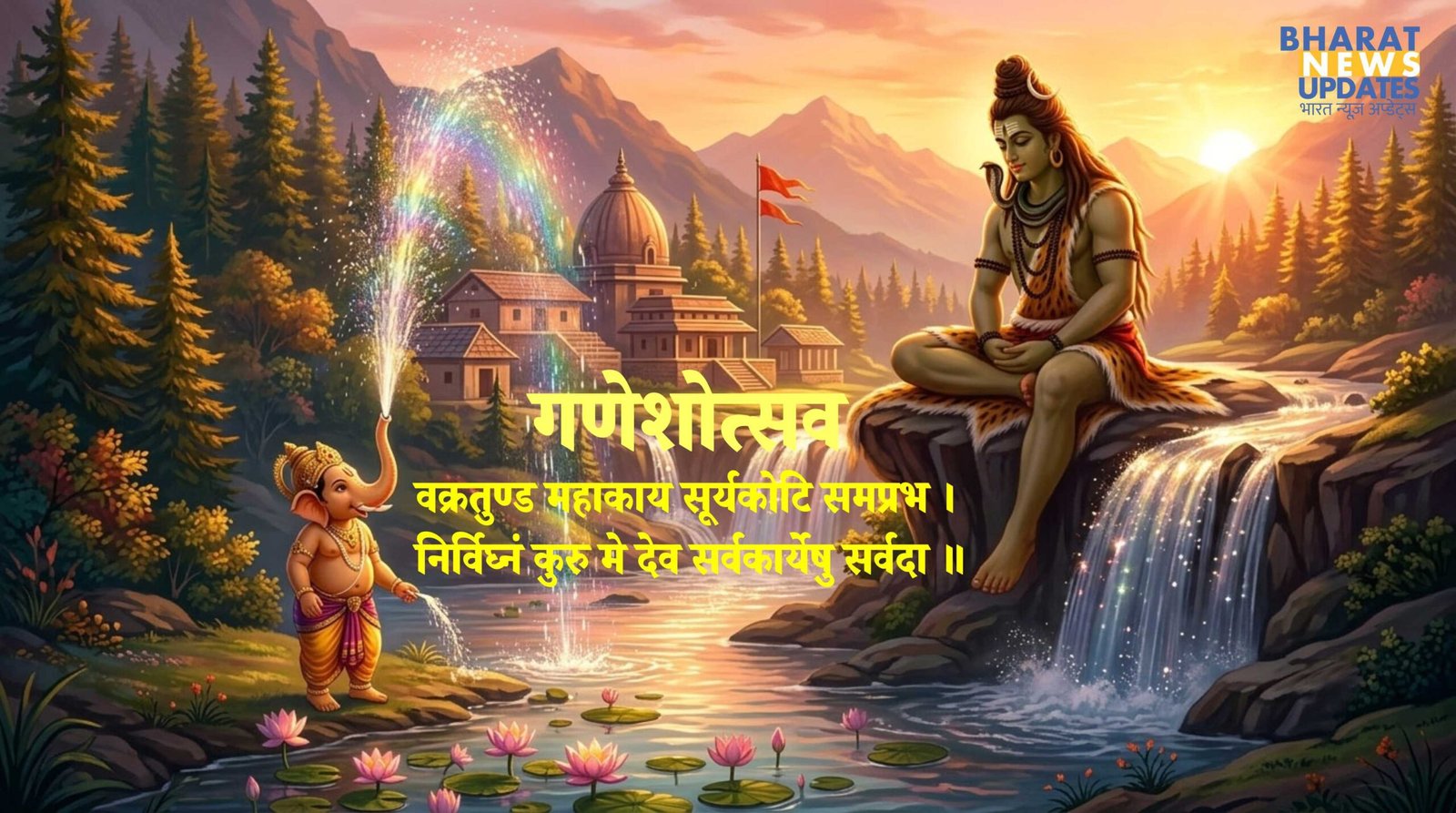
जीयादुदस्तहस्ताग्रविकीर्णवमथूत्करः । हेरम्बोऽनुहरंश्चूडागलद्गङ्गाम्भसः पितुः ॥
May Ganesha reign supreme. With the jet of water spouted by the tip of his upraised trunk, he imitates his father, from whose crest flow Ganga’s waters.
Disclaimer: Timings are based on Panchang calculations and can shift slightly by city and by the priest consulted. Please confirm with a local pandit for exact muhurat in you