

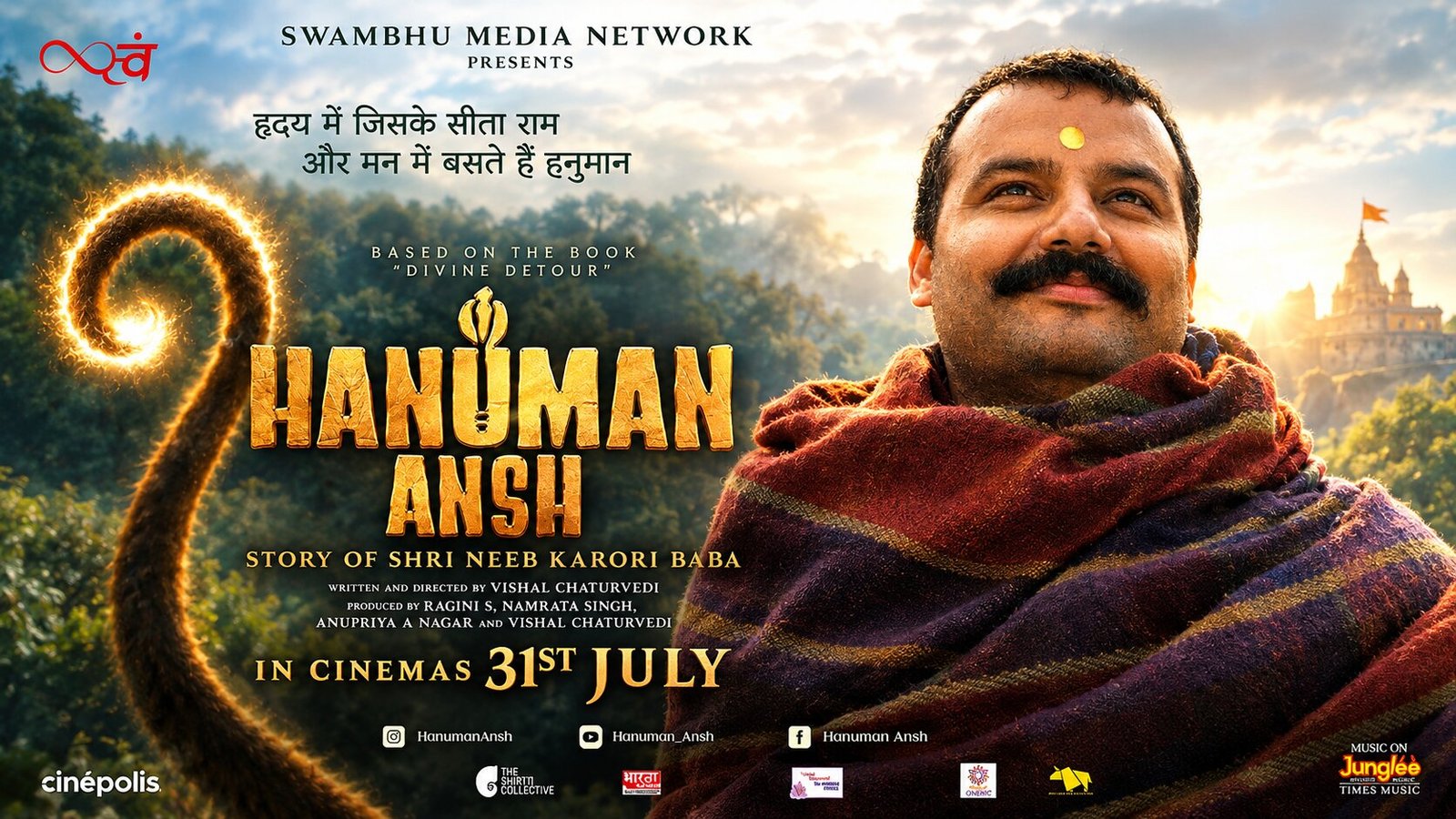
A film review that reads like a scripture, and a box office story that reads like a thriller
There is a scene playing out in Indian multiplexes right now that no marketing executive planned, no star-studded promo tour engineered, and no algorithm predicted. A film shot on a budget smaller than what most A-listers charge for a single day’s work has quietly, then thunderously, walked past the ₹200 crore mark at the worldwide box office. No item song. No overseas junket. No trending hashtag war. Just a story, told with conviction, about a heartbroken boy who became a saint.
That film is Hanuman Ansh, and if you haven’t watched it yet, you are the last one at the satsang.
The Story Nobody Was “Supposed” to Care About
Written and directed by Vishal Chaturvedi, Hanuman Ansh is not a superhero saga, not a star vehicle, not even a conventional biopic in the glossy sense Bollywood usually serves up. It follows a grieving young man named Lakshmi Narayan who, shattered by the death of his mother, walks out of his home in search of God. What unfolds is a wandering, aching, luminous journey across pre-Independence North India, a journey that eventually transforms him into one of the most quietly influential spiritual figures of the twentieth century: Shri Neem Karoli Baba Ji, the very guru whose blessing Steve Jobs once credited with reshaping the course of his life.

That single thread with Silicon Valley‘s most mythologized founder tracing part of his inner awakening to a barefoot Indian saint is the quiet hook that has pulled in audiences who would never normally step into a “devotional” film. This isn’t a movie about miracles performed for spectacle. It’s a movie about a man who learned to serve strangers with food, silence, and an unreasonable amount of love, long before anyone called him a legend.
Unknown Faces, Unforgettable Performances
Here’s the uncommon part: there isn’t a single marquee name in the cast. Lakshminarayan and everyone around him are played by actors most audiences are meeting for the very first time. And that absence of star baggage turns out to be the film’s secret weapon. You aren’t watching a celebrity “play” a saint for two hours, you’re watching a face you’ve never seen before disappear entirely into the role, so completely that the illusion of performance vanishes. The supporting cast are ordinary-looking actors with extraordinary control over stillness, silence, and restraint carries scenes that a starrier film would have overplayed into melodrama.
This is the hidden truth of Hanuman Ansh’s success: unfamiliarity became authenticity. When you don’t recognize the actor, you stop watching the actor and start watching the character.
The Numbers That Broke the Trade’s Own Rulebook
Let’s talk business, because the business here is the story.
The film opened on 7 August 2026 across a modest 250 screens and reportedly earned only about ₹10 lakh on its opening day, a number so small that most trade analysts wrote it off within the week. Two weeks in, it had scraped together barely ₹1.48 crore net. By every conventional metric, this was a film destined to vanish from screens quietly.
Then something nobody in the industry could script happened.
Word of mouth real, human, temple-courtyard, WhatsApp-forwarded word of mouth took over where marketing budgets could not. Weekly collections reportedly jumped from around ₹10 crore in week three to ₹61 crore in week four, and then an almost unbelievable ₹90 crore in week five alone, a fifth-week haul that trade trackers describe as the biggest fifth-week collection any Bollywood film has ever recorded. By Day 36, on Friday 11 September 2026, the film had crossed the ₹200 crore mark at the worldwide box office, with reported worldwide gross collections around ₹205 crore and net collections above ₹170 crore.
Made on a shoestring budget widely reported at around ₹2 crore, that return has already made Hanuman Ansh one of the most extraordinary return-on-investment stories Indian cinema has ever produced, with trade reports comparing it to the legendary 1975 devotional hit Jai Santoshi Maa as the benchmark for cost-to-collection miracles.
Contradiction? Absolutely. A film with zero stars, a wandering pace, and a budget that wouldn’t cover a single VFX shot in a superhero movie has now out-earned films with A-list casts and marketing spends fifty times its size reportedly overtaking even parts of Ranveer Singh’s Dhurandhar franchise numbers and leaving newer big-budget theatrical releases from the same week struggling to find footing.
What the Trade Missed (and What You Shouldn’t)
Every unheard tip about this film’s success traces back to one thing: it never tried to be a “movie” in the commercial sense. It behaved like a pilgrimage. Audiences didn’t walk in expecting entertainment, they walked out having felt something closer to catharsis. That’s a rare, almost extinct sensation in a theatre seat today, and it’s precisely why families, elderly viewers, and even skeptics who “don’t watch devotional films” have been returning for second and third viewings.
The visuals lean into stillness rather than spectacle with dusty roads, flickering diyas, silence held a beat too long for comfort. Where a bigger-budget film would have thrown a drone shot and a background score at every emotional moment, Hanuman Ansh trusts its audience to sit with quiet. That trust, it turns out, is what modern moviegoers were starving for.
The Honest Verdict
Is Hanuman Ansh a technically flawless film? No. Some stretches meander, some transitions are rough around the edges, betraying its shoestring budget in ways a bigger production house would have polished over. But perfection was never the point. What the film gets right is soul, sincerity, and a story that refuses to condescend to its audience is exactly what most big-budget releases this year have gotten wrong.
If you’re the kind of moviegoer chasing the next big spectacle, this isn’t it. But if you want to remember why you fell in love with cinema in the first place is its power to move a room of strangers to the same lump in the throat as Hanuman Ansh deserves your ticket, your two hours, and honestly, your respect.
Bollywood didn’t make this film a hit. Audiences did. And that’s the real story here.
A SWAMbhu Media Network presentation, the film cast: Shobhinaw Satyaa, Vihaan Shedge, Chandan K Anand, Purnima Tiwari, Anil Rastogi, and Gulshan Pandey.
#HanumanAnsh is written and directed by Vishal Chaturvedi, and produced by Ragini S, Namrata G Singh, Anupriya A Nagar, and Vishal Chaturvedi.
Music on Times Music
All-India release by Cinepolis India.
Rating: ⭐⭐⭐⭐½ (4.5/5)