

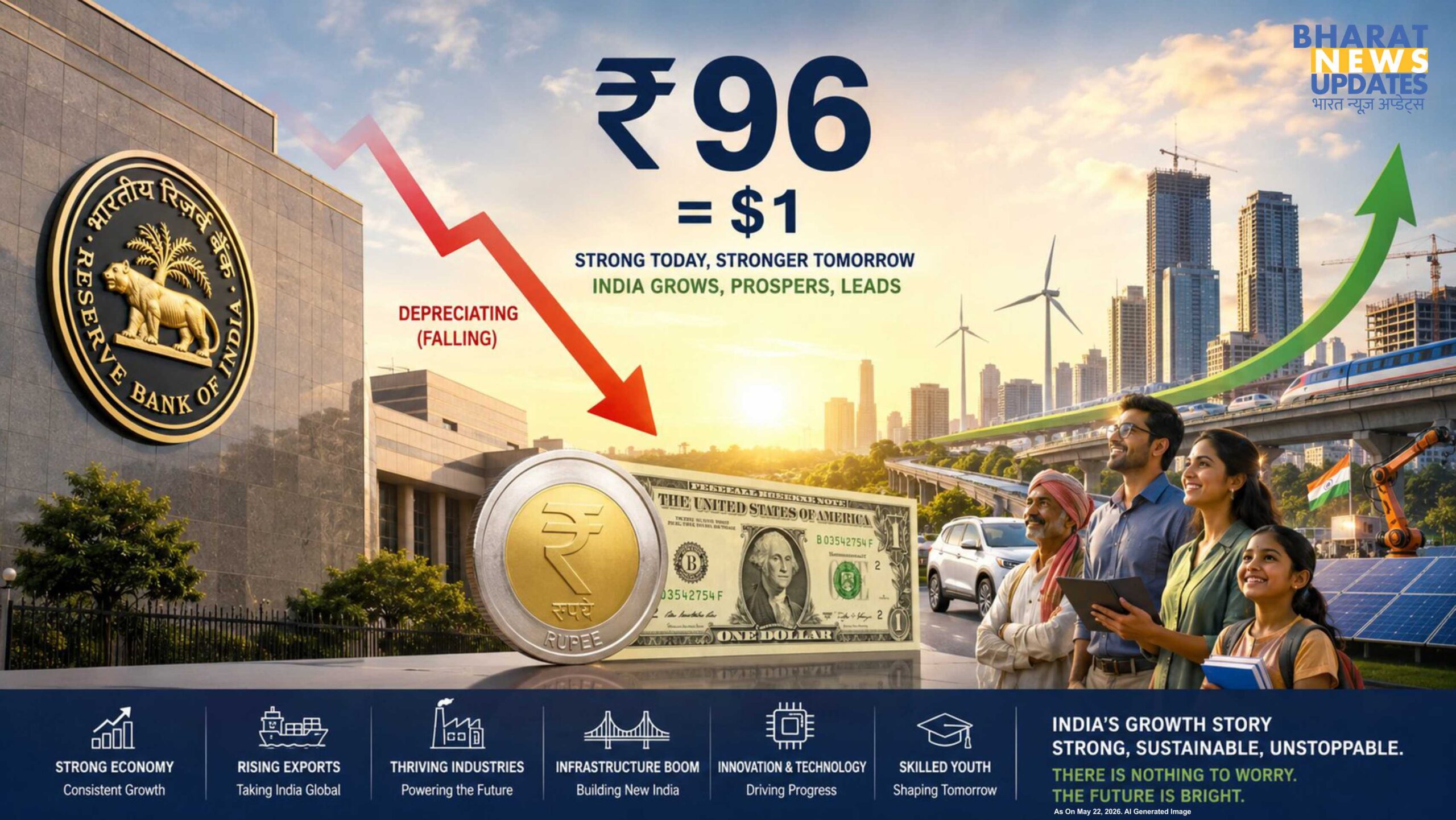
₹96 to a Dollar and Counting
India’s GDP is surging. Its central bank holds nearly $690 billion in reserves. Yet the rupee keeps sliding. What’s really happening and should you panic?

Here is the contradiction that should bother you: India’s economy is growing faster than almost any other major nation on earth. Its central bank just raised its GDP forecast for FY26 to 7.4%. Moody’s rates the country resilient. And yet, the Indian rupee has lost more than 10% of its value in the past year sliding from ₹85 in early 2025 to ₹96 today, touching fresh record lows almost every week.
Something about that does not add up. Unless, of course, it does and the story is just more complicated than “weak economy, weak currency.”
Why is a growing economy producing a falling currency?
Start with what is not causing this. India’s fiscal deficit is manageable. Inflation has been relatively tame. Domestic demand is strong. The rupee’s fall has almost nothing to do with India’s internal health. The rot is in the capital account, the invisible flows that most people never think about until they travel abroad and wince at the exchange counter.
Since mid-2025, Foreign Institutional Investors have been pulling money out of Indian markets at a sharp pace roughly $17 to $18 billion in net outflows. At the same time, FDI has turned negative in several months. Why? Because US bond yields are hovering around 5%, and in uncertain times, money follows safety. When Washington offers 5% with zero geopolitical risk, why park capital in an emerging market?
Add to that: the West Asia conflict has pushed crude oil above $100 a barrel. India imports nearly 90% of its oil requirements. Every dollar of oil costs more. Every dollar of oil must be paid for in dollars. So the demand for dollars inside India goes up and when demand for dollars rises, the rupee falls. Simple arithmetic with brutal consequences.

The hidden reality nobody is writing about
Here is something the doom headlines miss: relative to its Asian peers, the rupee is not doing badly at all. The Japanese yen has fallen 8.7% against the dollar this year. The South Korean won is down 6.3%. The Indonesian rupiah 5.8%. The Indian rupee? About 4.2% year-to-date. The dollar is simply a wrecking ball rolling through emerging markets, and India is actually absorbing the hit better than most.
The RBI deserves some credit here, even if its interventions are not without controversy. Since 2025, it has sold over $100 billion in spot and forward markets to slow the rupee’s descent. Forex reserves have dipped from a record $728 billion in February 2026 to around $690 billion today a real cost, but still 11 months of import cover. That cushion matters.
“The relevant number is not the actual value of the exchange rate. What matters is jobs, inflation and output.”
Gita Gopinath, former IMF Deputy MD & Harvard professor, May 2026
Will ₹100 happen and does it even matter?
DBS Bank’s economists now see the rupee in the ₹95–100 range for the rest of 2026, revised upward from their earlier forecast of ₹90–95. MUFG predicts a partial recovery toward ₹92 by Q3. Goldman Sachs, more bullish on India’s fundamentals, cites strong NRI remittances and services exports as stabilizers.
Will the rupee touch ₹100? Possibly: if the West Asia conflict deepens, oil stays above $100, and capital outflows accelerate. But former NITI Aayog Vice Chairman Arvind Panagariya put it best in a post that went quietly viral: “100 is just a number, like 99 and 101.” The psychological barrier matters to traders and newspaper headlines, not to the real economy, not directly, anyway.
What does matter is the speed of the fall, not the destination. A slow, managed glide from ₹85 to ₹100 over 18 months gives businesses time to hedge, gives exporters time to plan, gives households time to adjust. A rupee that plunges from ₹96 to ₹100 in three weeks is a different and dangerous beast, it triggers panic buying of dollars, exporter hoarding, speculative pile-ons, and self-fulfilling collapse.
The contradiction at the heart of this: depreciation is partly the cure
This is the part that economists understand but find genuinely hard to explain at a dinner table. A weaker rupee is not just a problem. It is also part of the solution to its own problem.
When the rupee falls, your imported goods cost more, so you buy fewer of them. That reduces dollar demand. Indian exports become cheaper for foreign buyers, so orders potentially pick up. The trade deficit, which is part of why the rupee is weak, gets some natural correction. VK Vijayakumar, Chief Investment Strategist at Geojit Investments, calls it plainly: “Rupee depreciation boosts exports and at the same time reduces foreign exchange expenditure. Expensive dollar can curtail forex expenditure more than austerity appeals.”
The caveat and it is importance is that India’s exports are highly import-intensive. When crude oil, machinery, and intermediate goods cost more in rupee terms, production costs rise and some of the export competitiveness advantage gets eaten away. Depreciation is not a free lunch. But it is not purely punishment either.

Reason to worry, or not: a clear-eyed verdict
Reasons for concern
- Oil at $100+ widens import bill by ~$1.8bn per 1% rupee fall
- Imported inflation could push CPI to 4.7–5.5%
- Faster reserve depletion if oil stays elevated
- Panic depreciation could trigger capital flight spiral
- US tariffs on India at 50%, highest globally suppress export upside
Reasons for calm
- India outperforming most Asian peers in currency stability
- $690bn reserves, 11 months import cover
- GDP growth 6.9–7.4%, structural strength intact
- CAD at manageable 1.7–2% of GDP (vs 4.8% in 2013 crisis)
- Services exports and remittances provide structural dollar inflows
The honest answer is: mild concern, not panic. India in 2026 is not India in 2013. The macro foundation is incomparably stronger. The risk is not currency collapse, it is a slow inflationary grind if oil stays high and capital does not return. That would squeeze household budgets, complicate RBI’s rate decisions, and could dent the growth story that has made India the world’s favourite emerging market narrative.
The government’s move to double gold import duties to 15% in May 2026 is a telling sign, it is a Band-Aid on a larger wound, and risks encouraging smuggling. It shows policymakers are worried about reserves, even if they will not say so directly.
The rupee at ₹100 is not a catastrophe, if it arrives slowly and is accompanied by stable inflation and continued growth. It becomes a crisis only if the fall is disorderly driven by panic, not fundamentals. That is the line the RBI is walking, every single day.