

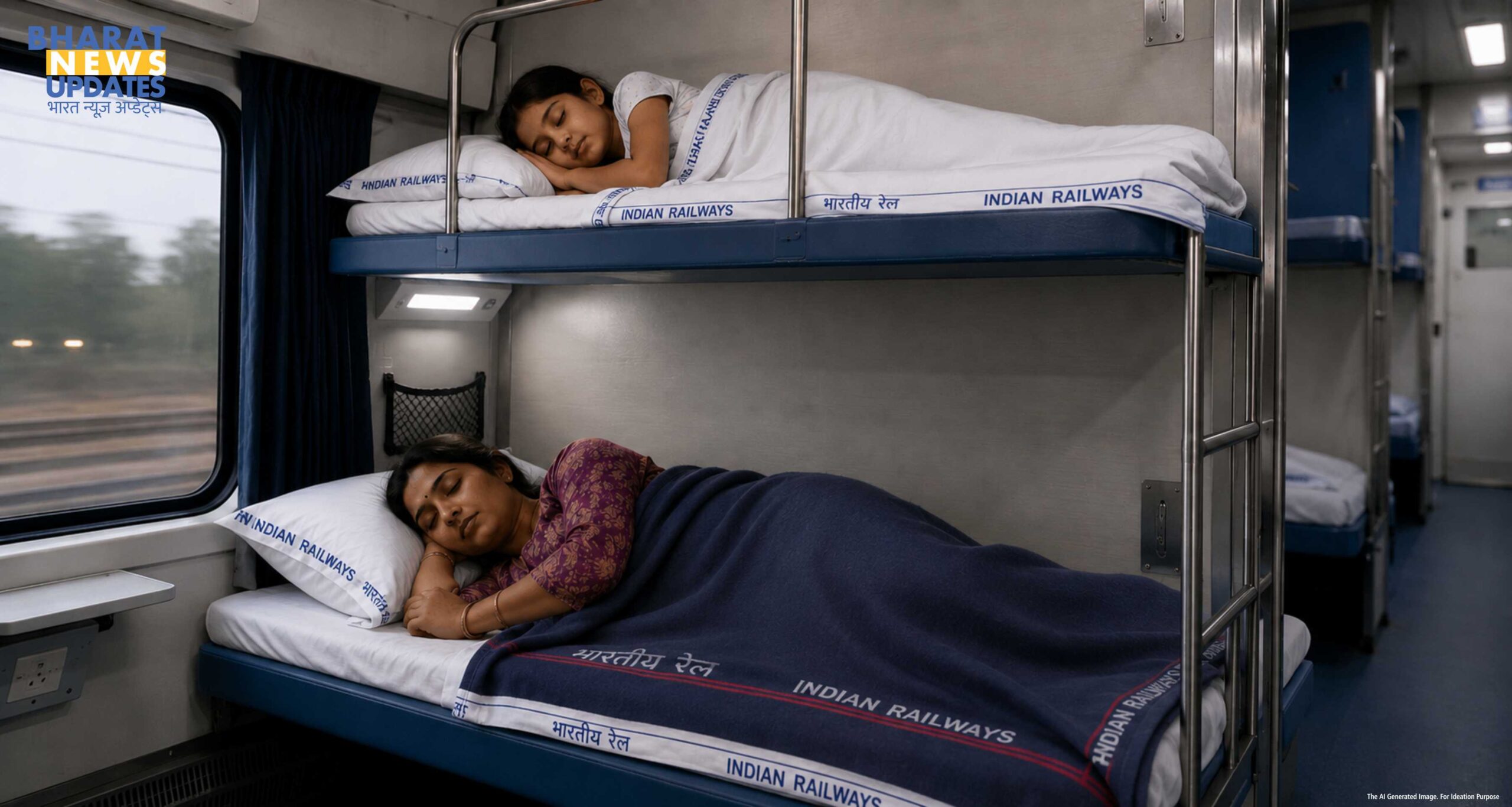
You board your Indian railway AC 3-tier coach at 11 pm, half asleep already, and the attendant hands you a plastic-wrapped bundle: two bedsheets, a pillow cover, a towel, and a folded blanket. Most of us tear it open, spread one sheet, throw the blanket on top, and pass out. Almost nobody in that coach knows they just skipped a step that Indian Railways itself designed and that a woollen blanket sitting on that berth may not have seen a washing machine in weeks.
That’s not a conspiracy theory. It’s what Railway Minister Ashwini Vaishnaw told Parliament this July 2026, in reply to a pointed question from Congress MP Chandrakant Handore, who wanted to know exactly how often those blankets get washed. The answer, in effect: not every trip. Only bedsheets is.
Two Identical-Looking Sheets, Two Very Different Jobs
Here’s the part almost no traveller is told at the counter. The bedroll isn’t “two spare sheets” yet, it’s a system with a division of labour:
- Sheet 1 goes directly on the berth, under you.
- Sheet 2 is meant to go between you and the blanket, not folded uselessly at your feet or used as a second layer under yourself.
Why? Because the blanket is the one item that isn’t rewashed after every passenger. It’s warm, it’s reused, and unless you’re on a handful of pilot routes, it comes straight from the previous traveller’s shoulders to yours. The second sheet exists purely as a barrier so that woollen fabric never actually touches your skin. Skip that step as most of us do and you’ve defeated the one hygiene safeguard Railways built in.
It’s a strange contradiction: the system is engineered around a workaround for something, it can’t fully solve (washing a blanket after every single journey, on a network moving over 2 crore passengers a day, isn’t logistically realistic), yet almost nobody explains the workaround to the person who needs it most.
The Replacement Clock You Never See
Every piece of linen on an Indian train is quietly running on a countdown, called its “codal life” in Railway paperwork:
| Item | Replaced every |
|---|---|
| Handloom bedsheets | 12 months |
| Polyvastra (synthetic-blend) sheets | 24 months |
| Pillow covers & towels | 9 months |
| Pillows | 24 months |
| Woollen blankets | 24 months |
That doesn’t mean a sheet is washed once in 12 months, washing happens after every trip for sheets. The codal life is when the item itself, the physical sheet, not its cleanliness gets retired and replaced with new stock. A sheet that’s gone thin, frayed, or stained beyond recovery gets pulled before its 12 months are even up.
Whito-Meters: The Machine That Judges Whiteness Like a Strict Aunt
Every mechanised Railway laundry runs finished linen past a device called a Whito-Meter which essentially an optical scanner that bounces a specific light spectrum off the fabric and measures how much bounces back versus gets absorbed. That reflectance is converted into a whiteness score against international benchmarks. Fail the score, and the batch doesn’t leave the laundry.
The Hidden Reality: Your Sheet’s Fate Depends on Which Zone Washed It
Here’s what most articles on this topic skip entirely: the AI camera upgrade isn’t network-wide, and pretending it is would be misleading. As of this July, the automated stain-detection pilot exists in exactly three laundry hubs, Pune (Central Railway), and Jaipur and Jodhpur (North Western Railway). If your linen wasn’t washed in one of those three divisions, no AI camera has looked at it. It’s still human eyes and a Whito-Meter reading, same as it’s been for years.
Similarly, the blanket-cover innovation, a washable cover that slips over the blanket itself so you never need the improvised second-sheet trick is currently only standard on North Western Railway trains and the new Vande Bharat Sleeper between Kamakhya and Howrah. Everywhere else, you’re still on the two-bedsheet honour system.
What the AI Camera Actually Catches
Positioned along the laundry’s finishing line, these cameras photograph every sheet and pillowcase as it exits the wash, in high resolution, and compare it against a model trained on thousands of clean-versus-stained images. Tea rings, oil marks, rust spots patterns a tired human eye might wave through on a night shift get flagged and the piece is pulled from circulation before it ever reaches a berth.
The Traveller’s Actual Move
Until blanket covers reach your route, the real fix costs nothing and takes five seconds: unfold that second sheet fully over the blanket before you sleep, don’t just drape it. It’s the single most-skipped instruction in Indian train travel, hiding in plain sight inside a plastic packet you’ve opened a hundred times.
Also worth remembering: CCTV now watches over 13,000 coaches and 3,200-plus stations for passenger security, a separate but related push toward accountability on the network. Linen hygiene is just one front in a much larger modernisation drive