

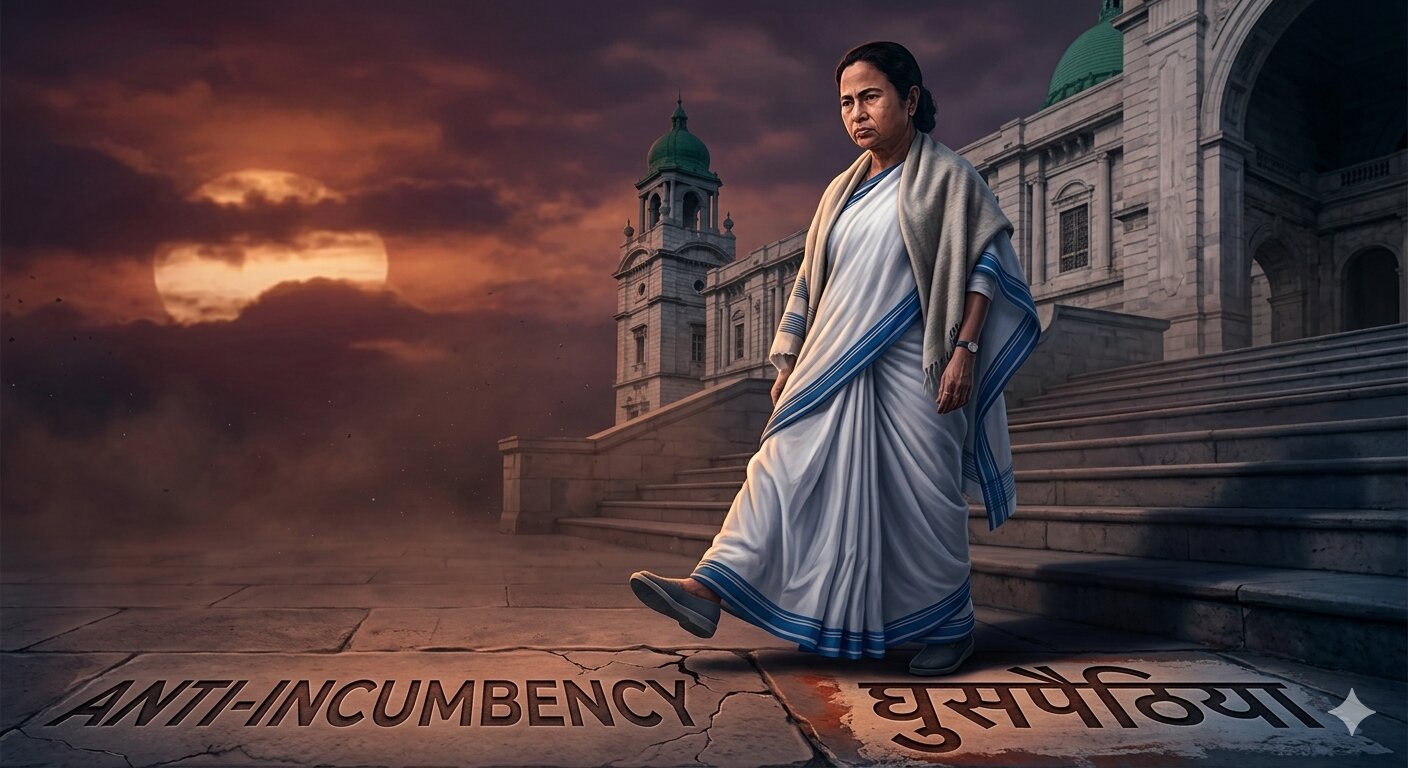
When Power Refuses to Walk Out the Door: Mamata Banerjee, Defiant Chief Ministers, and What the Constitution Says
There is a scene that plays out in Indian politics every few years, dramatic and oddly theatrical: the results are in, the verdict is clear, the crowds have gone home— and yet the occupant of the Chief Minister’s chair simply refuses to leave.
On Tuesday, Mamata Banerjee gave India its most spectacular version of that scene.
A day after the BJP swept West Bengal with 207 seats, reducing her Trinamool Congress to 80— and after she personally lost her Bhabanipur constituency to rival Suvendu Adhikari by over 15,000 votes— Didi walked into a press conference in Kolkata and said, more or less, that none of it had happened.
“I have not lost, so I will not go to Raj Bhavan. I will not tender my resignation,” Mamta Banerjee told reporters. Then came the line that will likely define this moment in Bengal’s political history: “Officially, through the Election Commission, they can defeat us, but morally we won the election.”
Morally won. Officially lost. But still in office. And, by most accounts, this is the first time in Indian democratic history that an outgoing Chief Minister has flatly refused to resign after so decisive an electoral defeat.
The People Who Did What She Won’t
India’s political history is full of Chief Ministers who lost elections and did the decent thing.
When Buddhadeb Bhattacharjee’s Left Front crumbled in West Bengal in May 2011 — ending 34 years of unbroken communist rule — he had lost his own Jadavpur seat to the TMC’s Manish Gupta, a man who had previously served as Chief Secretary under his own government. The humiliation was complete. He resigned on May 13. No speeches about moral victories. No press conferences about stolen mandates. He packed up and left.
The person who defeated him was Mamata Banerjee, who is now refusing to do what he did. The contrast is not lost on anyone.
In Tamil Nadu in 1996, Chief Minister Jayalalithaa lost the Bargur seat by 8,366 votes, her party reduced to just 4 seats across the state. She stepped down. In 2009, Shibu Soren lost a by-election by 9,000 votes while serving as Jharkhand Chief Minister and resigned as constitutional norms required. Even Mayawati — never anyone’s idea of a pushover — tendered her resignation the day after the BSP lost its majority in UP in March 2012. She left. She went to the Rajya Sabha instead.
Just this week, Tamil Nadu Chief Minister M.K. Stalin lost his Kolathur stronghold by 18,795 votes. He made no noise about a stolen mandate.
The pattern across decades and party lines is consistent: you lose, you go. Mamata is choosing to break it.

What Article 164 Actually Says
India’s Constitution does not bluntly say “the Chief Minister must resign after losing an election.” It doesn’t need to. The system is built on conventions — the assumption baked into the architecture is that if you lose the legislature’s confidence, you leave.
The key provision is Article 164(1): ministers, including the Chief Minister, “shall hold office during the pleasure of the Governor.” That phrase— a relic of colonial-era drafting— is more precise than it sounds. The Governor’s pleasure is not arbitrary. A Chief Minister can only be dismissed if the party has lost majority support in the legislative assembly.
In Bengal’s case, the numbers leave no room for interpretation. The BJP has 207 seats, the TMC has 80, and the majority mark is 148. There is no hung Assembly, no coalition arithmetic, no ambiguity.
When debating Article 164, the Drafting Committee was asked why there was no explicit provision requiring ministers to resign if they lost the Assembly’s confidence. The reply: it was unnecessary, because it was widely understood that the Governor would simply exercise his pleasure in dismissing them. No one thought they’d need to write it down.
Nobody anticipated Mamata Banerjee.
The Governor’s Roadmap— and Its Limits
If she stays defiant, the Governor has a clear constitutional path. He can assess the seat tally, call for a floor test, and when the Mamata government inevitably loses— 80 seats against 207 is not a contest— withdraw his “pleasure” under Article 164(1) and dismiss the Council of Ministers. The Supreme Court confirmed in the landmark 1974 case of Shamsher Singh vs. State of Punjab that the Governor can act without Ministerial advice in precisely these exceptional situations.
The Governor can also direct the Chief Secretary to disregard her orders or call a special Assembly session. In the most extreme scenario, Article 356— President’s Rule— is available if the constitutional machinery breaks down entirely. But that is a nuclear option, rarely invoked in situations this clear-cut.
There is a limit, though. Courts have repeatedly warned that the Governor cannot act arbitrarily. The majority must be formally tested on the Assembly floor, not assumed. The process must follow the Constitution’s letter, not the Governor’s instincts.
What Mamata Is Actually Doing
It would be a mistake to read this as mere sour grapes. Mamata knows the constitutional machinery will catch up with her. What she is doing, quite deliberately, is building a political narrative for the years ahead— framing the BJP’s victory as the product of a rigged Election Commission, a biased Centre, and what she called “direct interference.”
She alleged that elections had been “stolen” in Maharashtra, Haryana, and Bihar before Bengal. Whether you believe her or not, she is laying the groundwork for opposition politics that will outlast her tenure in Writers’ Building.
It is also worth remembering: in 2021, Mamata lost her own Nandigram seat to the same Suvendu Adhikari, by just 1,956 votes. She came back, won a by-election in Bhabanipur, and governed for another five years. She has personal experience of defeat not being the end. The difference in 2026 is that her party has also collapsed. There is no TMC majority to return to. The score reads 207-80, and no amount of moral math changes that.
The Precedent That Will Outlast This Moment
Indian democracy’s stability has rested on politicians accepting election results — even bad ones, even ones they suspect were manipulated. Every precedent matters. If a Chief Minister can declare a lost election illegitimate and force the Governor to physically remove them, the system grows more brittle. Future losers will cite this moment.
India’s founders built Article 164 assuming the conventions would hold. Mamata is testing whether the machinery still works when they don’t.
It does. The Constitution is clear: the pleasure of the Governor does not last forever.
Mamata Banerjee may not be going to Raj Bhavan today. But the Constitution will find a way to make her go eventually.
Based on election results declared May 4–5, 2026, and publicly available constitutional provisions.