

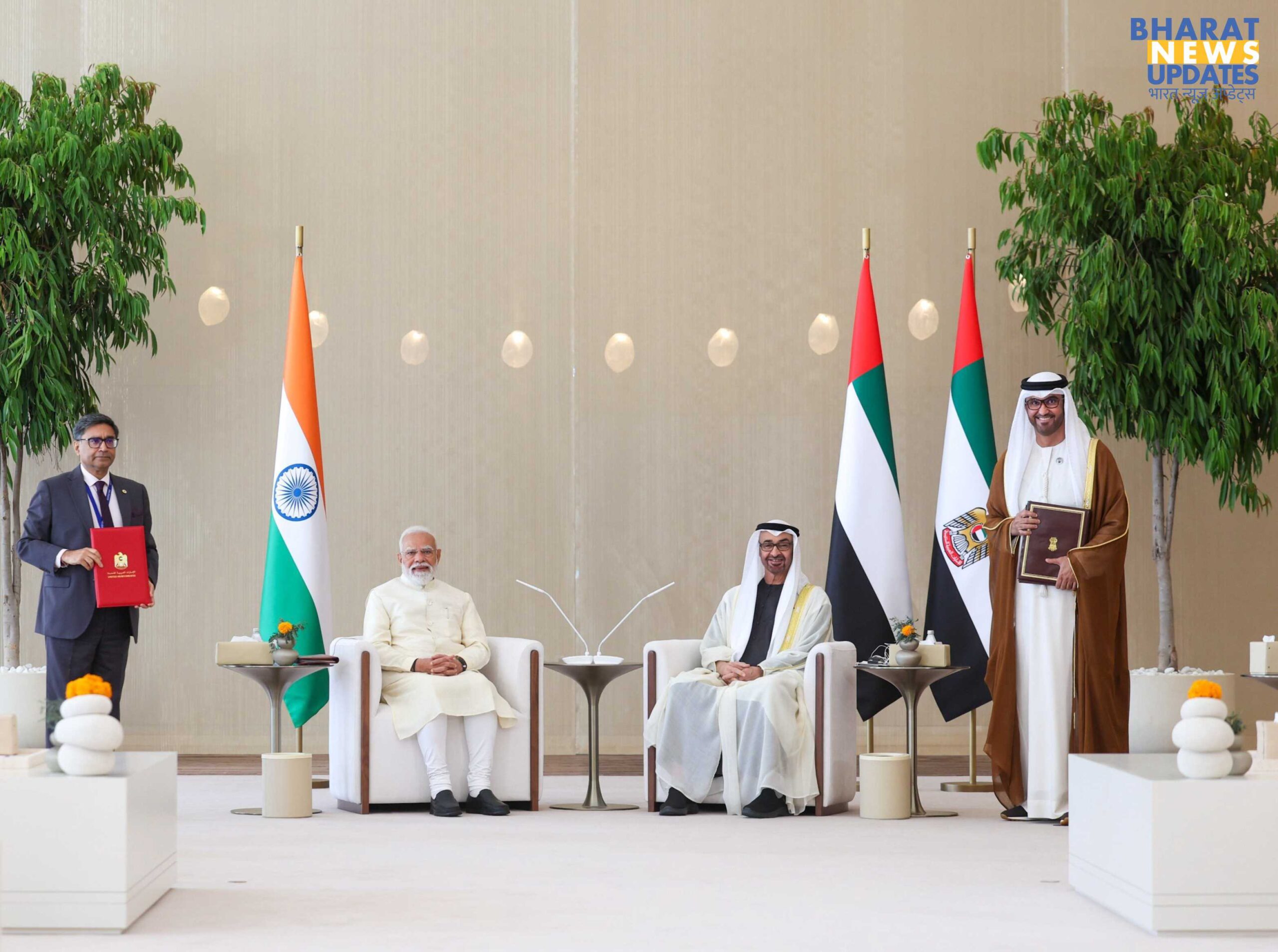
Modi in Abu Dhabi: Seven Deals, One War, and the Quiet Reshaping of Asia’s Energy Map
The Visit Nobody Fully Understood, Until Now
PM Narendra Modi’s stopover in Abu Dhabi today was billed as a “working visit.” That understated label buried the headline: in under 24 hours, India and the UAE stitched together a web of agreements that could quietly determine who controls energy corridors, defense supply chains, and digital infrastructure across South Asia and the Middle East for the next two decades.

The backdrop matters enormously. Iran’s war has turned the Strait of Hormuz through which roughly 20% of the world’s traded oil passes, into a question mark. India imports over 85% of its crude oil. The UAE exports nearly all of its energy through the same chokepoint. Both countries, for entirely different reasons, needed today’s meeting to be more than a photo opportunity. It wasn’t.
Deal 1: The Petroleum Reserve Pact: India’s Underground Insurance Policy
The most structurally significant agreement signed today rarely gets explained properly. ISPRL (Indian Strategic Petroleum Reserves Limited) and ADNOC (Abu Dhabi National Oil Company) have formalized a collaboration that will allow the UAE to store up to 30 million barrels of crude inside India’s Strategic Petroleum Reserve facilities, specifically in Visakhapatnam, Andhra Pradesh, and a new facility being developed in Chandikol, Odisha.

Here’s what the press release didn’t say plainly: India is not just building storage. It is building leverage.
When a foreign national oil company stores crude in your territory, that crude is accessible to you in a supply emergency, subject to negotiated terms. India has quietly used this model before, a small portion of the Visakhapatnam cavern was previously used by ADNOC but scaling to 30 million barrels is a strategic leap. At current consumption rates, 30 million barrels is roughly ten days of India’s total oil needs. That’s not comfortable. But it’s not nothing.
The hidden reality: these underground salt caverns in Andhra Pradesh and Odisha cost India enormous capital to build and maintain. Having ADNOC effectively co-finance them through storage arrangements is a clever piece of infrastructure diplomacy that India’s competitors haven’t replicated.
Deal 2: The Fujairah Gambit: Crude Stored Outside the Strait
This is where things get genuinely unconventional, and frankly, underreported.
The agreement includes a clause allowing India to store crude oil in Fujairah, UAE and have that stockpile count as part of India’s strategic petroleum reserve. Fujairah sits on the Gulf of Oman, outside the Strait of Hormuz. It is one of the few major oil terminals in the world that does not require tankers to pass through the Strait.
This matters right now, today, with Iranian forces periodically threatening Hormuz access. India is, in effect, pre-positioning emergency fuel outside the chokepoint. Combined with reports that Abu Dhabi is actively studying an undersea pipeline from its interior oilfields to Fujairah, which would allow crude export even during a complete Hormuz blockade, India’s reserve in Fujairah becomes a genuine crisis buffer, not just a paper arrangement.
The contradiction worth acknowledging: India officially maintains it is “neutral” in the Iran conflict. And yet, storing oil specifically at a port designed to circumvent Iranian control of Hormuz is not a neutral logistical choice. It is a hedge. A clear-eyed, necessary hedge, but a hedge nonetheless.

Deal 3: LPG Supply Security, The Kitchen Table Geopolitics
The IOCL-ADNOC long-term LPG supply agreement is being treated as a commercial footnote. It isn’t. India has 330 million Ujjwala Yojana LPG connections for rural households. A supply disruption doesn’t just hit refineries, it hits cooking gas in villages across Uttar Pradesh, Bihar, and Rajasthan.
Long-term LPG supply agreements with a Gulf producer are, bluntly put, domestic political insurance for the Indian government. This agreement’s significance is felt in kitchens, not boardrooms.
Deal 4: The Defense Framework, Reading Between the Lines
The “Framework for Strategic Defense Partnership” signed today covers the expected ground: joint exercises, maritime security, cyber defense, secure communications. Standard enough language.
What isn’t standard: “special operations and interoperability.”
That phrase, quietly buried in the official list of outcomes, suggests the two militaries are moving beyond ceremonial cooperation toward something more operationally integrated. The UAE operates one of the most sophisticated small-force militaries in the world, with real combat experience in Yemen. India is one of the world’s largest arms importers working to become an exporter. The combination: UAE’s operational expertise, India’s manufacturing scale points toward a defense industrial relationship that has so far been underdeveloped relative to the closeness of the two countries.
Timing note: this defense pact is signed while UAE’s immediate neighbourhood is at war. That is not coincidence. It is signal.

Deal 5 & 6: Vadinar and the Maritime Workforce Play
Two shipbuilding MoUs involving Cochin Shipyard and Dubai’s Drydocks World deserve more attention than they will receive. The Vadinar Ship Repair Cluster sits on India’s western coast, close to the Gujarat energy hub. A UAE-backed ship repair facility there means Indian-flagged and Gulf-flagged vessels get serviced faster, at lower cost, without European or East Asian diversion.
The tripartite skill development MoU adding the Centre of Excellence in Maritime & Shipbuilding is the less glamorous but more durable piece. India has a surplus of young workers. The UAE has a chronic shortage of skilled maritime labour. Training Indian workers to international certification standards and deploying them in UAE facilities creates a remittance pipeline and a geopolitical dependency that benefits both governments.
Deal 7: 8 Exaflop Supercomputing, The AI Mission’s Gulf Connection
The term sheet between CDAC (India’s premier computing agency) and G42 (Abu Dhabi’s AI-and-cloud giant) to establish an 8 Exaflop supercomputing cluster is India’s biggest public compute announcement in years.
Here is the exception the headlines miss: G42, while headquartered in Abu Dhabi, has historically had complex relationships with both Chinese technology vendors and US national security concerns, concerns significant enough that US officials were reportedly scrutinizing G42 partnerships as recently as 2024. India’s decision to partner with G42 for its AI Mission infrastructure is a bet that those concerns have been resolved. That bet may be correct. But it is worth watching.
An 8 Exaflop cluster, for context, would place India among the top five nations in publicly accessible compute. It would meaningfully change what Indian researchers, startups, and government agencies can model, simulate, and build.

The $5 Billion in UAE Investment, Real Money, Real Stakes
Three investment commitments were announced: ADIA (Abu Dhabi Investment Authority) and NIIF (National Investment and Infrastructure Fund) partnering on up to $1 billion in Indian infrastructure, Emirates NBD (ENBD) investing $3 billion in RBL Bank, and the International Holding Company putting $1 billion into Sammaan Capital.
The RBL Bank investment is the most interesting and least discussed. RBL is a mid-sized private bank that has navigated a turbulent few years. An ENBD investment at this scale is not just capital — it is credibility, international correspondent banking access, and a signal to Indian markets that Gulf institutions see Indian financial assets as undervalued. Watch what RBL does with this capital over the next 18 months.
What This Visit Reveals That Official Statements Cannot
The honest read of today: India and UAE are building redundancy into each other’s strategic systems.
India’s energy supply becomes less vulnerable to a single chokepoint. UAE’s oil revenue becomes less dependent on a single corridor. India’s maritime workforce gets export-quality training. UAE’s ports get Indian engineering labour and Indian-flagged vessel traffic. Both nations’ defense establishments get a formal framework to work together quietly, professionally, without the noise that a treaty with a larger power would generate.
PM Modi’s visit was short. The agreements signed today will not be.
The deepest shift is psychological. India is no longer approaching Gulf partnerships from a position of asymmetric need, the supplicant energy-hungry nation grateful for supply. These agreements are negotiated between strategic equals, each bringing irreplaceable assets to the table. That is genuinely new. And it is, quietly, the most important thing that happened in Abu Dhabi today.
Sources: Ministry of External Affairs, Government of India— Official Outcomes Document, May 15, 2026