

“Why Should We Trust You?” The Oslo Moment That Exposed Two Very Different Worlds
By Bharatnewsupdates | May 19, 2026
It began with a video. It ended with a journalist clarifying, on social media, that she is not a foreign spy.
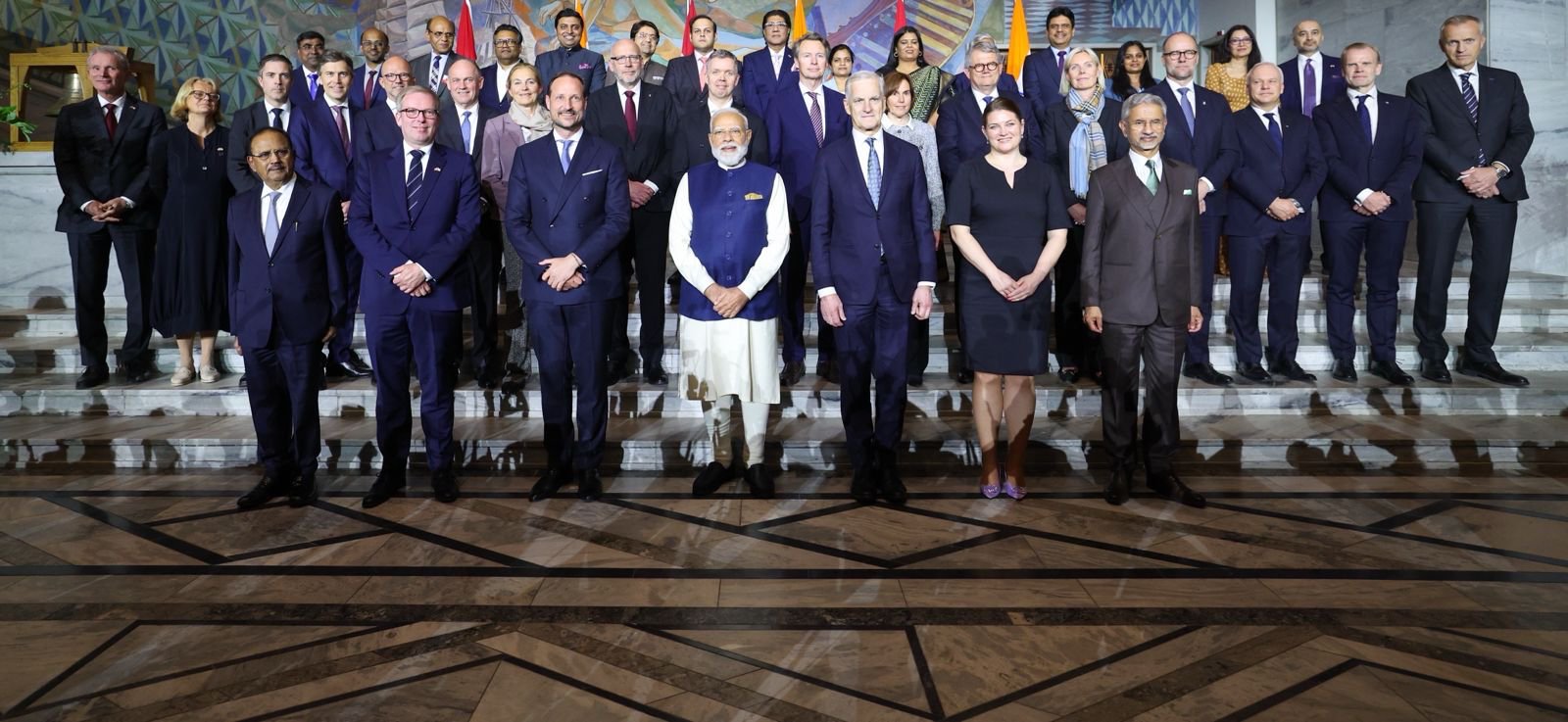
In between, a diplomatic visit to Norway produced what may be the most unexpectedly revealing exchange of Prime Minister Narendra Modi‘s five-nation Europe tour not at the summit table, but in the rooms around it, where a Norwegian newspaper commentator and an Indian diplomat squared off in real time over one of the oldest, most loaded questions in international relations: Who gets to tell a country’s story?
The answer, it turns out, is still fiercely contested.

The Shouted Question That Launched a Thousand Tweets
On the afternoon of May 18, a joint press statement concluded in Oslo. These events follow a global diplomatic template, two leaders stand, deliver prepared remarks, and leave. No Q&A. No back-and-forth. This is true in Washington, in Berlin, in Paris, and yes, in Oslo too.
As Prime Minister Modi walked out, a woman’s voice rang across the room: “Why don’t you take some questions from the world’s freest press?”
No response. He kept walking.
Moments later, Norwegian newspaper commentator Helle Lyng who, it bears noting, had purchased X Premium verification just weeks before this trip, giving her posts priority visibility on the platform shared a video of the exit with a caption that was equal parts journalism and theatre: “Primeminister of India would not take my question. I was not expecting him to. Norway has the number one spot on the World Press Freedom Index. India is at 157th, competing with Palestine, Emirates & Cuba. It is our job to question the powers we cooperate with.”
The post found its audience instantly. Indian opposition politicians amplified it. International journalists retweeted it. For a brief, intense window, one unanswered shouted question at a protocol-driven ceremony became the defining image of a diplomatic mission built on energy partnerships, bilateral investment, and Indo-Nordic goodwill.
But Lyng’s video was only the opening act. What followed in a formal MEA presser a few hours later was considerably more combustible, and considerably more revealing.
“Why Should We Trust You?” The Room Where It Got Real
Lyng showed up at the Ministry of External Affairs briefing. She put two questions to MEA Secretary (West) Sibi George, back to back, that functioned less as journalism and more as prosecution.
“Why should we trust you?”
And then: “Can you promise you will stop the human rights violations that go on in your country?”
And finally: “Will the Prime Minister start taking critical questions from the Indian press?”
These are not small questions. They deserve serious engagement. But the framing the word promise, the guilt embedded in “violations that go on” was less an inquiry than a verdict delivered in interrogative form.
George did not deflect. He did not pivot to rehearsed talking points. He did what few diplomats do in these moments: he answered at length, in real time, on the record. And at several points, he visibly ran out of patience.
“Please don’t interrupt me,” he said, with the particular irateness of a man trying to answer a question while being told to answer it faster. “You asked a question, don’t ask me to answer it in a particular way. These are my prerogatives.”
What followed was an extended tour through civilizational history, constitutional architecture, democratic record, and global crisis response. It left the room either energized or exhausted, depending on which version of India you had arrived with.

The Diplomat’s Case: Three Arguments Worth Taking Seriously
George made three distinct arguments. Each is stronger than the international media’s coverage suggested.
First: India is not a country, it is a civilization. “What is a country? Population, government, sovereignty, territory. We are a civilizational country of 5,000 years. Continuous civilization. Contributed immensely to the world.” This was received by some as nationalist boilerplate. It is actually a genuine epistemological point. Norway has roughly 800 years of recorded statehood. India has 5,000 years of documented, continuous civilization producing mathematics, medicine, linguistics, and governance frameworks that shaped the entire Eastern hemisphere long before the Westphalian nation-state was invented. The suggestion that this entity should be primarily assessed through a survey of 150 NGO respondents compiled in Paris is not self-evidently reasonable.
Second: India earned global trust through action, not rhetoric. When the room asked why the world should trust India, George pointed not to a press release but to a pandemic. “The whole world suffered in Covid. What did we do? We didn’t hide in a cave, we didn’t say we will not save the world. We came out offering a helping hand to the world and that builds trust.” India’s Vaccine Maitri programme supplied doses to over 100 countries, many unable to access Western pharmaceutical chains. India hosted the G20 presidency. It engaged the Global AI Summit. These are trust-building acts in the real world, not in an index. George also cited India’s leadership at global platforms to stress that the country does not merely participate in multilateralism, it helps drive it.
Third: and most pointed: “Go to court.” On human rights, George did not concede the premise. He said India’s Constitution guarantees fundamental rights, and that anyone whose rights are violated has the legal remedy to approach an independent judiciary. “We are proud to be a democracy.” This is not evasion, it is the standard by which democracies are supposed to be judged. The Indian Supreme Court has, on its own motion, struck down surveillance programmes, questioned demonetization, decriminalized homosexuality, and expanded forest rights for tribal communities. It is one of the most interventionist high courts in the world. The claim that India offers no legal recourse to its citizens is, in fact, demonstrably lies and false narrative.
The Press Freedom Number and the War Zone It Forgot
Lyng anchored her argument on a number: India at 157 on the World Press Freedom Index.
It is worth pausing on what sits at 156.
Palestine where since October 2023, over 220 journalists have been killed by Israeli forces, including at least 70 killed in the active course of their reporting work. Where the Committee to Protect Journalists documented a record 129 press members killed globally in 2025, with Israel responsible for two-thirds of those deaths. A territory where journalists have been bombed, starved, had communications severed, and killed in what is the deadliest conflict for the press in recorded history.
Palestine is ranked one spot above India.
This is not a rounding error. It is a structural absurdity that the index’s own publishers have not adequately addressed. When a number ranks an active conflict zone where journalists are dying daily, above a 1.4 billion-person functioning democracy that holds free elections, the number is revealing something. But it is not revealing what the index claims to measure.
India’s NITI Aayog has laid out the methodological concerns clearly: the RSF survey uses approximately 150 respondents and 18 NGOs to assess 83 questions per country. Scores are not disclosed question-by-question. Respondent lists are not made public. The Press Council of India has written to RSF multiple times since 2015 seeking methodology clarification and has received no reply.
There is also a quiet double standard worth naming. Norway, Denmark, Finland, and Sweden, the top four on the index, all provide direct government subsidies to their national press. Government financial influence over media is flagged as a press freedom crisis in India. In Scandinavia, the same dynamic passes without comment. The behaviour is identical. The treatment is not.
None of this means India has no press freedom challenges. Journalist safety, and media ownership concentration in corporate hands close to the government (past and present) are legitimate concerns raised consistently by Indian journalists themselves. They deserve honest scrutiny. But rank 157 positioned among active war zones and authoritarian one-party states against largest real democracy, does not survive a serious factual audit.
200 TV Channels, and the NGOs That Didn’t Watch Them
George made one remark quoted widely, often mockingly: “At least 200 TV channels in Delhi alone, in English, in Hindi, in multiple languages. People have no understanding of the scale of India. They read one or two news reports published by some godforsaken, ignorant NGOs and then come and ask questions.”
The mockery is understandable. “Godforsaken” is not standard diplomatic language.
But the underlying point is not absurd. India has nearly 900 privately owned television channels, half dedicated to news. Around 140,000 publications in over 20 languages. A digital media landscape that produced during the same years India was supposedly suppressing its press. the Adani-Hindenburg investigation (which ran everywhere), the NEET exam scandal (which brought down officials), state government corruption exposés, and a 2024 election result that genuinely surprised the ruling party and forced it into coalition governance.
These are not the outputs of a regime that has achieved totalitarian media control. They are the loud, messy outputs of a system that is contested, under pressure, and still producing accountability journalism at scale.
The Identical Script in Two European Capitals
Here is the detail that received far less attention than it deserved.
The day before Oslo, New Delhi had already rejected Dutch Prime Minister Rob Jetten’s reported remarks on India’s declining media freedom and erosion of minority rights dismissing them as reflecting a “lack of knowledge” and reiterating India’s status as a vibrant democracy.
The same framing. The same specific concerns. The same language. Two different European capitals. Two consecutive days of a diplomatic tour.
When nearly identical questions, press freedom, minority rights, human rights appear from two separate Western governments in the same week, the question of coordination is not paranoid. It is analytical. Whether this represents genuine convergent concern or something more organized is a question the international media should be investigating with the same vigour it brings to investigating India.
The Spy Who Wasn’t
The most quietly remarkable moment in this episode arrived not in Oslo’s press halls but on Helle Lyng’s X timeline, hours after the MEA presser concluded.
She posted a clarification.
“I never thought I would have to write this, but I am not a foreign spy of any sort, sent out by any foreign government.”
It is not entirely clear who prompted the response. But the defensive register is telling. A journalist who set out to ask a pointed, legitimate question about press freedom ended the day reassuring the internet that she is not an intelligence asset.
She also noted with a half-amused frustration that reads as the most honest line in the entire affair, that when she tried to get Indian officials to be specific about human rights, “I was unsuccessful. The representatives talked about India’s effort during Covid, and also yoga, among other things.”
The yoga detail is human and real. It captures the essential gap of the day: a question sized for a press conference, answered at the scale of a continent.
What Oslo Was Actually About
Strip away the viral video, the index rankings, the “godforsaken NGOs,” the Covid vaccine diplomacy, and the spy disclaimer, and what remains is a collision between two genuinely different ideas about journalism’s relationship to power.
Lyng believes not unreasonably, that a journalist’s job is to press leaders of countries her government cooperates with, particularly on rights. This is a legitimate tradition.
India’s position expressed with varying degrees of patience by George is that this tradition, when exercised through a framework built on opaque surveys, NGO networks of uncertain funding, and an index that ranks active war zones above billion-person democracies, is not a neutral accountability exercise. It is a particular political project wearing the costume of universal principle.
Both things can be true simultaneously. Journalism should press power. And the infrastructure that defines and ranks “press freedom” deserves at least as much scrutiny as the governments it grades.
George said it with the bluntness of a man who had run out of diplomatic patience: “We are one sixth of the total population of the world but not one sixth of the problems of the world.”
That is not a defense of impunity. It is a demand for proportion. And in an age when a single post from a newly-verified commentator can outrun a week of diplomatic goodwill, proportion is precisely what is hardest to find.
India walked out of Oslo with its head up. Its diplomat answered every question, on the record, without a script, in real time which is more than the leader Lyng was asking about is typically expected to do in joint statements anywhere in the world.
Whether the world’s freest press was truly listening is, perhaps, the one question nobody asked.
This article draws on official MEA briefing accounts, Helle Lyng’s public X posts, RSF methodology documentation, NITI Aayog’s analysis of the World Press Freedom Index, and publicly reported accounts of PM Modi’s Europe tour