

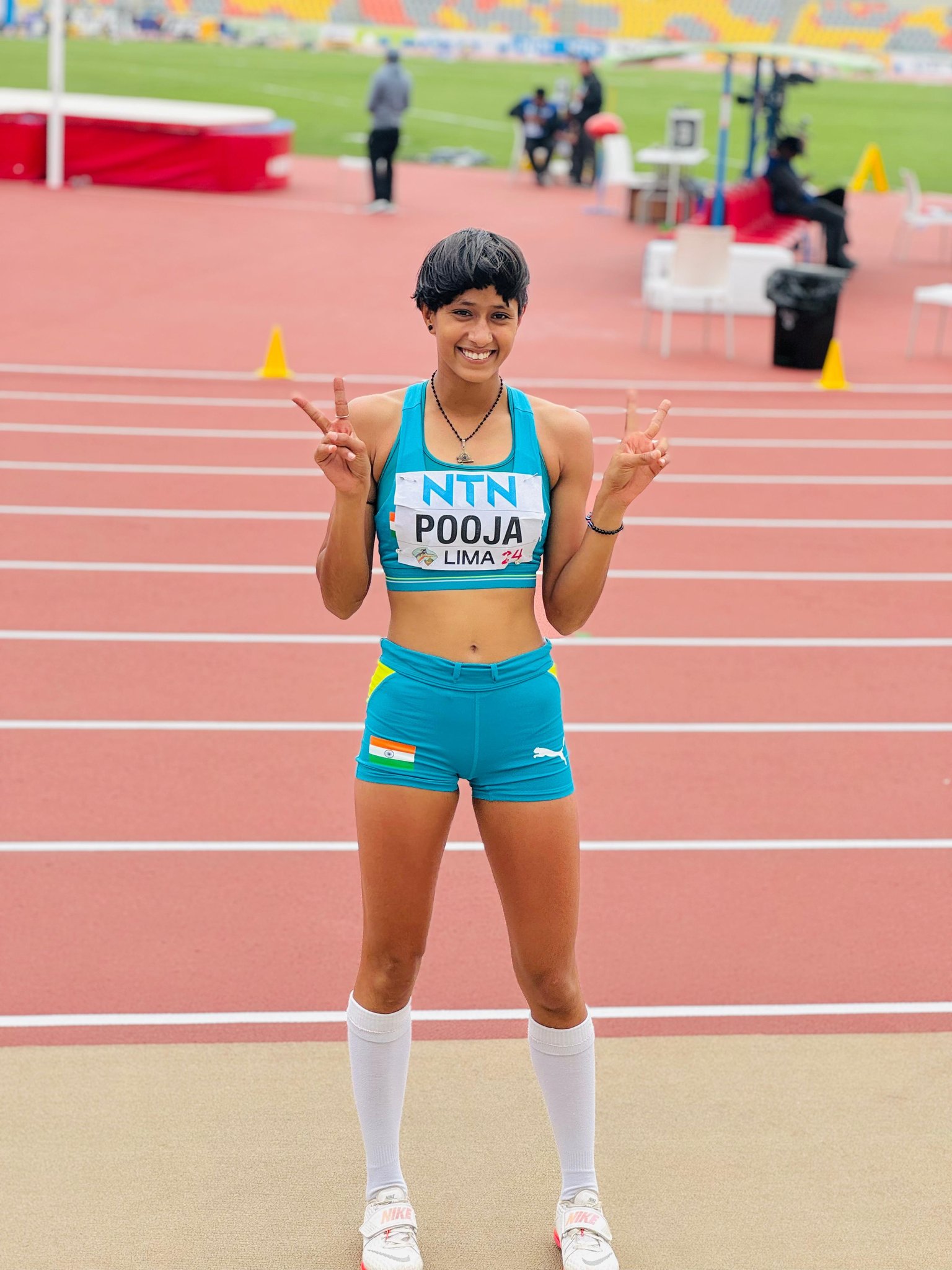


Pooja Beat Her Own Coach’s Record. That’s the Story.
Pooja Singh, 19, sets a new national record of 1.93m to win gold at the 22nd Asian U20 Athletics Championships, Hong Kong and in the process, leaps past a mark set by the woman now standing in her coaching corner.
There is a certain poetry and a certain awkwardness in clearing a bar your own coach couldn’t. Sahana Kumari set India’s women’s high jump national record at 1.92m in 2012. Fourteen years later, she travelled to Hong Kong as part of India’s coaching contingent for the Asian U20 Championships. She watched her own record disappear into the Hong Kong sky.
Pooja Singh didn’t just clear 1.93m. She did it on her first attempt, with a composure that belongs to athletes twice her age. There was no drama of failed attempts, no desperate third-bar scramble. She had already sailed over 1.91m comfortably, walked back, collected herself, and then simply rewrote Indian athletics history.
What 13 Centimetres Actually Means
The silver medal went to China’s Meiqi Chen at 1.80m. The gap between gold and silver: 13 centimetres is not a number you see often in elite high jump. In a discipline where tenths of a centimetre separate world-class athletes, a 13cm margin over your nearest rival is not a close contest. It is a statement.
The bronze was shared by Chinese Taipei’s Pei-hsuan Lin and Sri Lanka’s D.K. Mihinsa Dewmini, both clearing 1.72m on equal countback a good 21 centimetres behind the winner. Pooja didn’t race anyone in Hong Kong. She was in a different competition entirely.
The Record Nobody Talks About: A 20-Year-Old Benchmark, Gone
Before the national record, there was another record to erase. Uzbekistan’s Svetlana Radzivil, a three-time Asian Games gold medallist had held the Asian U20 Championship record at 1.90m since 2006. Twenty years. A full two decades of young Asian high jumpers unable to touch it. Pooja cleared it, then added three more centimetres on top.
That’s the quiet part of this story that often gets buried under the national record headline. Radzivil’s 2006 mark wasn’t a soft record left by a forgotten era. It belonged to one of Asia’s finest ever high jumpers in the under-20 category. And a teenager from India wiped it away on a Friday afternoon at Kai Tak.
The Hidden Reality of Indian High Jump
Here is something rarely spoken about in the celebration of Indian athletics milestones: the women’s high jump national record had been stuck at 1.92m since 2012. Not because India lacked talent but because of thin competition pipelines, limited exposure to international-level facilities, and the way Indian athletics has historically underinvested in field events relative to sprints.
That a 14-year-old record stood this long is not a badge of Sahana Kumari’s greatness alone though it absolutely is that too. It is also a reminder of how few Indian women have been given the conditions to even approach that kind of performance. Pooja Singh breaking it is a moment of individual brilliance. But it also exposes a structural truth: we should have had more challengers, sooner.
A Coach Watching Her Own Legacy Being Surpassed
Let us sit with that image a little longer. Sahana Kumari, on the coaching staff, trackside at Kai Tak. Watching a 19-year-old go past 1.92m. There is no bitterness in this story, Kumari is part of the machine that produced Pooja Singh. But it is an unusual, genuinely moving moment that Indian sport rarely manufactures: the passing of a torch so literal you can almost see it in the air above the bar.
Good coaches are defined by the athletes who surpass them. By that measure, whatever Sahana Kumari has done for this generation of Indian high jumpers, Friday confirmed it.
Where This Leads
The 1.93m clearance does practical work beyond the medal. It clears the Commonwealth Games 2026 qualifying standard of 1.92m — meaning Pooja is already on the plane to whichever city hosts the Games. It also marks the second time this outdoor season she has beaten the 1.81m World U20 Athletics Championships qualifying standard. World Juniors is no longer a question of whether, only of what.
The trajectory from here is steep and clear. She went from 1.89m personal best in 2024, to 1.90m at an indoor meet in early 2026, to 1.93m outdoors six months later. If that progression continues, a 1.95m or 1.96m attempt is not fantasy, it is a training plan.
India has had isolated moments of brilliance in women’s field events. What Pooja Singh is building looks less like a moment and more like a career.
The next stop on that career? The World U20 Athletics Championships 2026 where a teenager with her coach’s old record in her pocket will be considered one of the names to watch in Asia, and beyond