

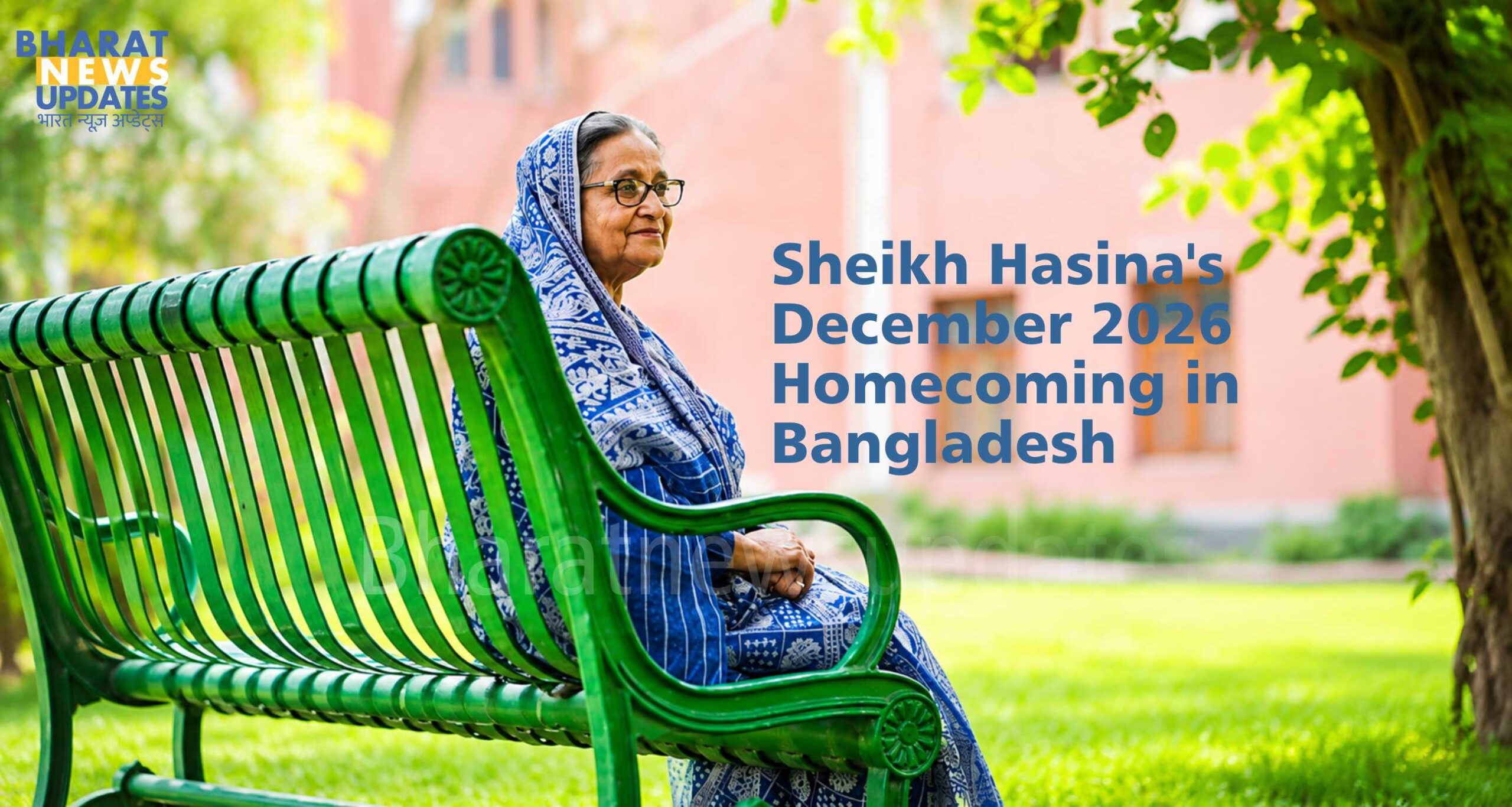
Sometime around December 2026, a 78-year-old Sheikh Hasina who ruled Bangladesh for two decades says she will board a flight out of India, land in Dhaka, and hand herself over to a court that has already sentenced her to hang. She said it herself, on the record, to press: “They may arrest me on my return, they may even kill me. Still, I have to go.”
That single sentence should stop anyone who follows South Asian geopolitics in their tracks. No modern head of government facing a death verdict for crimes against humanity has volunteered to walk into custody. So the real question isn’t whether Sheikh Hasina is serious. It’s what she actually knows that the rest of us don’t.
The Verdict That Was Supposed to End Former PM Sheikh Hasina
In November 2025, Bangladesh’s International Crimes Tribunal (ICT) convicted Sheikh Hasina in absentia of crimes against humanity incitement, ordering the use of drones and lethal weapons against protesters, and failing to stop killings during the July 2024 uprising that toppled her government. Her home minister, Asaduzzaman Khan Kamal, got the same sentence. The 453-page judgment reads like a closing chapter. Except it isn’t, and here’s the part almost no coverage has spelled out clearly: an in-absentia conviction under international legal norms, the standard Bangladesh’s own tribunal has been criticized for ignoring entitles the convicted person to a full retrial the moment they surrender in person. Bangladesh’s ICT Act never explicitly codifies that right. Legal scholars have flagged this as a gaping hole. Sheikh Hasina’s return, then, isn’t simply a martyrdom walk. It may be a calculated bet on a legal loophole that forces Dhaka’s courts to reopen a case built entirely without her participation and this time with lawyers of her choosing, cross-examination, and a live audience of international observers. If she is right about that loophole, “surrender” and “victory” start to look uncomfortably similar.

Deal, Delusion, or Genuine Reading of the Ground?
Is this a secret handshake with Prime Minister Tarique Rahman‘s BNP government? Hasina denies it flatly, she told international media, she hasn’t consulted any government about the timing. There is no public evidence of a deal. But consider the political arithmetic Rahman inherits: Bangladesh’s economy is limping, IMF talks are tense, minority violence keeps making international headlines on his watch, not just his predecessor’s, and the “Bangladesh First” foreign policy needs India onside for border and trade cooperation. An Awami League that stays banned and radicalized in exile is a bigger long-term threat to stability than one that returns, gets tried, and either goes to prison or gets discredited in open court. Some Dhaka insiders quoted anonymously in regional media suggest the government isn’t remotely ready to handle her arrival which is a strange thing to say about an administration that claims the League is “finished.” If it truly were finished, a trial would be a formality, not a flashpoint.
The more uncomfortable possibility is that Sheikh Hasina still believes correctly or not that Awami League’s base never disappeared, only went quiet under threat of mob violence and jail. She’s been holding online meetings covering 125 of Bangladesh’s 300 constituencies from exile. That’s either the discipline of a party rebuilding underground, or the fantasy of a leader who hasn’t updated her mental map of a country that burned her father’s house down in effigy.
The Minority Question Nobody in Dhaka Wants to Own
Here’s the contradiction that cuts against everyone’s script. Sheikh Hasina now frames her return as a rescue mission for Bangladesh’s persecuted Hindus, Buddhists, and Christians which is genuinely alarming numbers back the crisis itself: rights groups documented over 2,500 incidents of violence against minorities between August 2024 and December 2025, including dozens of killings, and the toll has not slowed under the elected BNP government that replaced Yunus’s interim administration. Temple bombings, land grabs, and mob lynchings over blasphemy rumors continued well into 2026. But minorities also disproportionately backed Hasina’s Awami League for years precisely because it billed itself as secular, a claim her critics say was never as clean as advertised, and one that did little to prevent 2013-era ICT death sentences against Islamist opposition figures either. Neither camp in Bangladesh currently has clean hands on this, which is exactly why both keep weaponizing minority suffering rhetorically while doing little to stop it operationally.

India’s Quiet, Awkward Leverage
New Delhi has hosted Hasina since August 2024 without formally answering Dhaka’s repeated extradition requests, offering only vague language about engaging “constructively.” India has genuine legal cover, the Bangladesh-India extradition treaty carries exceptions for politically tinged and capital cases, and the death sentence itself may actually strengthen India’s argument for continued refusal under non-refoulement principles, since sending someone to near-certain execution after an internationally criticized in-absentia trial is the kind of move Western courts have blocked for years in similar cases. But India also doesn’t want a permanently frozen relationship with a BNP government sitting on its eastern border while tightening its own border security. If Sheikh Hasina returns voluntarily, India is relieved of an awkward diplomatic weight without ever having to extradite anyone, a quietly convenient outcome for New Delhi, regardless of what happens to her afterward.
What Happens If She’s Wrong
If the retrial right doesn’t materialize the way she hopes, or if a mob reaches her before the courtroom does, Bangladesh gets its most volatile scenario yet: a slain former prime minister, a banned party with a live grievance, and a government instantly on the defensive. If she’s right, and the trial genuinely reopens, Bangladesh faces something almost as destabilizing, a courtroom battle that could unravel the current government’s founding narrative of a clean break from the past. Either way, the “gamble” is not really about whether Hasina survives. It’s about which version of Bangladesh’s fragile transition survives her return.
Bharatnewsupdates International Insight Team ⊥ July 2026, 15