

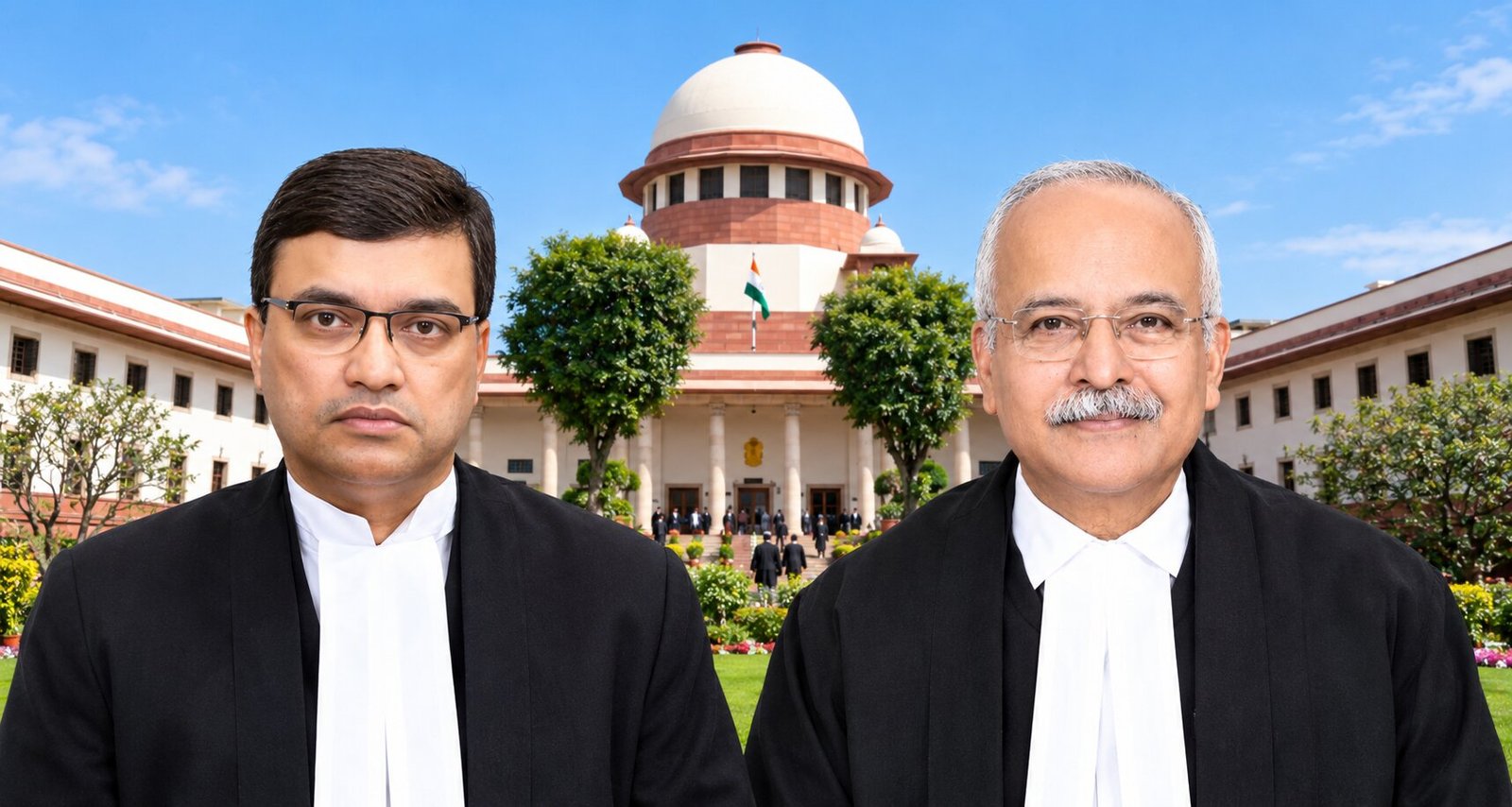
New Delhi, September 23, 2026: Two Supreme Court judges heard the same arguments on poll body selection for five days. Both agreed the Election Commission must not just be independent but it must look independent. And yet, when it came time to decide something as basic as which bench should even hear the case, they couldn’t agree. That, in a single sentence, is what happened at the Supreme Court on Wednesday, and it says more about the state of Indian constitutional adjudication than most 50-page judgments manage to.
What Actually Happened In Supreme Court
A bench of Justice Dipankar Datta and Justice Satish Chandra Sharma was deciding a narrow but loaded question: should petitions challenging the Chief Election Commissioner and other Election Commissioners (Appointment, Conditions of Service and Term of Office) Act, 2023 be sent to a larger, five-judge Constitution Bench, as the Centre wanted?
Justice Datta said no as the Centre’s request for reference didn’t hold up, because the core principles were already settled by the Constitution Bench in Anoop Baranwal v. Union of India (2023). Justice Sharma disagreed, holding that whether Parliament was right to drop the Chief Justice of India from the selection panel was a fresh constitutional question that only a larger bench could rule on.
Unable to reconcile, the two judges did the only procedurally sound thing: they sent the file up to Chief Justice of India Surya Kant, asking him to decide whether and with how many judges, a Constitution Bench should be formed. That’s it. That’s the “verdict.” Not a ruling on the 2023 law’s validity. Not a final word on the Election Commission’s independence. A split opinion on a preliminary, procedural question, with the substantive fight postponed for another day, possibly another year.
If headlines around this make it sound like the Court has ruled on the CEC appointment law itself, treat that with suspicion. It hasn’t not yet.
The Cricket Punch That Did the Heavy Lifting
Justice Datta, an opening batter for the Chief Justice of India’s own cricket XI, reached for the sport to make his sharpest point of the hearing: an umpire picked by the batting side, even if every decision he gives is correct, will always carry the shadow of suspicion because he’s presumed loyal to the team that picked him.
It’s a simple image, but it does something dense legal language usually fails at as it explains why perception matters as much as fact in institutional design. You can have the most scrupulously fair Election Commissioner in the world; if the process that put them there looks rigged, the outcome is tainted anyway. That’s not cynicism. That’s how public trust actually works.
What Justice Dipankar Datta Actually Said
The 2023 Act set up a three-member selection committee: the Prime Minister, a Union Cabinet Minister nominated by the PM, and the Leader of Opposition in the Lok Sabha. It replaced the earlier interim arrangement from Anoop Baranwal, where the Chief Justice of India held the third seat.
Justice Datta’s problem with this wasn’t hypothetical. A minister who owes their cabinet berth to the Prime Minister, he reasoned, cannot realistically be expected to vote against that same Prime Minister’s preference not because the minister lacks integrity, but because the Constitution’s own doctrine of collective cabinet responsibility structurally forecloses dissent. He went further: with the government effectively holding a 2:1 majority on the panel, the Leader of Opposition’s presence becomes “largely ornamental” a seat at the table with no real leverage.
This is the part that deserves more attention than it’s getting. Justice Datta wasn’t just criticizing optics. He was pointing at a design flaw baked into the law’s arithmetic as two votes will always beat one, regardless of who occupies the LOP’s chair or how principled they are.
Justice Dipankar Datta Also Defended the Collegium
Here’s what most coverage is missing. During the hearing, the Centre’s Solicitor General Tushar Mehta made an argument that’s been floating around in public discourse for years: if judges can appoint judges through the Collegium system, why is it wrong for the Executive to have a stronger hand in picking Election Commissioners?
Justice Datta didn’t let that pass. He called the “judges appoint judges” framing a myth as a narrative he said had been pushed by vested interests to mislead the public. He pointed out that Collegium recommendations pass through checks including intelligence and background inputs from the Centre and state governments before anyone is elevated, and that final appointments still run through a constitutional process involving the Executive.
That’s a rare moment: a sitting judge using an election-commission hearing to publicly correct a widely-believed misconception about how judicial appointments actually work and, in the same breath, criticizing the Centre for what he called selective, uneven processing of Collegium proposals, which he said causes its own delays. It’s a judge cutting both ways in a single breath, and it’s the kind of nuance that rarely survives into a headline.
The Uncomfortable Confession Buried in the Order
Perhaps the most human moment came when Justice Datta openly noted that after five days of hearings, a “unified voice” from the bench would have best reflected institutional cohesion but it didn’t happen. Two judges, one courtroom, one set of arguments, and still no agreement on even the threshold question.
Both judges then did something unusual: they flagged, on the record, that Constitution Bench references in India routinely languish for years, and said this “does not reflect well on the institution.” They went a step further and urged the CJI to consider setting up a permanent five-judge bench purely to handle constitutional questions with an implicit admission that the current system of assembling ad hoc Constitution Benches is too slow for issues this urgent.
That’s not boilerplate judicial politeness. That’s two judges telling the country, in effect, that the Supreme Court’s own machinery for resolving constitutional disputes is creaking.
What Happens Next And Why It Matters More Than the Cricket Metaphor
The file now sits with CJI Surya Kant. He must decide whether to constitute a Constitution Bench, and if so, of what strength may be five, seven, or more. Until that happens, the 2023 Act stays in force exactly as written: PM, PM’s nominee, LOP. Election Commissioners will continue to be appointed under this structure for however long the reference takes to resolve, which going by the two judges’ own admission could be a while.
The irony is sharp: a law about protecting institutional independence is now itself hostage to institutional delay.