

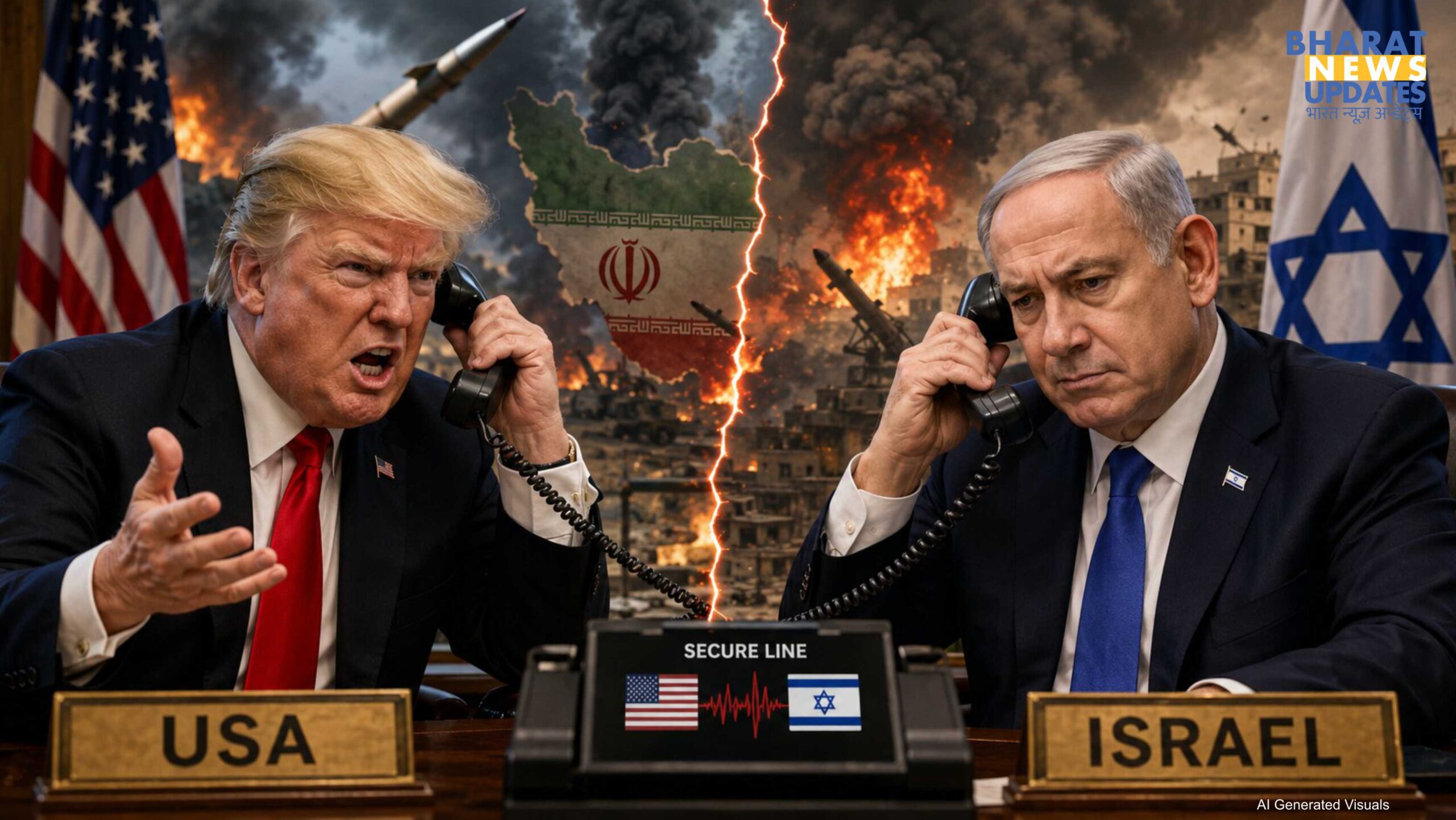
When Allies Disagree in Wartime: The Trump-Netanyahu Iran Fault Line
The ceasefire is holding barely. But the bigger fracture isn’t between Washington and Tehran. It’s between Washington and Jerusalem.
The Phone Call That Said Everything
Sometime in mid-May 2026, Donald Trump and Benjamin Netanyahu had a call that was described, by a U.S. official who was briefed on it, in three words: “Bibi’s hair was on fire.”
The two leaders were discussing Qatar and Pakistan’s revised peace memo, a framework for a “letter of intent” that would formally end the U.S.-Iran war and open 30 days of negotiations on Iran’s nuclear program and the Strait of Hormuz. Trump saw it as deal-making. Netanyahu saw it as a blunder.
That gap tells you almost everything about where the Middle East stands today.
Two Men, Two Completely Different Wars
Trump went into this conflict wanting a signature win, a dramatic show of force followed by a deal he could brand as historic. His version of success is Iran signing a paper, the Strait reopening, and oil prices falling. He’s already said publicly that the U.S. “achieved its military goals.” He wants an off-ramp that looks like victory.
Netanyahu wants something else entirely. He wants Iran broken completely not just set back.
In his CBS 60 Minutes interview, Netanyahu was unusually blunt: “There’s still nuclear material, enriched uranium, that has to be taken out of Iran. There’s still enrichment sites that have to be dismantled… ballistic missiles that they still want to produce. We’ve degraded a lot of it, but all of that is still there and there’s work to be done.”
This is not a man who thinks the job is done.
What the Bombs Actually Achieved and What They Didn’t
Here’s the hidden reality that most coverage glosses over: the military campaign was significant, but not conclusive.
Across two phases of the war, the 12-day conflict in June 2025 and the broader campaign from February 28 through the April 8 ceasefire between nine and twelve Iranian nuclear-linked sites were targeted. Iran’s major enrichment facilities were “severely damaged” in the first phase. The second phase added another layer, targeting sites linked to the practical work of weapons assembly.
But and this is the part that haunts Netanyahu, no reconstruction or resumed enrichment has been detected yet. “Yet” is doing a lot of work in that sentence. Iran’s nuclear program is wounded, not dead. Its ballistic missile capability is degraded, not eliminated. Its proxy network Hezbollah, Hamas, the Houthis, militias in Iraq is weakened but operational.
Netanyahu’s calculation is rational: a ceasefire now freezes Iran at 70% destroyed. Continued pressure could push it to zero.
Trump’s calculation is also rational: continued strikes risk widening a war, destabilizing Gulf allies, and crashing oil markets with no guarantee of “zero.”
Both men are right. That’s what makes this dangerous.
The Strait of Hormuz: The Real Chessboard
The nuclear question gets the headlines. The Strait of Hormuz is the actual leverage point.
Iran’s closure of the Strait of Hormuz through which roughly 20% of the world’s oil flows has been its most effective weapon. Not missiles. Not proxies. A choke on global shipping. Oil hit above $100 a barrel. Stock markets wobbled. Gulf states panicked.
The April 8 ceasefire was explicitly transactional: Iran agreed to allow safe passage through the Strait; the U.S. paused its bombing campaign. That’s the entire deal in one sentence.
Iran’s latest negotiating position, reopen the Strait if the U.S. lifts its blockade on Iranian shipping, unfreezes frozen assets, and pauses nuclear negotiations, essentially asks Washington to give up its most important bargaining chip to get back what was already a right under international law. Trump called this “TOTALLY UNACCEPTABLE.” He’s not wrong.
But here’s the contradiction nobody says aloud: the U.S. needs the Strait of Hormuz open more urgently than Iran does. Iran has already absorbed the economic pain. The Gulf and global markets haven’t.

Is a Ceasefire the Answer? An Honest Assessment
The ceasefire is described including by Trump himself as being on “life support.” That’s unusually honest for a sitting president to admit.
The case for a diplomatic settlement is real: Iran’s infrastructure is heavily degraded, its economy is in crisis, its air defenses are compromised, and its leadership knows that another round of Sledgehammer-style strikes could be terminal for the regime. A deal, even an imperfect one, could lock in those gains without further bloodshed.
The case against Netanyahu’s case, is equally real: Iran has survived sanctions, assassinations, explosions, and two rounds of airstrikes and still retained enrichment knowledge, missile technology, and the Strait of Hormuz as a weapon. A ceasefire without verified, irreversible dismantlement hands Iran time to rebuild behind diplomatic cover. It’s the North Korea scenario played out in the Persian Gulf.
The exception that neither side wants to discuss: Iran may not have the capacity to rebuild quickly even if it wanted to. The IAEA has confirmed no significant reconstruction or renewed enrichment activity. The Iranian economy has been devastated. The Revolutionary Guard’s command structure has been decimated. The regime may, for the first time in decades, be genuinely vulnerable not just to bombs, but to internal pressure.
A ceasefire that locks in Iran’s current weakened state with real verification mechanisms might actually be better than continued strikes that risk miscalculation, third-party escalation, or a cornered regime making desperate moves.
The Mediators Nobody Expected
Pakistan and Qatar as co-architects of a U.S.-Iran peace framework would have seemed absurd two years ago. Yet here we are. Pakistan’s Field Marshal Asim Munir personally called Trump to request a halt to the bombing. It worked. Qatar has shuttled drafts between Washington and Tehran. Saudi Arabia, Turkey, and Egypt have all contributed to a revised peace memo.
This is the unspoken story of this crisis: the Gulf states are terrified. Not of Iran, of the economic fallout. The UAE reported drone attacks from Iran. Kuwait scrambled air defenses. Qatar which hosts the largest U.S. air base in the region is simultaneously mediating for Iran’s benefit. The contradiction is extraordinary, and it tells you how much pressure these governments are under to end this war on any terms.
What Mitigation Actually Looks Like
If a deal is eventually reached, the framework that matters isn’t symbolic. It must include:
Verified dismantlement, not suspension, of enrichment infrastructure with IAEA inspectors given access that previous agreements denied. Iran’s enriched uranium stockpile must be removed from the country, not stored.
Permanent Strait of Hormuz guarantees backed by multilateral naval presence not just a gentleman’s agreement that Iran can revoke the moment pressure eases.
Phased sanctions relief tied to compliance milestones, not front-loaded. Iran received front-loaded relief in 2015. The lesson was not learned.
A Hezbollah disarmament roadmap which Iran has so far refused to include in any negotiation, insisting it’s a separate matter. It isn’t.
Without these elements, a ceasefire is not a solution. It is a pause before the next crisis.
The Uncomfortable Truth
Trump says Netanyahu “will do whatever I want him to do.” Netanyahu keeps calling Washington. Both statements cannot be true simultaneously.
What is true is that these two men want the same outcome, an Iran that cannot threaten Israel or U.S. interests but disagree completely on the method and the timeline. Trump wants it done before the midterms. Netanyahu wants it done permanently, and he’s not on a domestic political clock the same way.
History suggests that when America wants a deal and Israel wants war, America usually wins but Israel usually gets something out of it. Watch for what Netanyahu extracts in Washington when he visits. That will tell you the real shape of whatever agreement eventually emerges.