

3rd India–Nordic Summit · Oslo, 19 May 2026
Green Technology & Innovation Strategic Partnership

By The Numbers


Key summit outcomes
- India–Nordic ties elevated to Green Technology & Innovation Strategic Partnership
-
India–EFTA TEPA in force (Oct 2025); India–EU FTA concluded— Nordic states key partners
-
Norway joins the Indo-Pacific Oceans Initiative(IPOI) for maritime security
-
Deeper Arctic & polar research cooperation; skill development & talent mobility pacts
-
Maritime Security Dialogues launched with Norway and Denmark
-
Cooperation on green hydrogen, CCUS, carbon capture, solar & wind projects
-
University-lab-startup ecosystem linkages formalized across all five Nordic nations
-
Joint stance: firm against terrorism, no double standards; ceasefire support— Ukraine & West Asia
The contradiction at the heart of Oslo


“One of the most significant outcomes is our decision to elevate ties to a Green Technology and Innovation Strategic Partnership combining innovation with scale and talent.”
— PM Narendra Modi, Oslo, 19 May 2026

When Oslo Whispered “Sambandh”: What the 3rd India-Nordic Summit Really Means for a Fracturing World
Oslo, 19 May 2026, Five prime ministers, one extraordinary morning, and a word that bridged two civilizations.
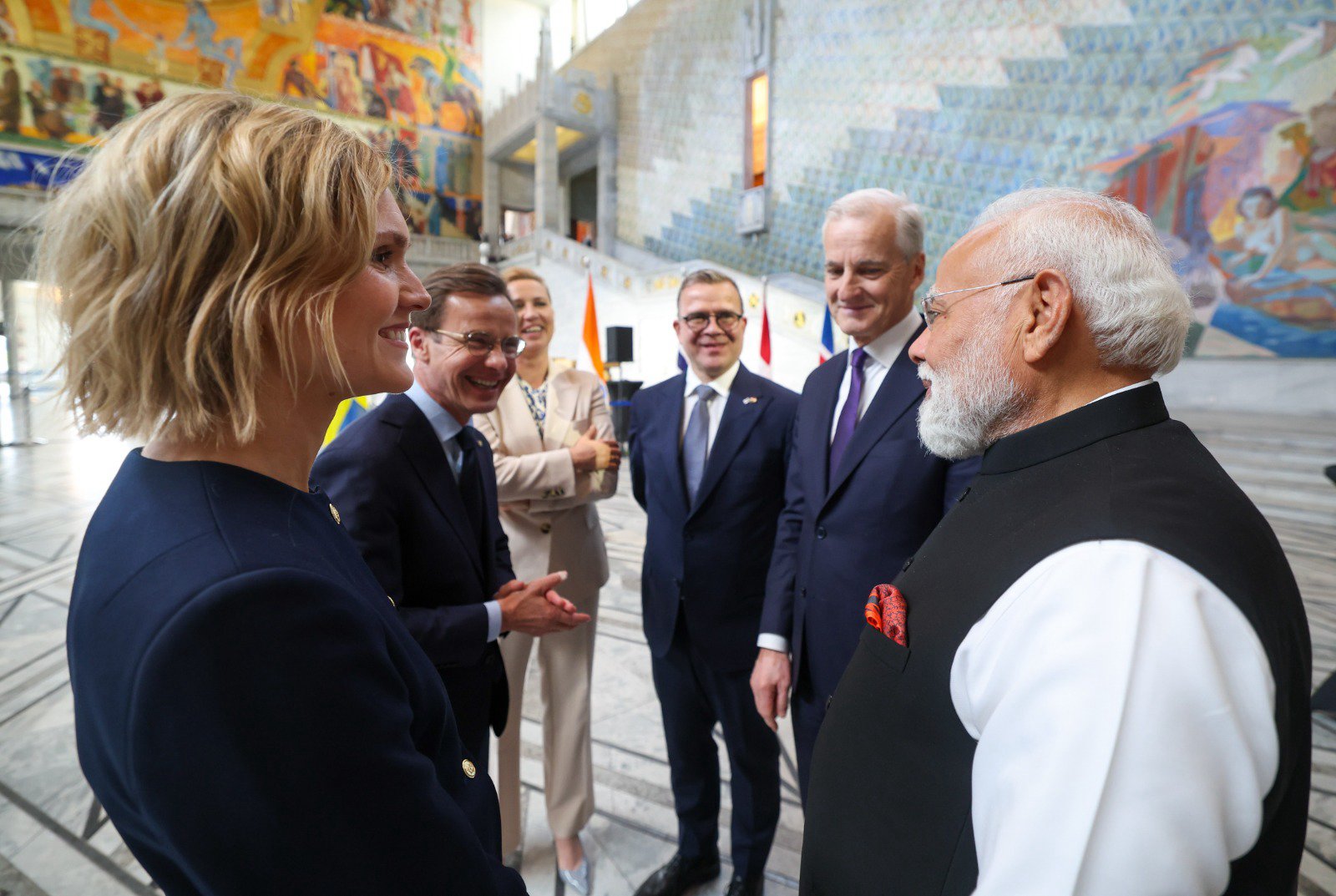
There is a certain electricity to watching five heads of government wait for one. On a grey Nordic morning in Oslo, the prime ministers of Norway, Denmark, Finland, Iceland and Sweden gathered at the Radisson Blu Plaza Hotel and waited for Narendra Modi. It was, as one diplomat noted quietly, a tableau that would have been unthinkable a decade ago. India coming to the Arctic table not as a supplicant seeking investment but as the indispensable partner everyone wants a piece of.
The rapid succession of bilateral meetings showcased India’s expanding diplomatic stature, one country hosting five Nordic prime ministers meeting a single counterpart within hours, signalling the strategic weight India now commands in Northern Europe. The 3rd India-Nordic Summit was not just a diplomatic photo opportunity. It was a statement about where power is migrating in a world that has stopped pretending the old order still holds.
The Summit That Wasn’t Supposed to Happen Here
The first two India-Nordic summits, Stockholm in 2018, Copenhagen in 2022 were warm, if polite, occasions. This visit comes at a crucial time for India-Nordic relations, particularly following the recently signed European Free Trade Association (EFTA) agreement. Oslo 2026 is different in texture. The backdrop is one of compounding disruptions: a grinding war in Ukraine, tensions smouldering in West Asia, fractured global supply chains, and an energy market still recalibrating after years of geopolitical shock.
Underneath the carefully balanced diplomatic agenda lies a more urgent mission, a search for energy security in an increasingly unstable world, framed by wars in the Persian Gulf and in Ukraine. India depends on imports for 85 percent of its crude requirements, remaining acutely vulnerable to the oldest pressure point in modern politics, energy pricing and availability.
That vulnerability is the invisible fourth participant in every room Modi walked into in Oslo.

The Green Partnership and Its Inconvenient Truths
The headline out of Oslo is clean and compelling: the leaders decided to elevate the India-Nordic relationship to a trusted Green Technology and Innovation Strategic Partnership. It is a good headline. It is also a headline that papers over a genuine contradiction.
Norway is Europe’s largest oil and gas producer. Its sovereign wealth fund, the largest in the world was built on North Sea hydrocarbons. Oslo is simultaneously Norway’s capital and the city where Norwegian diplomats will press India to reduce its dependence on Russian crude. Norwegian Prime Minister Jonas Gahr Støre said Norway hopes India will use its diplomatic ties with Russia to push for a ceasefire in the Ukraine war, acknowledging differences between the two nations on the issue but saying he understood India’s energy requirements.
Read that carefully. Norway an oil exporter is asking India, an oil importer to use its closeness with Russia (an oil supplier) to push for peace, while simultaneously offering itself as an alternative LNG supplier and signing a “green” partnership. This is not hypocrisy so much as it is geopolitics: everyone’s idealism has a price list attached.
India and Norway agreed to a “green strategic partnership” aimed at promoting a clean-energy transition and sustainable development, with Modi stating: “From clean energy to climate resilience, from the blue economy to green shipping, in every sector, India’s scale, speed and talent will combine with Norway’s technology and capital.”
The word “scale” is doing enormous work in that sentence. India’s scale is simultaneously its greatest asset and its greatest constraint. The International Energy Agency projects that India will lead global oil demand growth over the next decade and account for nearly half of the incremental global increase, with oil demand expected to rise from 5.5 million barrels per day in 2024 to 8 million by 2035. No amount of geothermal enthusiasm from Reykjavik will cover that gap in the near term.
Five Nations, Five Specific Bets
What distinguishes Oslo 2026 from previous summits is the granularity. Modi did not merely speak of “the Nordic region” as a monolith. He parcelled out each nation’s comparative advantage with the precision of a seasoned investor constructing a portfolio.
India and Norway marked a significant upgrade in bilateral ties with the signing of 12 agreements and initiatives, signalling a broad expansion across climate, technology, maritime, and scientific domains. Norway joined the Indo-Pacific Oceans Initiative, a quiet but significant step that pulls Oslo further into the Indo-Pacific strategic calculus, far from its traditional North Atlantic comfort zone.
Iceland brings geothermal expertise and carbon capture technology sectors where it genuinely leads the world. Discussions covered expanding cooperation in the Blue Economy, Renewable Energy, Climate and Environment, Carbon Capture, Utilization and Storage, Green Hydrogen, Solar and Wind Projects, Green Shipping, Fisheries, Water Management, Space Cooperation, and Arctic Cooperation.
Sweden’s contribution is the sharpest in strategic terms. Modi’s Stockholm stop, the third leg of his tour, had already produced what officials are calling the India-Sweden Technology and Artificial Intelligence Corridor a joint innovation framework that goes well beyond trade promotion into co-development territory.
Finland’s telecom heritage, Nokia’s shadow still looms large, makes it a natural partner for India’s 5G/6G buildout, while Denmark’s strengths in cybersecurity and health-tech align with India’s growing digital economy vulnerabilities. The portfolio logic is sound. Whether the institutional machinery can deliver is a different question entirely.

Denmark’s Prime Minister Said the Quiet Part Loud
Mette Frederiksen of Denmark, rarely one to speak in diplomatic euphemism, delivered what may be the most memorable line of the summit. When a journalist tried to characterize India as a “middle power,” she pushed back: “We cannot say that India is a middle power. You are one of the biggest powers. It’s not very easy to say that the Nordic countries are a middle power because we are too small. But when we are united, the Nordic countries, then we are a middle power.”
This is worth sitting with. A bloc of five prosperous, technologically advanced democracies describes itself, collectively, as a middle power. That is the scale of India’s gravitational pull in 2026. And Frederiksen’s framing reveals something the joint statement’s careful language obscures: the Nordic countries need this partnership as much as India does perhaps more urgently, as the European security architecture undergoes its most significant stress test in decades.
The prime ministers noted that they are meeting at a time of global geopolitical flux and rapid economic and technological transformation and agreed on the need to deepen the partnership for mutual benefit based on shared interests and values and to cooperate in addressing global challenges.
“Geopolitical flux” is diplomatic language for: the rules nobody is sure apply anymore.
The Trade Architecture Underneath the Speeches
Away from the cameras, the structural trade news out of Oslo deserves more attention than it received. The leaders particularly welcomed the entry into force of the India-EFTA Trade and Economic Partnership Agreement and the conclusion of the India-EU Free Trade Agreement. They stressed that in addition to the economic benefits, the India-EU FTA and India-EFTA TEPA could support economic security and resilience through diversifying critical value chains. They welcomed the shared objective under TEPA that EFTA states shall aim for investment of USD 100 billion leading to the creation of one million direct jobs in India.
One hundred billion dollars. One million jobs. These are not rhetorical numbers they are treaty-embedded targets with accountability mechanisms. This is the architecture that will outlast any particular government’s tenure in Delhi or Oslo. Whether it functions as designed depends on implementation bodies that rarely make the news.
What “Sambandh” Actually Means in 2026
PM Modi ended his Oslo address with a word “Sambandh.” In Hindi, it means connection, relationship, the bond between people. In several Nordic languages, the cognate “Samband” carries the same meaning. The linguistic coincidence delighted the room.
But the deeper resonance is this: the summit’s entire logic rests on the idea that shared values democracy, rule of law, multilateralism, an aversion to double standards on terrorism create a natural constituency between India and the Nordic bloc. Modi wrote: “India will keep working with the Nordic nations for more trade and investment, sustainable growth, greater innovation, climate action, and cooperation in the Arctic.”
The test of “Sambandh” is not the word itself but the institutions built beneath it. Trade agreements ratified but not implemented. Investment targets set but not resourced. Research partnerships announced but not staffed. The gap between diplomatic language and bureaucratic reality is where most summits go to quietly die.
Oslo 2026 has richer structural foundations than its predecessors. The EFTA TEPA is in force. The EU FTA is concluded. Norway has formally joined the Indo-Pacific Oceans Initiative. Maritime security dialogues are launched. These are not mere expressions of goodwill, they are treaty obligations with review mechanisms.
The Hidden Bet: Arctic
The Arctic angle of this summit is systematically underreported. Indian researchers have been active in the Arctic for many years, studying how melting Arctic ice affects the Indian monsoon. There could be more India-Nordic cooperation going forward in this domain. This is not a peripheral concern. The Arctic is warming four times faster than the global average. Its ice melt directly affects monsoon patterns that determine whether India’s farmers have a good year or a catastrophic one. India’s interest in Arctic science is existential, not academic.
Norway’s Arctic expertise, political, technological, environmental is among the deepest in the world. The formalization of India-Nordic Arctic cooperation at Oslo quietly advances India’s presence in a theatre that will define geopolitics through the remainder of this century.
The Verdict: Real, But Unfinished
The 3rd India-Nordic Summit is the most substantively grounded of the three. The trade architecture is real. The investment targets are treaty-embedded. The strategic partnerships carry specific sectoral mandates rather than generic aspiration. Modi’s 43-year-first visit to Norway was received with genuine warmth — Norway conferred upon Modi the Grand Cross of the Royal Norwegian Order of Merit, his 32nd global honour and second of the five-nation tour.
But the harder question can five small, technologically sophisticated democracies and one very large, fast-growing democracy actually build the institutional sinew to make “Green Technology and Innovation Strategic Partnership” mean something in ten years, remains open and possible.
In Oslo, a Norwegian prime minister asked an Indian prime minister to leverage his relationship with Moscow. An Indian prime minister asked five Nordic prime ministers to combine their innovation with his nation’s scale. A Danish prime minister told the world India is not a middle power.
And a single word “Sambandh” reminded everyone in the room that the deepest connections predate the politics that currently complicate them.
From India’s perspective, the outcome of the 3RD INDO-NORDIC SUMMIT 2026 is influenced by PM Modi’s visit:


