

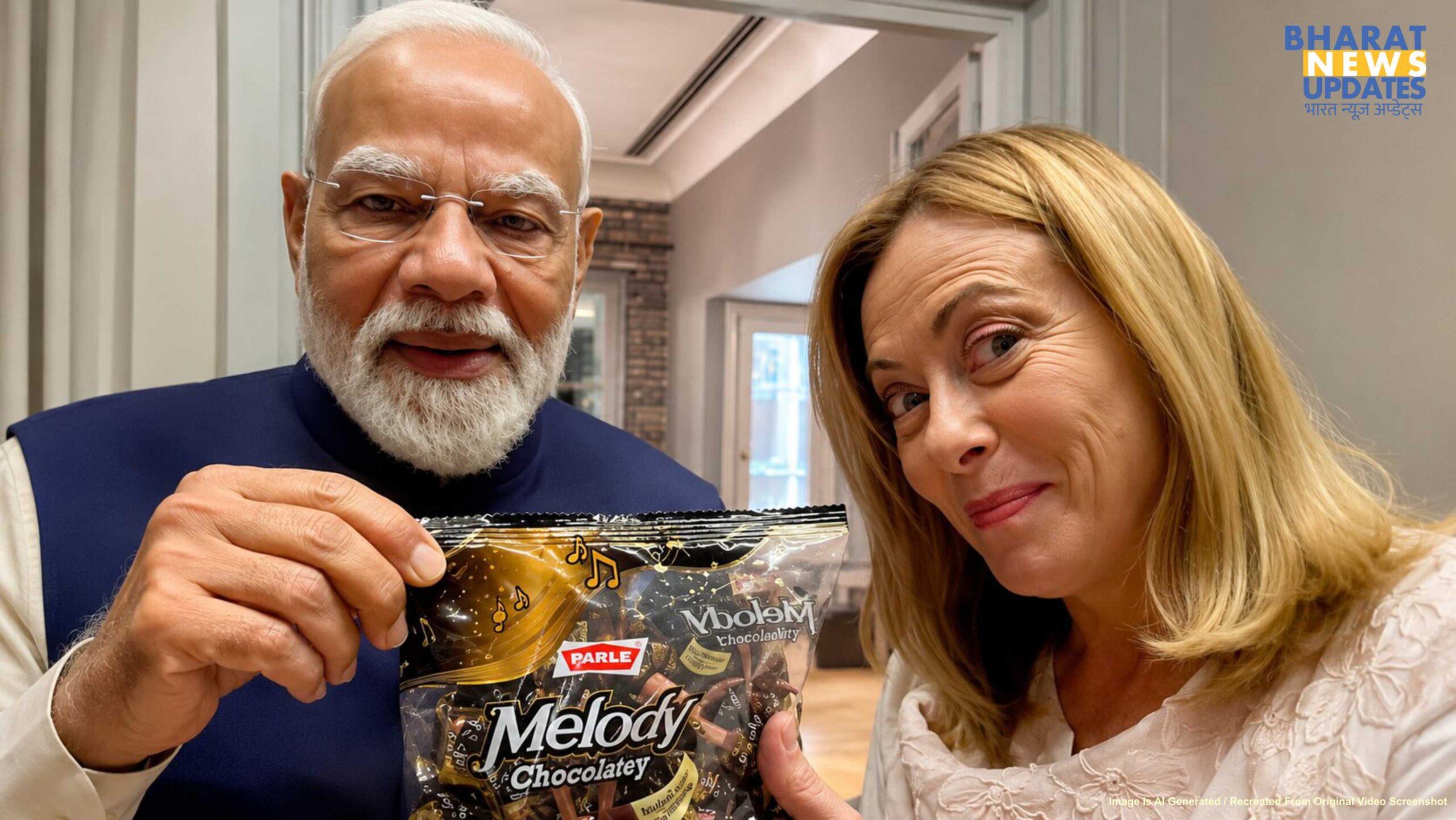
When Modi Gifted Melody to Meloni, A ₹5 Toffee Conquered the World
Head-of-state gifts are usually ancient manuscripts, hand-woven silks, or museum-grade artefacts. Indian PM Narendra Modi handed Italy’s PM Georgia Meloni a packet of candy, Melody. Within hours, Parle Products hit the stock market’s upper circuit, Google searches surged 4750%, and a toffee born in 1983 became a global icon. This is not a story about chocolates. This is a masterclass in soft power.

Somewhere in Rome on Wednesday, a world leader unwrapped a piece of Indian childhood. Giorgia Meloni, Prime Minister of Italy, held a packet of Melody toffees, the caramel-chocolate square that millions of Indian millennials once argued over at school canteens for ₹1 apiece. She laughed. PM Modi laughed. The camera rolled. And India’s internet promptly lost its collective mind.
In six hours, that video on Meloni‘s social media accounts crossed 110 million views. The search term “parle melody” on Google surged 4750% in a single day. Parle Products, a company that has been selling biscuits and toffees since the British were still in charge hit the stock market’s upper circuit, with investors stampeding to buy shares in a confectionery firm that most of them hadn’t thought about since Class 7.
But here’s the thing that gets lost in all the breathless headlines: none of this was an accident.

The Pattern Nobody Should Be Surprised By
Cast your mind back. At the India-Nordic Summit, PM Modi slipped in the Sanskrit word Sambadh meaning “Relationship” into a multilateral speech, gently reminding the world that the language of connection is older than any of us. In West Bengal, he ate Jhalmuri at a roadside stall, turning a humble puffed-rice snack into a national conversation about authenticity. During COVID, India vaccinated its neighbours before many richer nations had even placed their orders, a gesture the world noticed more than any formal aid cheque. When the Maldives row erupted, he didn’t issue a statement; he let Lakshadweep do the talking, and tourism enquiries for the island chain exploded overnight.
There is a philosophy running through all of this, and it is not subtle once you see it: every appearance is an opportunity to put something Indian on a global stage. Not with a press release. With a moment.

The Hidden Reality of This Particular Toffee
Here is what makes the Melody choice quietly brilliant: it is not a premium product. It is not Amul‘s exotic flavour collaboration or some artisanal Indian confection from a Bengaluru startup. Melody is an honest, unglamorous, universally beloved ₹5 toffee that your mother probably dropped into your school bag without a second thought. It is mass India. It is the Gully, Mohalla, the Kirana shop counter, the after-lunch ritual of 1.4 billion people.
By gifting it to an Italian PM, a country whose own chocolate and confectionery heritage runs centuries deep, PM Modi made an implicit argument: India’s everyday is worthy of your attention. We don’t need to dress things up. The real India is good enough for the world’s table. That is a harder case to make with a gold-plated artefact in a velvet box.
The Parle Story in BriefFounded in 1929 in Vile Parle, Mumbai, Parle Products has outlasted empires, liberalization, and the rise of multinational snack giants. Melody launched in 1983. For over four decades, it held its price point, its recipe, and its place in Indian memory. It took one viral moment not a marketing campaign worth crores to put it on the world map in a single afternoon.
The Contradiction at the Heart of It All
Mayank Shah, Parle‘s CMO, told media, the company expects “a lot of traction in domestic and international sales.” That is the honest corporate answer. But here is the contradiction nobody wants to say aloud: Parle didn’t do this. They had no part in the strategy, no brief, no media plan. The most valuable marketing moment in the company’s nearly century-long history happened because a Prime Minister reached into his pocket and handed someone a toffee.
That is both wonderful and slightly troubling. Indian brands have world-class stories to tell: Parle, MDH, Amul, Dabur, Khadi but they mostly wait for the world to discover them. What Wednesday showed is that a single authentic gesture by a visible person can do what years of export marketing cannot. The lesson is not “get PM Modi to carry your product.” The lesson is: authenticity travels. A ₹5 toffee can circle the globe if the moment is real enough.

What PM Meloni’s Laughter Really Meant
Watch the video again, if you haven’t. Italy PM Meloni‘s reaction is not the polite diplomatic smile of a leader accepting a ceremonial gift she will immediately hand off to an aide. It is genuine delight, curious, warm, a little surprised. That surprise is the point. She was not expecting this. Nobody at that summit was expecting this. And that gap between expectation and reality is exactly where memory is made.
In a week of high-stakes diplomacy, geopolitical tensions, trade frameworks, security alliances, the image the world will remember from PM Modi‘s Italy visit is two leaders laughing over a packet of Indian candy. That is not a footnote. That is the headline. And somewhere in a Vile Parle factory, a toffee that has been the same since 1983 just became something else entirely: an ambassador.

There is a broader truth here that India’s export strategists, brand consultants, and ministry officials might want to sit with quietly. The country spends enormous sums on formal soft power, pavilions at world expos, cultural festivals abroad, tourism campaigns. And then a powerful PM pulls a toffee out of his pocket in Rome, and Parle gets more global visibility in an afternoon than it has ever bought with money.
The world, it turns out, does not need India to be sophisticated. It needs India to be itself. Melody khao, khud jaan jao. Now, apparently, the world will find out too.