

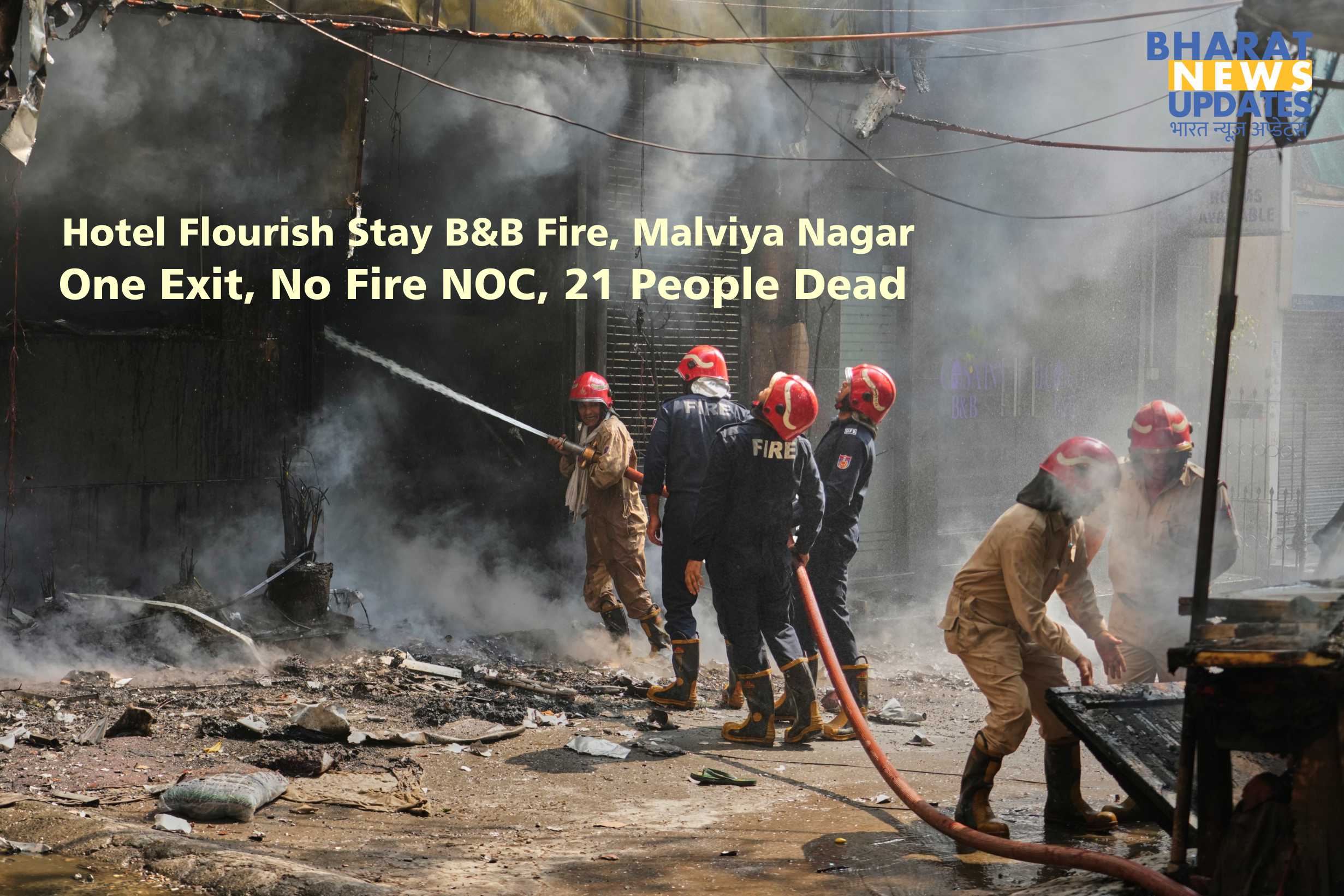
New Delhi | June 3, 2026: At 8:48 on a Wednesday morning, while most guests at Flourish Stay B&B in Hauz Rani, Malviya Nagar were still asleep, fire swallowed their borrowed time in Delhi. By the time 17 fire tenders reached the narrow, congested bylane, 21 people were dead, 17 of them foreign nationals who had come not for tourism, but to sit beside their sick relatives at a nearby hospital. They escaped war, poverty, and distance, only to die in a basement in South Delhi.

A Fire That Was Always Coming
The Flourish Stay hotel in Malviya Nagar’s Hauz Rani locality was not built for catastrophe, it was built for profit, in defiance of almost every regulation designed to prevent one.
The Delhi government had issued it a licence under the Bed and Breakfast (B&B) scheme a policy designed for small, home-style accommodations, permitting it to operate just six rooms. It was running 25. Rooms had mushroomed in the basement, in corners, in spaces that had no business sheltering sleeping human beings. The building had no windows in several sections, no fire sprinklers, and most damning of all no valid Fire NOC, the mandatory No Objection Certificate that requires a property to meet basic fire safety standards before it can host guests.
Delhi Fire Service Chief Fire Officer A.K. Malik confirmed the grim arithmetic: one entry, one exit. A single shutter gate, locked. When the fire broke out in the basement restaurant at 8:48 am and smoke began climbing the five-storey building, there was nowhere to go but up and then, for many, off the edge.


The Basement That Became a Tomb
The fire began in Lemon Green Restaurant, located in the basement of the building. Firefighters who arrived found the basement shuttered with a metal gate. They had to cut through it. Inside, six people were found. Some were already dead.
Kesar Singh, a chef at the adjacent Micasa Inn, was making tea on an electric stove when he heard a loud blast. He stepped outside to see an entire building engulfed. He ran. Others did not have the same chance.
Witnesses described scenes that carry the texture of nightmares: four to six people breaking glass and jumping from the building, mattresses being hastily spread on the ground to cushion bodies falling from multiple storeys. One man’s leg snapped on impact. A video that circulated on social media showed desperate silhouettes at shattered windows, the smoke behind them thick and black.
The fire eventually spread horizontally, consuming the adjacent hotel, Micasa Inn. Delhi Police’s DCP South Anant Mittal confirmed that 37 people were rescued; 21 were declared dead on arrival at Max Hospital and other facilities. The death toll is feared to climb further, several of the injured remain critical at AIIMS Trauma Centre.

Who Were the Dead? A Hidden Migration Nobody Talks About
Here lies the tragedy within the tragedy, the dimension that most headlines will miss: the majority of the victims were not backpackers or business travellers. They were families from Liberia, Nigeria, Mozambique, and Bangladesh who had come to India because a mother, a father, a sibling was undergoing treatment at Max Hospital in Saket, a few minutes’ walk away.
India’s medical tourism industry is a multi-billion dollar economy, proudly advertised by the government as a national strength. Hospitals like Max Saket cater to patients from across Africa and Central Asia who cannot afford equivalent treatment at home. But the ecosystem that receives these families once they step outside the hospital gates is invisible, unregulated, and as today proved lethal.
Budget B&Bs and unlicensed guesthouses in the lanes of Hauz Rani, Malviya Nagar, and similar neighbourhoods around large hospitals have quietly become a parallel hospitality industry serving medical visitors. They offer proximity and cheap rates. They ask no awkward questions. And nobody, not the municipal corporation, not the fire department, not the licensing authority asks them anything either.
Namit Goel, who rushed to Max Hospital’s mortuary, told reporters that six of his relatives were among those caught in the fire. Four bodies had been identified; two were still missing.
The Regulatory Maze Nobody Wanted to Navigate
The owner of Flourish Stay, Lavkesh Bajaj, reportedly owns three hotels in the same Hauz Rani area. His properties operated under a B&B license, a light-touch regulatory category that carries minimal oversight. The B&B scheme was designed in good faith to allow homeowners to let out a room or two. It was never intended to license a 25-room commercial hotel with a basement restaurant serving walk-in diners.
The contradiction is institutional. Delhi’s licensing framework has not kept pace with the explosion of informal hospitality around its hospital clusters. The fire NOC process, meanwhile, requires a building inspection and compliance with the National Building Code, a process that many small operators quietly skip, because enforcement is sporadic and bribes, by all accounts, are cheaper than compliance.
A senior fire official confirmed that “several hotels in the area operate without fire clearances.” Not one, not two. Several. On a street where foreign nationals sleep to be close to their dying relatives.
This was not an accident waiting to happen. It was a policy failure waiting to be noticed.

Condolences and Compensation and the Question After
Prime Minister Narendra Modi described the tragedy as deeply saddening and announced an ex-gratia of ₹2 lakh from the Prime Minister’s National Relief Fund for the family of each deceased, and ₹50,000 for those injured. Delhi Chief Minister Rekha Gupta expressed grief, confirmed that emergency services were mobilized swiftly, and said the Delhi government “stands firmly with the affected families.”
An enquiry has been ordered. An FIR is being registered against hotel owner Lavkesh Bajaj, with culpable homicide charges under consideration. Raids are underway to arrest him.
These are the correct responses. They are also, in a country with a long and bitter history of fire tragedies in unlicensed buildings, entirely predictable ones. In 2019, 17 people died in the Arpit Palace Hotel fire in Karol Bagh, also a budget hotel, also operating without adequate fire safety. That too prompted arrests, FIRs, condolences, and promises of a crackdown. Seven years later, the lanes of Malviya Nagar were still running fire-trap hotels for sick people’s families.
What Needs to Change and What Won’t Without Pressure
The single-exit trap at Flourish Stay is the most obvious villain, but it is not the only one. Buildings like this proliferate because the cost of non-compliance is lower than the cost of compliance, and because the people who stay in them, migrants, foreign medical visitors, low-income workers, do not have enough political voice to demand safety.
A genuine crackdown would require: a time-bound audit of all B&B-licensed properties near Delhi’s hospital clusters; mandatory physical inspection before any Fire NOC renewal; and crucially, a legal framework that holds local officials accountable, not just hotel owners, when buildings operate without clearance for years.
Until that happens, every budget hotel in the lanes around every major Delhi hospital is a potential Flourish Stay. The guests will keep coming, because the hospital won’t move and neither will poverty. The only question is whether the next fire kills ten people or thirty.
Twenty-one is already too many. Seventeen of them came from thousands of miles away, to keep vigil over someone they loved, in a city that took their money, gave them a room in a basement, and left them with no way out.